

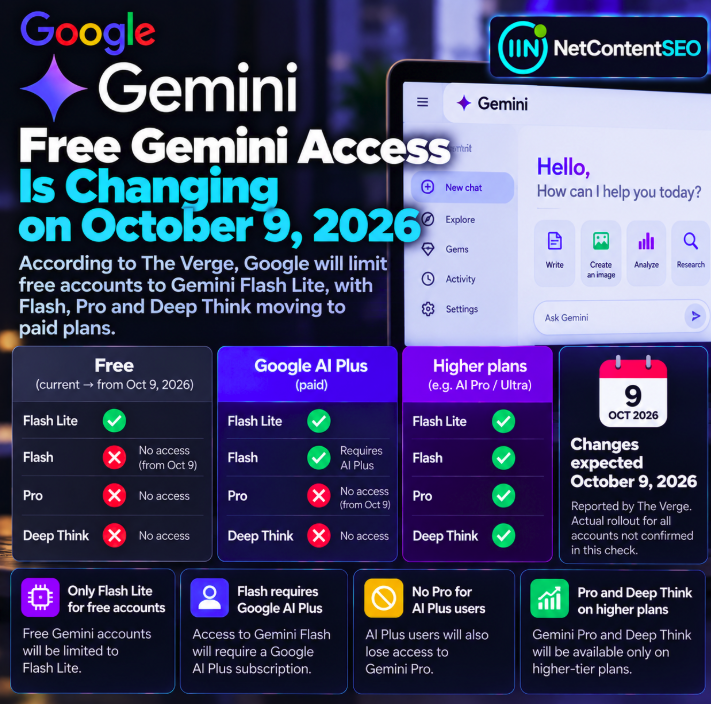

Google is reportedly changing which Gemini models are available across its free and paid subscription tiers from October 9, 2026. According to a report published by The Verge on October 6, free Gemini accounts will be limited to Flash Lite, while access to Flash will require Google AI Plus. More capable options, including Pro and Deep Think, are expected to remain on higher-tier plans. The report also says AI Plus subscribers will lose access to Pro.
Important status note: The change was reported ahead of the October 9 effective date. The supplied information does not independently confirm that every eligible account has already received the new restrictions. Subscription entitlements may also depend on region, account and rollout status.
What changes for free and paid Gemini users?
| Account tier | Reported model access from October 9 |
|---|---|
| Free Gemini account | Flash Lite; Flash, Pro and Deep Think no longer included |
| Google AI Plus | Flash available; Pro access reportedly removed |
| Higher paid tiers | Pro and Deep Think reserved for eligible higher-tier subscriptions |
This table summarizes the reported policy direction, not a live entitlement check for every user or region. The precise availability of each model and feature should be verified against the current Gemini interface and Google's official plan documentation.
Why model access matters for AI Search research
For SEO and Generative Engine Optimization (GEO) teams, the significance goes beyond subscription pricing. If different account tiers expose different Gemini models, then two researchers asking the same question may not be testing the same underlying system.
Model differences can affect how a response is composed, how instructions are followed and what content appears in the answer. They may also influence whether a given workflow supports particular research features. However, this report does not establish a measured difference in citations, web-source selection or brand recommendations between Flash Lite, Flash, Pro and Deep Think.
Flash Lite becomes the reported free-account baseline
The Verge says Flash Lite will be the model available to free Gemini users after the change. For researchers collecting observations from free accounts, this creates a new baseline that should be documented explicitly.
It would be misleading to label a future test simply 'Gemini' without recording the model that actually generated the response. A shift in model availability could otherwise be mistaken for a change in brand visibility or search behavior.
Flash moves behind Google AI Plus
Under the reported structure, users who want Flash will need Google AI Plus or an eligible higher-tier subscription. The distinction matters for reproducibility: a free-account result may no longer be directly comparable with a result produced by a paid account using Flash.
Research teams should avoid assuming that model names correspond to identical retrieval tools, citations or response behavior across all product surfaces. The consumer Gemini app, developer APIs and other Google AI products may have separate access rules.
Pro and Deep Think remain higher-tier options
The report says Pro and Deep Think will be restricted to higher subscription tiers and that AI Plus subscribers will lose access to Pro. These access changes can affect organizations that previously used AI Plus as a relatively low-cost way to sample Pro responses.
For ongoing experiments, the practical response is to record which models are actually selectable in each account, rather than assume an older subscription entitlement still applies.
How subscription changes can distort longitudinal AI visibility studies
Suppose a team monitors whether Gemini recommends a brand for the same set of commercial prompts every week. If its account switches from one model to another, a change in mentions or citations may reflect a change in the tested model rather than a change in the brand's underlying online visibility.
That does not mean every model change will alter results. It means model identity is a potential confounding variable that must be recorded before making causal claims.
A practical measurement protocol
- Record the exact date and time. Changes may roll out gradually and differ by market.
- Capture the subscription tier. Note whether the test used Free, AI Plus or a higher plan.
- Identify the model. Record the model name shown in the interface whenever possible.
- Document the product surface. Consumer Gemini, an API endpoint and other integrations should not be treated as identical.
- Keep prompts consistent. Preserve the original wording and language across repeated tests.
- Separate answers from citations. Track brand mentions, recommendations and clickable sources as distinct observations.
- Repeat samples. A single response is not enough to establish a stable visibility trend.
- Flag access transitions. Mark the first test after an account's model availability changes so historical comparisons can be interpreted correctly.
What the report does not establish
The reported subscription change does not prove that Google's public Search ranking algorithm has changed, that Google AI Overviews will use Flash Lite or that Gemini's source citation rules have been modified. It concerns access to models in Gemini subscription tiers, not a confirmed update to all Google AI products.
Likewise, the supplied information does not confirm that every account received the restrictions on October 9. Researchers should verify their own account state and avoid treating an announced effective date as proof of universal rollout.
FAQ
Will Gemini remain free?
According to The Verge, free access remains available but will be limited to Flash Lite under the reported new structure.
Will Gemini Flash require a subscription?
The report says Flash will require Google AI Plus or an eligible higher plan.
Can Google AI Plus users still access Pro?
The Verge reports that AI Plus subscribers will lose Pro access under the revised tier structure.
Where will Pro and Deep Think be available?
They are reported to be reserved for higher paid plans, subject to applicable eligibility and rollout conditions.
Has the change reached every Gemini account?
The supplied reporting does not independently establish universal rollout across all accounts.
Does this change Google Search or AI Overviews?
No change to those public search systems is established by this subscription-access report.
NetContentSEO analysis
The most important implication for AI visibility measurement is reproducibility. When access to models depends on subscription tiers, a study that records only 'Gemini' may be mixing fundamentally different test conditions. Analysts should preserve model names, account tiers, dates, locations and source-citation evidence, especially when comparing brand recommendations over time.
Source: The Verge — Google Gemini Free Access Changes, reported October 6, 2026, with changes expected October 9, 2026.