

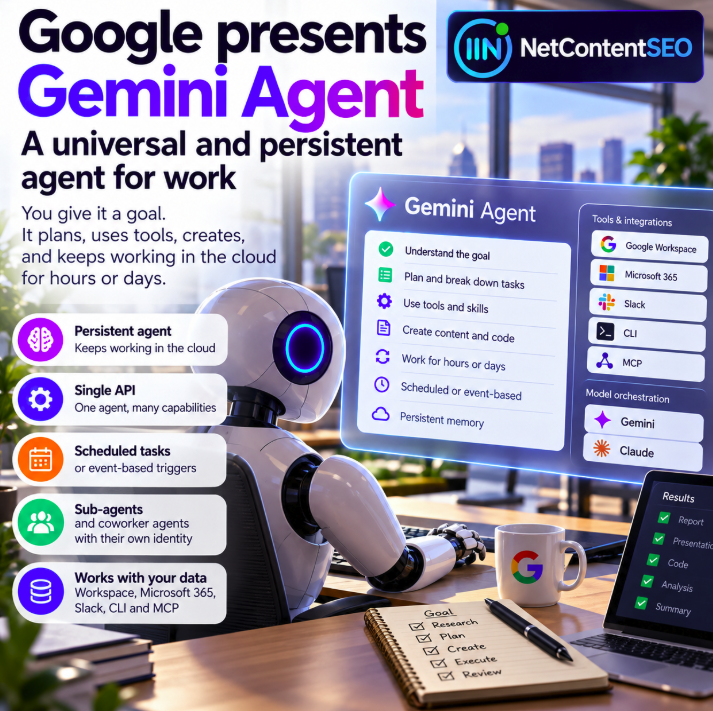

October 8, 2026 — Google has introduced Gemini Agent as part of its vision for enterprise AI that can carry out ongoing work, not merely answer isolated prompts. The announcement describes an agent architecture intended to accept a goal, plan the work, use organizational tools and skills, and continue executing tasks in the cloud over extended periods.
Rather than treating every request as a new conversation, the concept centers on a persistent working context, connected tools and repeatable execution. Google describes an initial controlled availability phase, not a general rollout to all users.
From chatbot to persistent work agent
In Google's description, Gemini Agent can take a higher-level objective and turn it into steps, using tools to gather information, generate content or code and complete parts of a workflow. Long-running cloud execution is a major difference from chat interfaces that depend on a user staying in the session.
One agent, one API and persistent context
The announced architecture aims to provide a unified agent interface with persistent memory and context. Teams can define tasks that run on schedules or respond to events, reducing the need to manually restart repetitive work. The exact controls, supported triggers and availability will depend on the product's rollout and enterprise configuration.
Enterprise connections: Workspace, Microsoft 365, Slack, CLI and MCP
Google highlights access to organizational work systems, including Google Workspace, Microsoft 365 and Slack, alongside command-line tools and connections using the Model Context Protocol (MCP). In practice, such integrations are meaningful only when administrators authorize the necessary access and apply appropriate security controls. An agent should not be assumed to have unrestricted access to every connected service.
Sub-agents and coworker agents
The announcement distinguishes temporary sub-agents, which can help complete parts of a task, from longer-lived coworker agents that may have their own identity and organizational resources, such as email and storage. This design points toward AI agents being managed more like ongoing digital workers, with identity, permissions and operational oversight.
Gemini and Claude under the same orchestration layer
One notable architectural claim is the ability to select dynamically between Gemini and Claude models while preserving the organization's agent context, memory and tools. If delivered as described, this separates the agent's operational environment from any single underlying model. It does not imply that all models, features or organizations are immediately supported in production.
Why this matters for SEO and AI visibility
The implications extend beyond conventional search results. As organizations adopt agents that discover and invoke approved tools, machine-readable descriptions of capabilities, skill registries, MCP endpoints and internal knowledge catalogs may become important discovery surfaces. An agent deciding which tool to use is not the same process as a human choosing which search result to click.
However, this is an analytical implication, not a confirmed Google Search ranking change. Google has not announced that registering an MCP tool or publishing a skill automatically improves rankings, indexing or visibility in AI Overviews.
What organizations should prepare
- Inventory useful capabilities: identify internal tools and services that agents might need.
- Document interfaces clearly: describe what each tool does, its inputs, outputs and limits in machine-readable formats where appropriate.
- Protect identity and access: apply least-privilege permissions, approvals and audit logs to agent actions.
- Improve knowledge quality: maintain authoritative, current documentation and clear ownership.
- Evaluate model flexibility: test whether workloads can be orchestrated across models without sacrificing governance.
- Measure outcomes: track task completion, accuracy, latency, cost and security—not just the number of generated responses.
Availability: announcement versus general access
The October 8 announcement describes controlled initial availability. Teams should verify access and integration requirements directly with Google before planning a production deployment. Feature scope, supported regions and model combinations may evolve.
NetContentSEO analysis: discoverability moves beyond web pages
Search engine optimization has historically focused on making pages discoverable and useful to search engines and people. Enterprise agent ecosystems introduce a related but distinct challenge: making tools, trusted knowledge and operational capabilities understandable and usable by authorized agents. For AI visibility research, that is an important emerging surface—but it should be studied separately from Google's established web indexing and ranking systems.
Source
Google Cloud Blog — Welcome to Gemini at Work 2026 (October 8, 2026).