
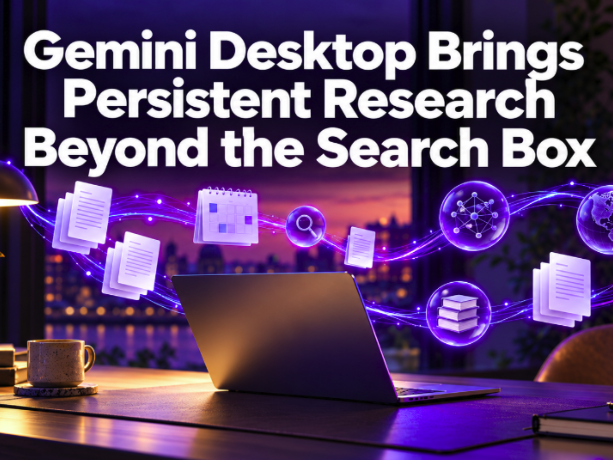
Google’s Gemini apps for Windows and macOS bring AI assistance into the place where people already work. The more consequential development is Gemini Spark: a personal agent that can continue assigned work in the background. For research, that changes the starting point from a fresh query to an ongoing brief.
The chronology matters. Google announced its Windows app on September 10, 2026. Spark’s macOS rollout was described on June 30. These sources do not establish a simultaneous September 30 launch for both platforms.
A desktop entry point for connected work
The official desktop page describes keyboard access, connected Google apps and delegation of research, planning and synthesis. It also distinguishes native capabilities by platform. Local folder connections, screen context and cross-app dictation are described for macOS; more native Windows features are scheduled to follow.
This distinction affects real workflows. A task that combines cloud documents with local material depends on the capabilities of the particular app and the access a user grants. Installing a desktop client does not establish that every workflow is available on both operating systems.
Research can become an ongoing assignment
On its Spark product page, Google describes tasks that continue even when a phone and laptop are turned off. It presents schedules with time-based or conditional triggers, together with optional connections to Workspace services. The agent operates under the user’s direction, and Google says those app connections are off by default.
Consider a weekly industry brief. A conventional workflow starts with searches, then moves through newsletters, documents and notes before producing a summary. An ongoing agent assignment could repeatedly gather relevant material and prepare a brief for review. That example illustrates the editorial implication of the product’s stated capabilities; it is not a performance result or a guarantee that Spark will identify every relevant development.
The shift is from asking for an answer once to defining what an agent should keep doing. The quality of that assignment depends on scope: which sources count, what time period matters, what should trigger an update and what evidence belongs in the result. Persistence makes those choices more consequential because the same instruction may guide repeated work.
Local files add context, with platform limits
Google’s June macOS announcement describes file organization and a workflow combining local invoices with a Workspace spreadsheet. It says file access is limited to material the user permits Spark to use. Its initial Mac rollout was a beta for adult AI Ultra subscribers in the United States.
Local context can make research more useful when public information needs to be compared with an internal brief. It also makes source distinctions essential. A team should be able to tell whether a conclusion comes from a public announcement, a private document or an interpretation generated from both. A polished summary alone does not establish that its claims are current or correctly supported.
Availability needs a separate check
The desktop app’s reach and Spark’s eligibility are separate questions. The current Spark page lists Google AI Pro and Ultra subscribers over 18 in selected countries, alongside selected business users. Google’s July expansion announcement also carried geographic exclusions. Readers should therefore check current account and regional eligibility rather than infer Spark access from the availability of the desktop download.
For publishers and research teams, the opportunity is a continuing flow of collected information. Whether it reduces work will depend on source coverage, reliability and the effort needed to review its output. The practical test is whether an ongoing assignment produces evidence that is useful enough to support the next decision.