

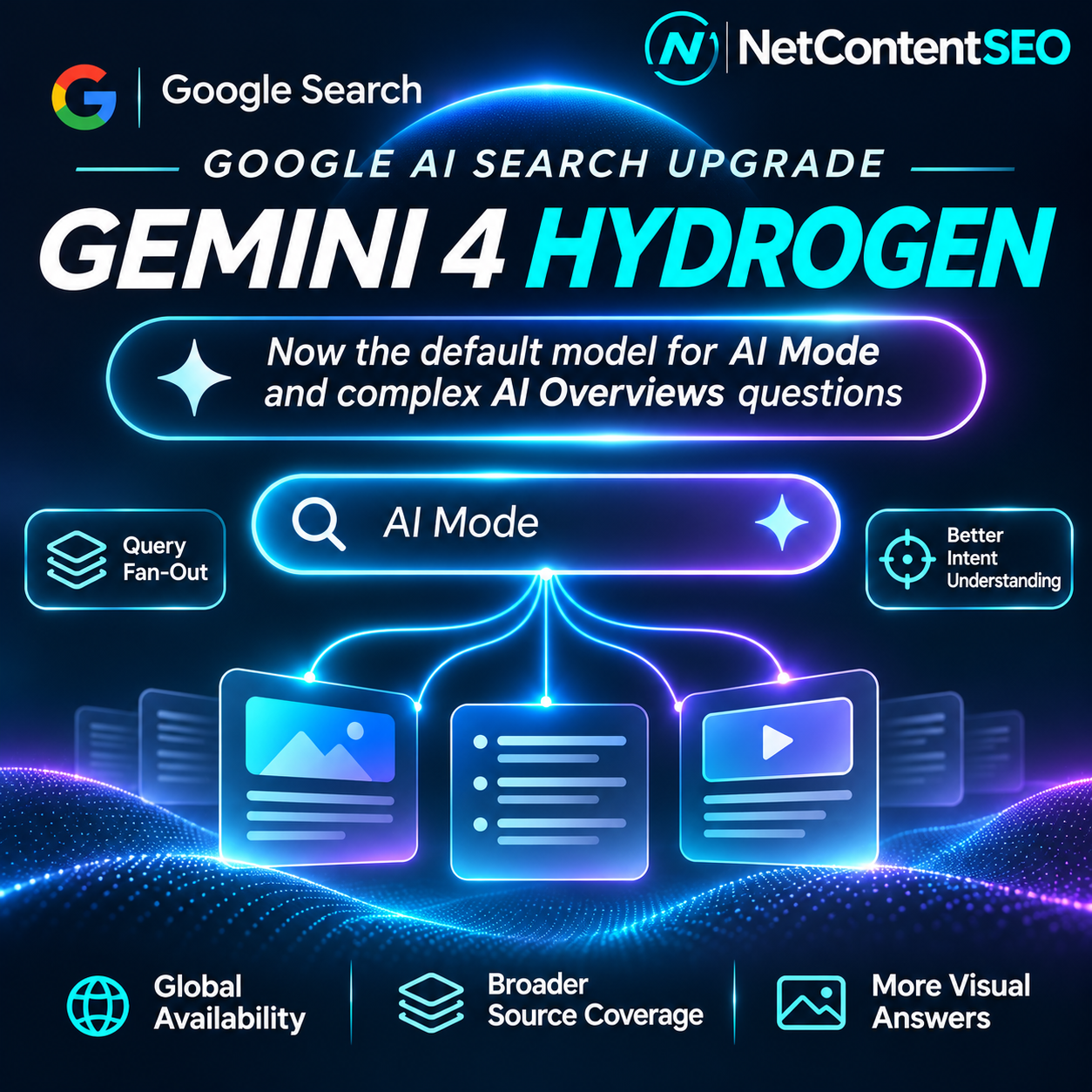

Google has made Gemini 4 Hydrogen the default model in AI Mode worldwide and is using it for the most complex questions in AI Overviews. Announced on November 12, 2026, the upgrade brings stronger intent interpretation, expanded query fan-out, a broader selection of links and richer visual answers. It arrives at an unusually sensitive moment for SEO measurement: Google's November 2026 core update began on November 10 and is still rolling out.
Google calls Hydrogen its biggest model upgrade to Search yet. That is the company's characterization, not an independently measured improvement in publisher traffic. The central question for website owners is whether a different model changes which sources AI Mode retrieves and cites—and whether those citations translate into visibility, clicks or conversions.
What Google officially launched on November 12
In its official Search announcement, Google said Gemini 4 Hydrogen is available globally in Search to all users. Robby Stein, Google's vice president of product for Search, separately clarified that Hydrogen is the new default in AI Mode and is used for the hardest AI Overview questions. This distinction matters: the announcement does not establish that every AI Overview uses Hydrogen, or that the model has replaced Google's conventional web ranking systems.
Barry Schwartz covered the launch on Search Engine Roundtable and Search Engine Land. Both reports highlight the timing and the potential implications for AI-generated search answers, rather than reporting a proven change in organic rankings.
Four changes Google says Hydrogen brings to Search
1. Better understanding of complex intent
Google says Hydrogen can handle multi-part questions, detailed constraints, ambiguous phrasing and typos more effectively. For example, a user might ask for a family-friendly hotel near a train station with step-free access, a specific price ceiling and late check-in. An AI system that interprets all those conditions may search across multiple attributes rather than treating the query as a simple keyword string.
For publishers, this creates a practical content challenge: pages need to state concrete facts, requirements, exceptions and limitations clearly enough to support complex questions. That is a content-quality recommendation, not a newly announced ranking factor.
2. More advanced query fan-out
Query fan-out is the process of breaking a complex request into multiple related searches. Google's announcement says Hydrogen improves this process by investigating relevant subtopics in parallel and connecting users to a wider range of useful websites.
The potential implication is significant: an AI answer may draw on sources that would not rank prominently for the user's exact original query, because they answer one important sub-question. But Google has not published a count of additional sites cited, an average change in source diversity or evidence that smaller publishers receive more referral traffic.
3. More visual and structured answers
Hydrogen supports responses containing images, comparison tables, structured information and custom tools. This may make answers easier to use without visiting multiple pages. It may also change the presentation and prominence of source links. A site can be referenced in an answer yet receive limited attention if citations are less visible than the generated content.
4. Richer language understanding
Google says the model improves nuanced responses across the languages currently supported by AI Mode. This is relevant to multilingual publishers and regional markets, but it does not prove equal performance across languages or establish that a given local-language site will be cited more often.
Why the November core update makes attribution difficult
Google's Search Status Dashboard records the November 2026 core update as starting on November 10 at 10:06 a.m. Pacific time. Hydrogen reached Search on November 12, during that ongoing rollout. These are separate developments with overlapping dates.
Core updates affect Google's ranking systems. The Hydrogen announcement concerns AI Mode's default model and difficult AI Overview questions. A publisher that observes a drop in organic clicks, a rise in AI citations or a change in which pages appear in answers during this period cannot attribute the movement to either event from timing alone.
Barry Schwartz explicitly raised the distinction in his Search Engine Roundtable coverage, questioning whether the Hydrogen change affects AI Overviews and AI Mode rather than core rankings. That is a reasonable analytical separation, but not a formal Google statement that all interactions between systems are impossible.
What changes for AI Search visibility?
The most immediate variable is source selection. A new model can interpret a question differently, decide to search additional subtopics, retrieve different documents or summarize evidence in a different format. Even if a page's classic Google ranking is unchanged, its appearance in AI Mode might vary. Conversely, a conventional ranking shift during the core update may affect discovery independently of the model change.
Google's promise of a wider range of helpful links is encouraging for the open web, but it is not evidence of increased clicks. More cited sources could mean more discovery opportunities, more competition for attention, or both. There is currently no independent before-and-after dataset demonstrating how Hydrogen changes citation counts, publisher click-through rates or conversions.
How to measure the impact without confusing ranking and citations
SEO teams should treat November 10 and November 12 as separate event markers and preserve a stable comparison framework.
- Record both release dates: mark the November 10 core-update start and the November 12 Hydrogen deployment in analytics notes.
- Freeze a query set: select representative branded, informational, comparison and transactional prompts, including multi-part queries likely to trigger query fan-out.
- Track AI Mode separately: record whether a domain appears, the cited URL, citation position, link prominence, competing sources and whether the answer includes visual or interactive components.
- Track AI Overviews separately: record whether an overview appears, whether it is expanded, which URLs it cites and any changes in source placement.
- Keep conventional Search metrics distinct: compare Search Console Web clicks, impressions, CTR and average position for stable page groups and query groups where available.
- Check the generative AI impressions report: where available in Search Console, examine AI-feature exposure, but do not interpret it as an AI-only click report.
- Compare consistent samples: hold language, geography, device, prompt wording and testing schedule as constant as practical. Document personalization and stochastic variation.
- Wait for the core rollout to finish: avoid declaring a lasting ranking effect while the update is still in progress. Continue measurements after completion.
- Measure outcomes: track qualified organic sessions, leads and conversions separately from citation visibility.
Do not divide all Google Web clicks by generative AI impressions and call the result AI Mode CTR. The populations are different, and the resulting ratio is not a valid measure of AI-specific click-through behavior.
A practical example: how query fan-out can change source selection
Imagine a query asking which electric SUV can fit three child seats, tow a trailer, charge quickly in cold weather and remain under a certain price. A conventional product page may answer only part of that request. An AI system using fan-out could consult vehicle specifications, independent cold-weather tests, child-seat fitment guidance and regional pricing information.
This example illustrates a plausible retrieval pattern; it is not a verified trace of Hydrogen's internal searches. The practical lesson is to publish specific, verifiable information and cite original evidence. Pages that address precise subtopics may be useful to an AI answer even if they are not a comprehensive response to the original question.
What publishers should improve now
Focus on changes that help readers and retrieval systems regardless of which model Google deploys:
- State the main answer early and expand with concrete supporting details.
- Document prices, availability, requirements, dates, exceptions and limitations when relevant.
- Use descriptive headings and accessible HTML for key facts, rather than relying on text embedded in images.
- Provide original research, firsthand experience, useful comparisons and clear attribution.
- Keep entity names, product versions and geographic availability consistent across pages.
- Update outdated content when the underlying facts change, without manufacturing freshness.
- Maintain crawlability, canonicalization and indexing hygiene under Google's established Search guidance.
None of these steps guarantees a citation in AI Mode. They make the underlying information clearer, more verifiable and more useful.
Confirmed facts versus open questions
| Question | Evidence as of November 13, 2026 |
|---|---|
| Is Hydrogen the default AI Mode model? | Yes, confirmed by Google Search leadership. |
| Is it available globally? | Yes, Google announced global availability for Search users. |
| Does it handle difficult AI Overview questions? | Yes, according to Robby Stein; Google has not published an exact classification of those questions. |
| Does it improve query fan-out? | Google says yes; the magnitude of source-selection changes is not independently quantified. |
| Will more websites receive citations? | Not established by a published before-and-after citation dataset. |
| Will publishers get more clicks? | Not established. |
| Is Hydrogen the November core update? | No. They are separately announced developments with overlapping rollout dates. |
| Did Google announce a new organic ranking factor? | No such ranking factor was announced with Hydrogen. |
Frequently asked questions
What is Gemini 4 Hydrogen in Google Search?
It is a Gemini 4 model that Google has deployed to power AI Mode by default and assist with difficult AI Overview questions, with improvements to intent interpretation, query fan-out and visual answers.
When did Google launch Hydrogen in Search?
November 12, 2026.
Is Gemini 4 Hydrogen available in every country?
Google says the model is available globally to Search users, within the languages and product experiences supported by AI Mode.
Does Hydrogen replace every AI Overview model?
No such blanket replacement has been confirmed. Google specifically says it is used for the hardest AI Overview questions.
Will AI Mode cite more websites?
Google says the improved fan-out connects users to a wider range of helpful links, but it has not provided independent counts or guaranteed citation increases.
Does this affect ordinary blue-link rankings?
The Hydrogen announcement does not establish a change to conventional ranking algorithms. The separate November core update may affect rankings.
Is the November 2026 core update still rolling out?
Yes. Google's Search Status Dashboard showed it as active when this article was prepared on November 13.
Can Search Console show Hydrogen-specific clicks?
No Hydrogen-specific click breakdown has been announced. Standard Search performance and generative AI impression reporting should not be treated as model-specific referral attribution.
Should publishers rewrite every page for Gemini 4 Hydrogen?
No. Prioritize clear, accurate, complete and well-structured information that answers genuine user needs. No Hydrogen-specific optimization formula has been established.
What should SEO teams monitor first?
Track AI citation inclusion and placement, Search Console visibility, organic clicks and business outcomes separately, while recording both the model-change and core-update dates.
The bottom line
Gemini 4 Hydrogen is a confirmed, global upgrade to Google's AI Search experiences. Its stronger intent handling and broader query fan-out could change which sources appear in AI answers, making this an important release for AI visibility research. But the November core update overlaps the launch, and Google has not published evidence that Hydrogen increases publisher clicks. The responsible response is to monitor citations and traditional rankings as separate variables, measure outcomes over time and resist attributing every November traffic movement to a single announcement.
Sources
- Google Search — Google Search gets a major upgrade with Gemini 4 Hydrogen, November 12, 2026.
- Google DeepMind — Introducing Gemini 4 Hydrogen, November 12, 2026.
- Search Engine Roundtable — Google Search Gets Massive Upgrade With Gemini 4 Hydrogen, November 12, 2026.
- Search Engine Land — Google Search gets major upgrade with Gemini 4 Hydrogen, November 12, 2026.
- Search Engine Journal — Google Makes Gemini 4 Hydrogen the Default Model in AI Mode, November 13, 2026.
- Google Search Status Dashboard — November 2026 core update.