

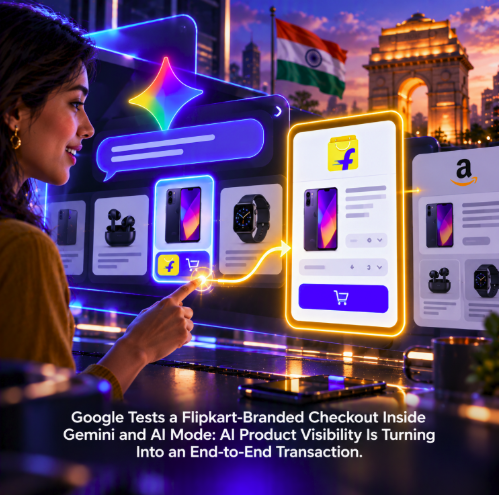
Google is testing what happens when an AI product recommendation stops being a referral and becomes the beginning of the transaction itself. A limited experiment in India is showing some Gemini and AI Mode users a “Buy” button on selected Flipkart products, opening a Flipkart-branded checkout flow without requiring the shopper to leave the AI experience.
The test was reported by TechCrunch, which says the early experiment is visible only to some users and a small selection of products, initially including smartphones, electronics and mobile accessories. Google confirmed to the publication that it is testing new ways to connect users with businesses but did not provide detailed rollout information. citeturn0news0
That limited status matters. This is not yet a general launch of Flipkart checkout across Gemini or AI Mode, and the exact implementation has not been formally documented by Google as a finished commerce product. But the experiment fits directly into a broader strategy Google has already announced: using the Universal Commerce Protocol, or UCP, to turn conversational product discovery into checkout.
The “Buy” button changes the endpoint of AI visibility
Product visibility inside generative AI has generally been discussed as a discovery problem. A shopper asks a conversational question, the model recommends or surfaces products, and the merchant hopes to earn the next click.
The Flipkart test compresses that sequence. According to TechCrunch, selected product listings can show a Buy button that takes the user into a Flipkart checkout flow while keeping the experience inside the AI interface. citeturn0news0
The important unit of visibility therefore changes. Being surfaced by the AI is no longer necessarily the top of a referral funnel. For an eligible merchant and product, it can become the first step of a transaction.
Amazon listings beside Flipkart do not get the same transaction path
One of the most revealing details in the observed test is the asymmetry between merchants. TechCrunch reports that Amazon products can appear alongside Flipkart offers, but the Amazon listings seen in the experiment do not carry the same Buy button. citeturn0news0
That illustrates a distinction likely to become increasingly important in agentic commerce: recommendation eligibility and transaction eligibility are not necessarily the same thing.
A retailer can be visible in the comparison layer without being integrated into the action layer. The first determines whether the product can participate in discovery; the second determines whether the AI can move the shopper directly toward purchase.
Google had already named Flipkart as an Indian UCP partner
The test did not appear from nowhere. In official Indian marketing guidance published earlier this month, Google said Flipkart was already partnering with it to offer an agentic shopping experience to Indian consumers through the Universal Commerce Protocol. Google describes UCP as an open standard that allows AI agents and merchant systems to communicate across the commerce journey. citeturn0search13
Google’s wording is explicit about the intended endpoint: UCP is designed so Gemini users’ agents can securely complete checkout and buy eligible products. citeturn0search13
What Google had not publicly detailed in that announcement was the specific limited Flipkart Buy-button experience now observed in Gemini and AI Mode. The TechCrunch report therefore provides a view of how that previously announced partnership is beginning to surface in the consumer interface.
UCP turns product data into executable commerce infrastructure
Google introduced UCP as a common language for agents and commerce systems. Its official documentation says the protocol is intended to span discovery, buying and post-purchase support, while reducing the need for a unique integration between every merchant and every AI agent. Flipkart is among the retailers and commerce companies that have endorsed the protocol. citeturn0search11
For merchants, this changes the strategic role of structured commerce data. Inventory, price, loyalty and checkout capabilities are no longer useful only for rendering product listings. They can become inputs and actions inside an AI-mediated transaction.
Google’s Indian guidance describes UCP as a “universal translator” between merchant inventories and AI agents. That framing is useful because the protocol is not merely about making a product understandable. It is about giving the agent a supported route from understanding to execution. citeturn0search13
The observed Flipkart flow appears merchant-branded
The early implementation reported by TechCrunch is especially interesting because the checkout is described as Flipkart-branded. That makes the experiment look different from a model in which Google itself visibly owns the entire payment experience. citeturn0news0
Google’s broader UCP strategy is deliberately flexible. Its official commerce materials say UCP allows businesses to choose experiences that make sense for them and supports both instant action within Google surfaces and transferring a Universal Cart to a retailer’s website for completion. citeturn0search22
The Flipkart test should therefore not automatically be treated as identical to every other Google UCP checkout implementation. Agentic commerce can have multiple transaction architectures even when they share the same protocol layer.
Google is building several paths from conversation to checkout
The Flipkart experiment sits inside a much larger commerce redesign. Google says UCP-powered experiences can surface across AI Mode, Gemini and other Google properties, allowing shoppers to research, find and buy in a single secure flow. citeturn0search22
Google has also introduced Universal Cart, a cross-merchant shopping layer that can collect products while users move through Search, Gemini, YouTube and Gmail. The cart can monitor deals, price drops and inventory in the background. citeturn0search12
NetContentSEO examined that architecture in “Google Universal Cart Turns Product Visibility Across Search and Gemini Into a Cross-Merchant Agentic Checkout Funnel.” The Flipkart test adds a merchant-specific implementation to that broader picture: instead of stopping at cart construction or transferring the shopper elsewhere, selected listings can expose an immediate Buy action inside the AI surface.
Conversational relevance can now sit immediately upstream of purchase
Traditional ecommerce funnels contain multiple interfaces between discovery and conversion. Search results lead to category pages, product pages, carts and checkout. Every transition creates another opportunity for the user to abandon the process.
Agentic commerce compresses those transitions. The AI already has the shopper’s conversational context: desired specifications, budget, use case and comparisons. If an eligible product appears with a direct purchase action, that same context can lead immediately into checkout.
This makes AI product visibility commercially more consequential. A recommendation is no longer simply an impression that might generate traffic. It can appear one interaction away from a transaction.
Merchant integration becomes a new visibility advantage
The difference between Flipkart’s Buy button and the Amazon offers reported alongside it demonstrates why agentic-commerce optimization cannot be reduced to product ranking.
There are at least two technical layers. First, the product needs to be discoverable and relevant enough to appear. Second, the merchant needs the transactional infrastructure that allows the AI surface to offer an action.
A retailer that wins the first layer but lacks the second can still participate in comparison, but the shopper may encounter more friction before purchase. That does not prove Google algorithmically favors transaction-enabled merchants in recommendation ranking; Google has not disclosed such a rule. It means the user experience after selection can differ materially.
Product feeds are becoming instructions for agents, not just listings
Google’s 2026 commerce announcements increasingly frame merchant data as infrastructure for AI agents. At Google Marketing Live, the company said it is introducing new tools and data attributes designed to help products appear and be discovered across conversational AI surfaces while expanding UCP capabilities. citeturn0search17
This raises the importance of data that goes beyond title, image and price. Real-time availability, variants, merchant policies, loyalty status and checkout compatibility can determine what the agent can actually do after finding a product.
The product feed is therefore evolving from a catalog supplied to a ranking system into part of an executable commerce layer.
India is becoming a live market for Google’s agentic commerce stack
Google’s India-specific marketing materials explicitly position the market as an early environment for agentic shopping. The company says Indian consumers are using Gemini for product and service discovery and names Flipkart as a partner helping bring UCP-enabled agentic experiences to shoppers. citeturn0search13
The limited checkout test provides concrete evidence of that strategy reaching users. It also arrives ahead of India’s major festive shopping period; TechCrunch reports, citing a person familiar with the plans, that Google intends a broader expansion later in October. Because Google has not publicly confirmed that rollout timetable, it should be treated as reported planning rather than an official launch commitment. citeturn0news0
A test is not yet a universal commerce rule
There are several reasons not to overgeneralize from the current experiment. Only some users are seeing the feature. The initial product set is limited. Google has not published detailed eligibility rules for the observed Flipkart flow. And the company’s public confirmation to TechCrunch was broad rather than a formal product announcement. citeturn0news0
It is therefore too early to conclude that every Flipkart product will become directly purchasable from Gemini or AI Mode, or that every UCP partner will receive an identical interface.
What can be said is that Google is testing the final transactional step in the same AI surfaces that already handle product research and comparison.
The conversion funnel is moving into the answer interface
Search optimization traditionally tries to win visibility and then move the user onto the merchant’s property. Agentic commerce changes where the conversion journey can happen.
If the AI can understand intent, compare offers and initiate checkout, the merchant’s website may no longer be the mandatory interface between discovery and purchase. The merchant still needs the underlying inventory, fulfillment, customer relationship and transaction systems, but the consumer-facing journey can be mediated by the AI.
That creates a new optimization question: not only “Can the AI find my product?” but “Can the AI transact with my commerce stack once it finds it?”
AI product visibility is becoming executable
The Flipkart experiment is still small, and Google has not announced a complete rollout. But its direction matches the company’s stated UCP strategy closely: move shoppers from conversational discovery to action while preserving merchant participation in the transaction. citeturn0search13turn0search22
For retailers, this creates a second frontier beyond ranking in AI recommendations. Product visibility increasingly depends on whether merchant data and systems can support the actions the agent wants to perform. For brands, it means product content can sit directly upstream of checkout. And for ecommerce measurement, the boundary between an AI impression, a referral and a conversion is becoming less clean.
Google’s Flipkart test shows what that transition looks like in practice. The AI does not merely tell the shopper what to buy. For selected products and users, it is beginning to provide the path to buy it.