

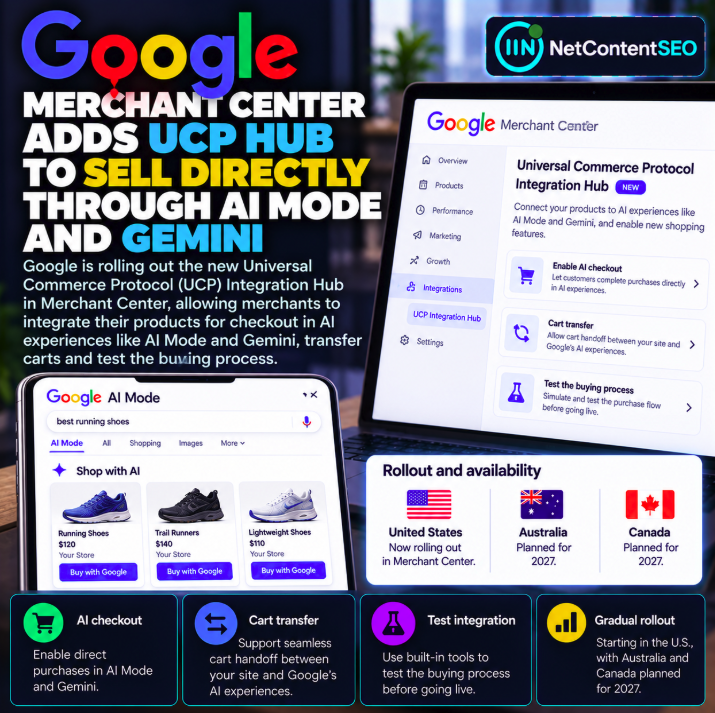

Google is rolling out a Universal Commerce Protocol (UCP) Integration Hub inside Merchant Center for merchants in the United States. Reported on October 7, 2026, the new integration experience is intended to help eligible retailers connect their commerce systems to AI-powered shopping journeys, including checkout in AI experiences, cart transfer and tools for testing the purchase process.
The move signals a shift from simply displaying products in AI-powered discovery interfaces toward supporting more of the purchase journey. However, a Merchant Center integration does not guarantee product placement, eligibility for every checkout feature or additional sales. The rollout is gradual in the US, with expansion to Australia and Canada planned for 2027.
Source: Search Engine Roundtable — Google Merchant Center UCP Integration Hub, reporting on Google's Merchant Center documentation.
What is the Universal Commerce Protocol Integration Hub?
The UCP Integration Hub is a Merchant Center entry point for connecting a merchant's commerce implementation to Google's AI shopping experiences. Rather than treating integration as an entirely separate technical project, the hub provides a place to begin the setup and review relevant commerce workflows.
The reported capabilities include support for checkout in AI experiences, cart handoff or transfer, and testing the purchase journey before a merchant launches its integration.
Exactly which functions are available to a given merchant may depend on rollout stage, eligibility, technical readiness and other Google requirements. The announcement should not be interpreted as immediate universal access.
Three capabilities merchants should understand
| Capability | What it is designed to support | What it does not guarantee |
|---|---|---|
| AI-experience checkout | Purchase steps within supported Google AI shopping experiences | That every shopper or product can complete checkout there |
| Cart transfer | Handoff of shopping-cart information between supported commerce experiences | That all merchant platforms support identical handoff behavior |
| Purchase-flow testing | Checking an integration before enabling a live shopping flow | That testing alone establishes compliance or production readiness |
Why AI Mode and Gemini matter for ecommerce
Google AI Mode and Gemini represent different interfaces through which users may discover and evaluate products. A commerce integration framework can potentially reduce the number of steps between product discovery and purchase when a supported flow is available.
For merchants, that introduces new operational questions beyond traditional search rankings: Is product information accurate? Can inventory and price data stay synchronized? Does the checkout process work correctly? What happens when a customer moves between Google's experience and the merchant's own systems?
These questions concern commerce integration and transaction quality, not just whether a product page appears in search results.
How cart transfer changes the shopping journey
Cart transfer, or handoff, is important because shoppers may start exploring products in one interface and complete the purchase in another. A reliable handoff should preserve the intended items and relevant purchase context, subject to the capabilities and policies of the participating systems.
Retailers should verify how quantities, variants, prices, availability and user consent are handled. The reported announcement does not establish a universal implementation for every ecommerce platform, nor does it mean that all cart data can move freely between services.
Why testing matters before going live
Checkout integrations can fail in ways that are not obvious from a product listing. A product might display correctly but encounter a problem with variants, shipping options, taxes, inventory or payment-stage transitions.
The integration hub's testing capabilities are therefore potentially valuable. Merchants should use them to inspect the full purchase journey and supplement built-in tests with their own quality assurance, especially for regional restrictions, refunds and exceptional cases.
Rollout timeline and geographic scope
| Market | Reported status |
|---|---|
| United States | Gradual rollout beginning in 2026 |
| Australia | Expansion planned for 2027 |
| Canada | Expansion planned for 2027 |
A planned 2027 expansion is not a confirmed launch date for every merchant in those countries. Availability may change as Google publishes additional requirements and rollout updates.
What merchants should prepare
- Review Merchant Center eligibility. Check whether the UCP Integration Hub is available in the account and market.
- Audit product data. Confirm that identifiers, prices, availability and product attributes are accurate.
- Map the checkout flow. Understand which steps occur within supported AI experiences and which remain on the merchant's systems.
- Test cart handoff. Validate product variants, quantities, inventory and failure recovery.
- Review customer experience. Confirm that shipping, taxes, returns and other important purchase information are clear.
- Check privacy and security. Evaluate data handling, permissions and integration responsibilities.
- Measure outcomes separately. Track eligible traffic and conversions without assuming that integration causes an automatic uplift.
What this means for ecommerce SEO
Traditional ecommerce SEO emphasizes crawlable product pages, structured product information, relevance and search visibility. AI-mediated shopping adds a transaction-oriented layer: merchants may need their product catalogs and checkout infrastructure to work within new discovery-to-purchase experiences.
That does not make technical SEO obsolete. Product data quality, accessible pages and accurate availability remain important. But a UCP integration is a commerce capability, not a new organic ranking signal announced by Google.
Merchant Center integration versus guaranteed AI visibility
Being technically integrated does not mean a merchant's products will appear in every AI Mode or Gemini response. Product discovery, selection, presentation and transaction eligibility involve different systems and criteria.
Publishers and SEO teams should therefore distinguish between being able to support a purchase flow and actually being selected for a given shopping interaction. The former can be tested technically; the latter requires observed visibility and performance data.
What remains uncertain
The reported rollout does not establish the precise launch date for every US account, the full set of supported ecommerce platforms or uniform feature availability across AI Mode and Gemini. Merchants should consult their live Merchant Center interface and current Google documentation before making implementation decisions.
Likewise, there is no evidence from the rollout announcement alone that UCP changes organic ranking algorithms or guarantees higher conversion rates.
FAQ
What is Google's UCP Integration Hub?
A new Merchant Center integration entry point for supported AI shopping and checkout workflows using the Universal Commerce Protocol.
What can merchants do with it?
The reported functions include preparing AI-experience checkout, cart transfer and purchase-flow testing.
Is the UCP hub available worldwide?
No. Google is rolling it out gradually in the United States, with Australia and Canada planned for 2027.
Does integrating UCP guarantee placement in Google AI Mode?
No. Integration and actual product visibility are separate matters.
Does UCP replace Merchant Center product feeds?
The reported announcement does not establish a universal replacement of existing product-data requirements. Merchants should follow current Google integration guidance.
Is this a Google Search ranking update?
No. It is a Merchant Center commerce integration rollout, not an announced change to organic ranking.
NetContentSEO analysis
The UCP Integration Hub points toward a future in which AI search visibility and transaction readiness are increasingly connected—but not interchangeable. Merchants will need to understand both whether products are discoverable in AI shopping interfaces and whether a supported purchase flow works reliably. The immediate opportunity is operational preparation, not a promise of automatic AI traffic or sales.
Source: Search Engine Roundtable, October 2026.