

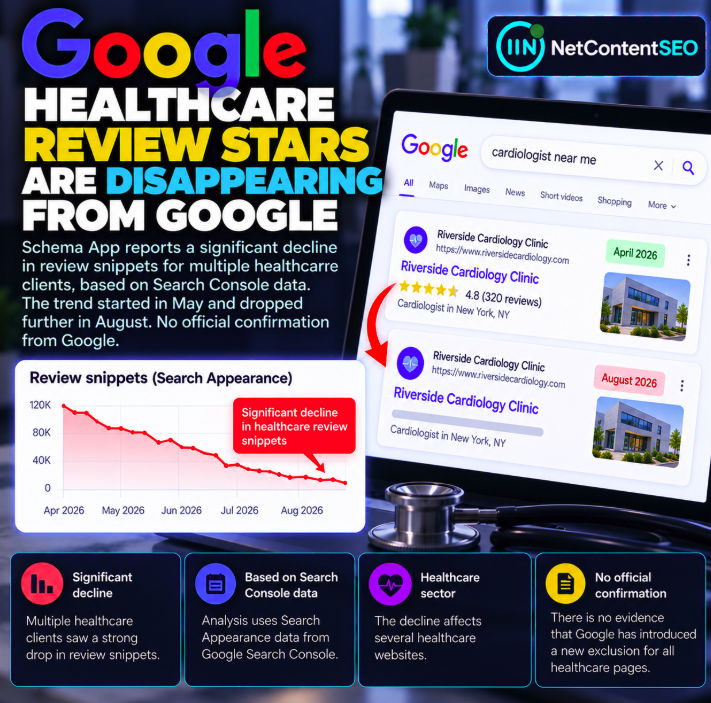

Healthcare websites have experienced a substantial decline in Google review rich result visibility, according to observations shared by Schema App and reported on October 7, 2026. The pattern reportedly began in May, with additional decreases in August, and was identified through Google Search Console's Search Appearance data for several healthcare clients.
The finding is relevant to healthcare SEO teams and structured data specialists, but its limits matter. Google has not confirmed a new algorithmic exclusion covering all healthcare pages, and a drop in review snippet appearances does not, on its own, establish that pages lost indexing, rankings or valid structured data.
Source: Search Engine Roundtable — Google Drops Healthcare Review Snippets, reporting Schema App's observations.
What Schema App observed
Schema App identified significant decreases in review rich result appearances among multiple healthcare clients. The analysis used the Search Appearance dimension in Google Search Console, which allows eligible search presentation types to be examined separately from general search performance.
The reported timeline points to a decline beginning in May 2026 and further losses in August. The evidence is observational and comes from a set of client properties, rather than a published Google announcement or a representative study of every healthcare website.
What review snippets are
Review snippets are search enhancements that can display rating information, often as stars, for supported content types when Google's eligibility and presentation systems select them. They are not identical to ordinary organic listings, local business ratings or all forms of review content.
Structured data can help Google understand review information, but valid markup does not guarantee a review rich result. Search appearance depends on Google's current policies, interpretation and presentation choices.
The reported timeline
| Period | Reported observation |
|---|---|
| May 2026 | Declines in review snippet visibility began appearing among monitored healthcare clients |
| August 2026 | Further decreases were observed |
| October 7, 2026 | Industry reporting highlighted Schema App's findings |
The reporting does not establish an exact date when Google changed its systems, nor does it provide a confirmed universal removal threshold for healthcare review snippets.
Why Search Appearance data matters
Google Search Console's Performance reports can separate certain rich result appearances from overall search impressions and clicks. This helps analysts determine whether a particular enhancement is appearing less frequently.
However, a decline in a Search Appearance category is not the same as a decline in all organic visibility. A page may continue to appear as a standard search result even when its review stars are no longer displayed.
Could the structured data still be valid?
Yes. A page can contain syntactically valid, policy-compliant structured data without Google choosing to show the corresponding rich result on every eligible query. Validation and actual search presentation are different stages.
Healthcare teams should avoid deleting review markup or making major schema changes solely because Search Appearance impressions declined. First determine whether the markup remains accurate and eligible under Google's current guidance.
What the data does not prove
- That Google introduced a new healthcare-wide review snippet exclusion.
- That all medical or healthcare websites are affected.
- That the affected pages have been deindexed.
- That every observed decline is caused by invalid structured data.
- That Google has imposed a new manual penalty on healthcare reviews.
- That the change has a measured effect on patient acquisition across the industry.
How healthcare SEO teams can investigate
- Open Search Console Performance. Inspect Search Appearance data for review snippets where available.
- Compare equivalent periods. Check trends before May, through August and after the reported declines.
- Segment affected pages. Determine whether the change is concentrated on specific templates, content types or locations.
- Compare total search metrics. Examine overall impressions, clicks and average position separately from review snippet appearances.
- Validate structured data. Review current markup and applicable Google rich result eligibility requirements.
- Inspect live SERPs. Document whether stars are present for representative queries, devices and markets.
- Check site changes. Review deployments, template updates, content edits and technical incidents that coincide with the decline.
- Monitor official guidance. Do not infer a new industry-wide policy without a supporting Google announcement.
Healthcare-specific trust and review concerns
Healthcare is a sensitive information category where accuracy, transparency and reliable claims are particularly important. Publishers should ensure that reviews are genuine, relevant and presented without misleading users about the provider or service being evaluated.
Existing Google review snippet rules also matter, including restrictions around self-serving reviews for certain types of organizations. The October observation does not by itself establish that Google created new rules, so site owners should consult the current official documentation rather than assume every healthcare review is newly disallowed.
How could disappearing stars affect click-through rates?
Stars can change how a result looks, so a reduction in rich result appearances could plausibly influence user attention. But the Schema App observation, as described, does not establish a causal CTR effect or a quantified traffic loss.
To investigate, analysts should compare relevant queries and pages while accounting for ranking movement, demand changes, device mix and other search interface features.
Why not to treat this as an indexing problem
Indexing determines whether a page can be included in Google's search index. Review snippets are a presentation feature applied to some search results. Losing the latter does not necessarily mean losing the former.
A reliable investigation checks indexing and ordinary organic performance independently from Search Appearance. This avoids turning a rich result presentation change into an unsupported claim of a broader search outage.
Could this be a broader rich results adjustment?
That remains an open question. The observed pattern could prompt investigation into presentation changes, eligibility interpretation or shifts in query and page composition. The current report does not isolate a definitive cause.
More data across independent sites and a statement from Google would be needed to establish whether the pattern reflects a systematic product change.
FAQ
Are healthcare review stars disappearing from Google?
Schema App reports substantial declines in review snippet visibility for multiple healthcare clients, based on Search Console data.
When did the decline begin?
The reported pattern began in May 2026, with additional decreases in August.
Has Google confirmed a healthcare-wide ban?
No. A universal new exclusion has not been confirmed.
Does losing review snippets mean a page is deindexed?
No. Review snippets and indexing are separate aspects of search performance.
Should websites remove their review structured data?
Not solely because stars disappeared. First verify markup accuracy, eligibility and the applicable Google guidelines.
Does this prove a drop in organic clicks?
No. Any traffic or CTR effect needs separate measurement.
NetContentSEO analysis
The healthcare review snippet decline is a useful reminder that structured data eligibility and actual rich result visibility are not interchangeable. Schema App's observations justify closer monitoring, especially for healthcare sites that depend on review enhancements, but they do not establish a new universal Google policy. SEO teams should compare Search Appearance with overall organic performance and avoid diagnosing indexing or markup failures without evidence.
Source: Search Engine Roundtable, October 7, 2026.