

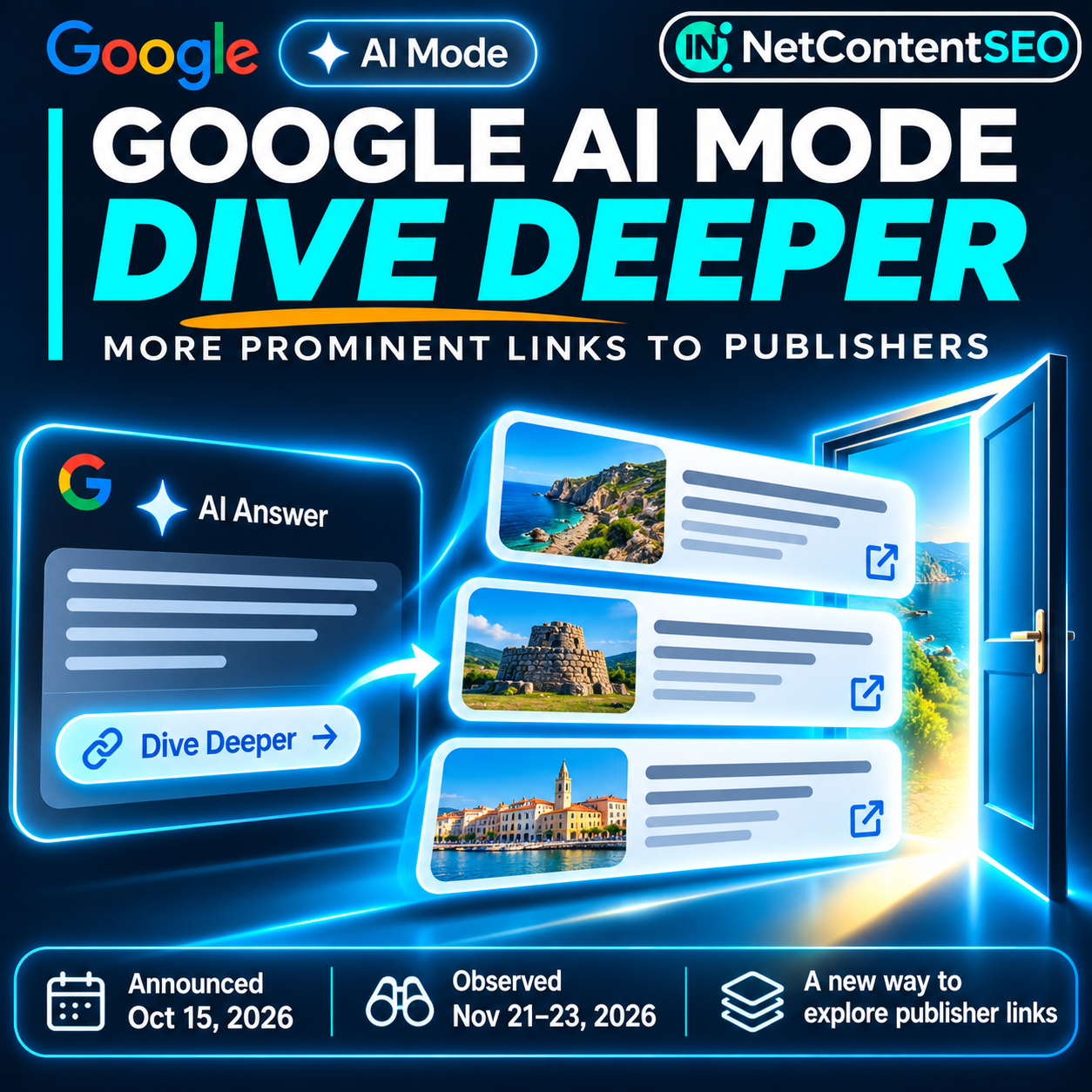

Google is giving publishers another opportunity to reach readers inside AI Mode. Its Dive Deeper section, announced on October 15, 2026, has now been observed in live AI Mode results. The redesigned links combine article titles, descriptions and visual previews, creating a more noticeable route to websites after an AI-generated answer. For publishers, the question is whether this additional exposure will translate into meaningful referral traffic.
From October announcement to November rollout
Google introduced the concept in its October 15 announcement about connecting users with the web. Search consultant Glenn Gabe reported seeing the feature on November 21. Barry Schwartz subsequently reproduced it and published his findings in Search Engine Roundtable on November 23. These sightings support the conclusion that deployment is underway, but do not establish availability across all countries, accounts or queries.
What Dive Deeper actually changes
The section presents related articles below selected generated responses. Rather than relying solely on conventional citations, Google provides a more visual presentation of additional reading. Observed examples contain blue linked titles, thumbnail images and explanatory descriptions. The purpose is to give readers a reason to explore beyond the initial answer.
These recommendations should not automatically be classified as citations supporting every claim in the generated text. A related article may offer additional context or a different perspective rather than serve as the original evidence behind the answer. Publishers measuring AI visibility should distinguish these placements.
Why placement matters as much as design
A prominent article card can be easier to discover than a compact text link. However, that advantage only matters if the reader reaches it. Schwartz noted that the section can require substantial scrolling. Someone satisfied by the generated answer may leave without ever seeing the recommended articles.
This creates two different measurement problems: how frequently a publisher is included in Dive Deeper, and how frequently users actually encounter and click its link. Neither can be inferred reliably from the presence of a thumbnail. Google has not supplied feature-specific click-through figures in the cited announcement.
Part of a broader effort to improve outbound discovery
The October announcement also described more prominent inline links, experiments highlighting official task-specific websites, expanded news carousels and creator-profile links. Together, these changes create several possible entry points from AI Search into the wider web. They are distinct interface features rather than a single new organic ranking system.
For editorial teams, the distinction is important. An inline citation might satisfy a reader seeking evidence for a particular statement. A related article might appeal to someone exploring a secondary question. An official website link may serve a visitor who wants to complete a task. Each placement has a different purpose and potentially different commercial value.
What this means for SEO and GEO
Dive Deeper introduces an additional visibility surface worth monitoring. It does not establish a new ranking factor, nor has Google disclosed a dedicated formula for selecting articles for the section.
A useful editorial strategy is to identify which questions remain unanswered after a concise AI summary. A publisher covering a technology announcement could offer original benchmarks, implementation instructions or an investigation of practical limitations. A travel publisher could provide first-hand photographs, detailed access instructions or verified seasonal restrictions that a short destination summary cannot fully communicate.
These examples illustrate how original reporting and specialist knowledge can give readers a reason to visit. They are not proven selection factors. Publishers should avoid manufacturing longer articles or superficial variations solely to target the new presentation.
Do images become more important?
The visual design gives publishers a practical reason to review their editorial imagery. Relevant, original and clearly described images can help readers understand what an article covers. Teams should ensure important images are accessible, appropriately sized and accurately represented in page metadata.
However, the rollout provides no evidence that a particular thumbnail size, image schema or visual style guarantees inclusion. Google controls presentation, and publishers cannot assume that their preferred image will always appear.
How publishers can measure the rollout
Start with a representative set of queries for which your publication provides genuinely useful coverage. Record the date, market, device, query and whether Dive Deeper appeared. Capture which articles were presented and whether they were also cited within the answer. Repeat the observations over time because generated results may vary.
Keep a record of the position of each link relative to the generated response. A link appearing after a very long answer may represent a different opportunity from one following a short answer. Where available, compare observations with Search Console and first-party analytics. Aggregate search traffic alone cannot isolate the effect of Dive Deeper, and a dedicated reporting breakdown should not be assumed without documentation.
Evaluate the quality of the resulting visits as well as their number. Engagement with original reporting, newsletter signups or relevant conversions may be more useful business indicators than raw referral volume.
Practical editorial checklist
- Identify follow-up questions that existing coverage does not answer adequately.
- Publish substantiated original insights, useful comparisons and actionable guidance.
- Maintain accurate headlines, descriptive images, source attribution and publication dates.
- Keep important article content accessible without requiring optional client-side features.
- Monitor related article placements separately from inline AI citations and traditional rankings.
- Validate traffic changes against comparable periods and account for changes in demand, seasonality and other search features.
What remains unknown
Google has not disclosed the specific eligibility or selection criteria for Dive Deeper, its complete geographic rollout schedule or its effect on publisher click-through rates. The available evidence does not demonstrate that independent publishers receive preferential treatment or that the section compensates for traffic potentially lost to AI-generated answers.
The bigger picture
Dive Deeper creates another opportunity for the web to participate in AI-assisted discovery. Its real value will depend on whether users continue exploring after receiving an answer, whether the recommended content offers something distinctive and whether publishers receive measurable referrals. For SEO and GEO teams, the appropriate response is to monitor this surface and invest in work worth reading beyond the summary—not to declare a traffic recovery before the evidence arrives.
Sources: Google, October 15, 2026; Search Engine Roundtable, November 23, 2026; Search Engine Land, November 23, 2026.