
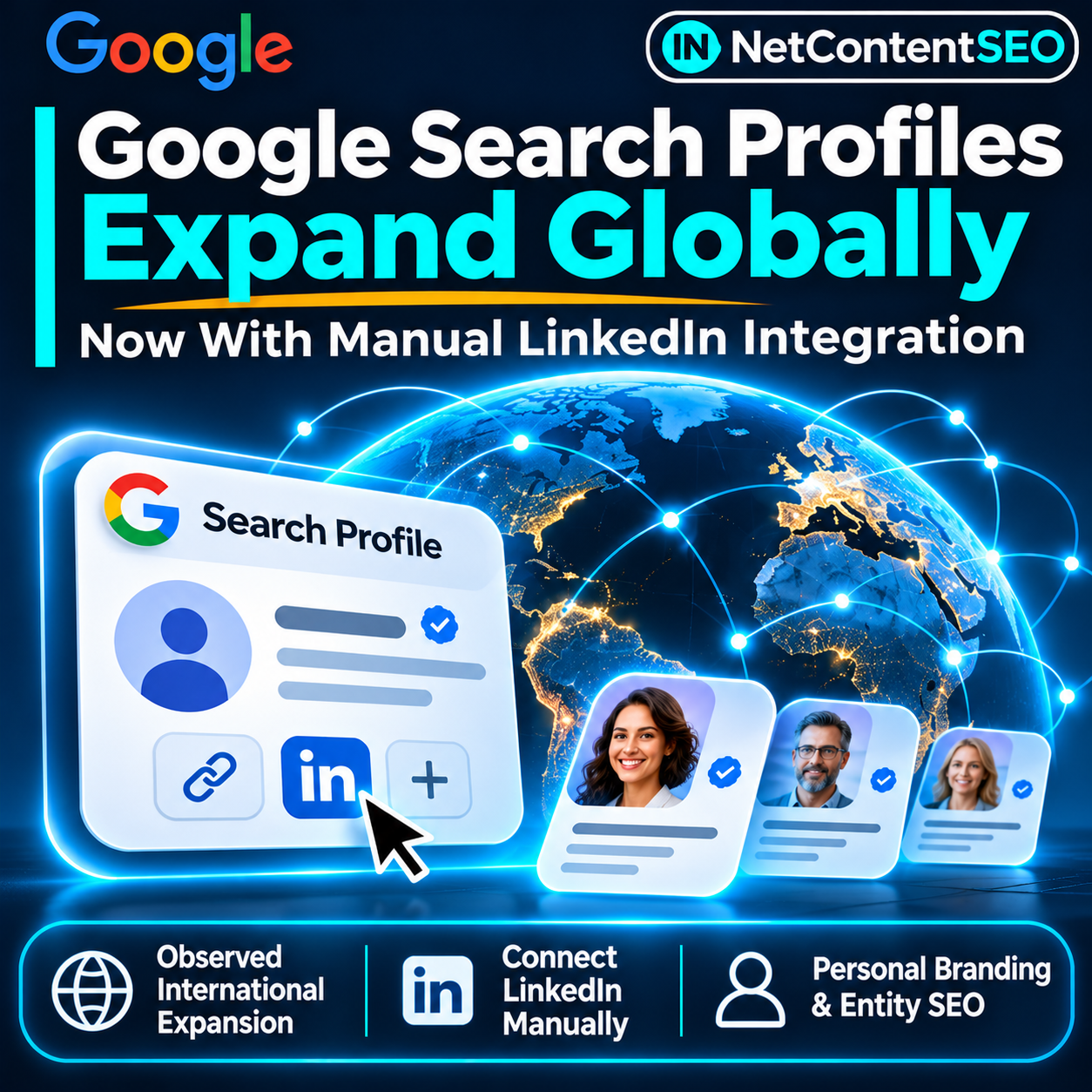
Google Search Profiles appears to be expanding internationally, alongside a new option to connect LinkedIn manually. Observations reported on November 22 and 23, 2026, suggest that Google's creator identity tools are reaching additional markets. For authors, publishers and SEO professionals, this creates another opportunity to present a coherent professional identity within Google's discovery ecosystem.
What has changed?
Search Engine Roundtable reported on November 22 that users in Spain and accounts associated with Australia, Singapore and Dubai could access profile claiming. These observations follow earlier official expansion announcements for Canada and India. Google has not yet announced universal availability in the reporting reviewed here, so the observed expansion should not be treated as proof of access in every country.
A second report on November 23 documents manual LinkedIn linking for already claimed profiles. Previously, LinkedIn could be associated automatically. The additional control allows eligible creators to manage that connection themselves.
What are Google Search Profiles?
Search Profiles bring a creator's online presence into a dedicated shareable page, connecting websites, social channels and published work. They are designed to help people discover creators and their content through Google's services. They should not be confused with Google Business Profiles, which serve businesses, or with automatically generated Knowledge Panels.
The distinction matters because claiming one type of profile does not automatically establish eligibility or control over another. A professional can maintain a useful website and appear in search results without qualifying for a Search Profile.
Why LinkedIn matters
LinkedIn can provide context about professional experience, specializations and employment history. Connecting it to an established Search Profile gives readers another route to evaluate an author's professional presence. This may be particularly useful for technical writers, researchers, consultants and independent publishers whose work spans multiple platforms.
However, adding a link is not equivalent to independently verifying every statement on the destination profile. Nor does the new option establish that LinkedIn followers count toward initial Search Profile eligibility.
Who can claim a profile?
The November reporting identifies a threshold of 10,000 followers on a supported social platform, including YouTube, TikTok, Instagram or X. LinkedIn, Facebook, Threads and personal websites can be added manually, but the reported eligibility rules distinguish those links from qualifying platforms.
Creators can start at Google's profile claiming portal and follow the account-specific instructions. Availability and eligibility should be checked directly rather than inferred from geography or total audience size across unrelated channels.
Implications for entity SEO
Entity SEO concerns the consistent representation of identifiable people, organizations and other subjects across digital sources. A coherent author identity can help readers distinguish between people with similar names and understand the relationship between an author and their publications.
Search Profiles offer another surface for communicating that identity. The feature does not establish a new ranking signal, guarantee a Knowledge Panel or demonstrate that connected websites will rank higher. Similarly, a LinkedIn connection should not be described as an automatic E-E-A-T boost.
Practical steps for authors and publishers
- Check eligibility through Google's creator portal using your actual account.
- Maintain accurate professional names, biographies and affiliations across your website and social profiles.
- Connect relevant channels and LinkedIn where the option is available.
- Build useful author pages that identify published work and genuine expertise.
- Use appropriate Person and ProfilePage structured data where applicable, ensuring it matches visible information.
- Review outdated professional details and broken links periodically.
These are sound identity-management practices, not a proven formula for Search Profile ranking or eligibility. Publishers should avoid creating artificial followers or misleading affiliations to obtain a profile.
What does this mean for AI Search and GEO?
AI-assisted discovery often requires systems to distinguish authors, organizations and sources with overlapping names. Clear, consistent identity information can support that task when available to a retrieval system. However, the November reports do not establish that Google AI Mode uses Search Profiles as a direct citation-selection signal or that other AI assistants consume the profile data.
SEO teams should therefore monitor branded search results, author discovery, Discover performance and AI citations independently. Changes in one surface cannot automatically be attributed to a newly claimed profile.
What remains unknown?
The full international rollout schedule, country-specific availability and measurable effect on publisher traffic remain uncertain. Google has not disclosed a ranking advantage associated with adding LinkedIn. The safest interpretation is that these changes expand identity-management options for eligible creators.
The bottom line
Google Search Profiles is becoming a more international and flexible creator identity surface. The opportunity is to help readers find the right person and their work across platforms. For entity SEO, the priority remains accurate, credible and consistent identity information rather than an assumed algorithmic shortcut.
Sources: Search Engine Roundtable, November 22, 2026; Search Engine Roundtable, November 23, 2026; October expansion reporting; Google creator profile portal.