

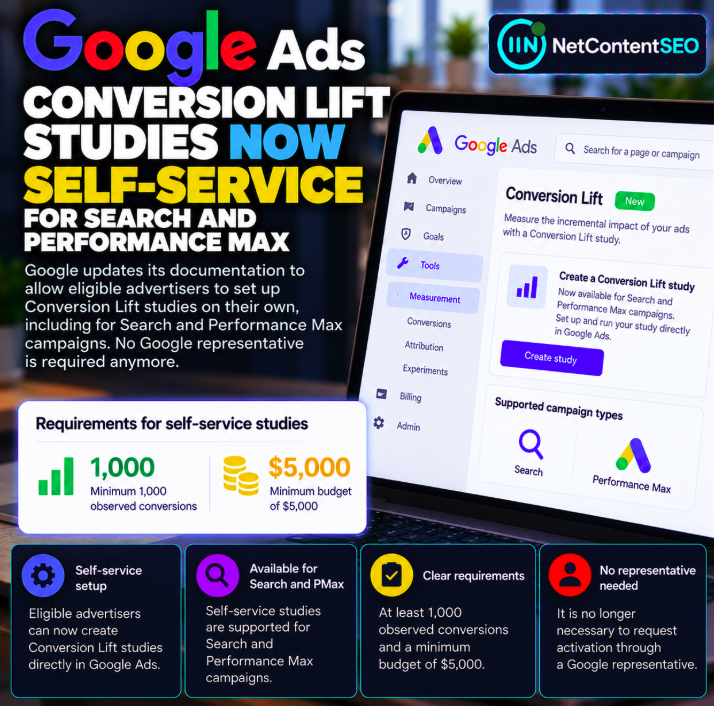

Google Ads has updated its Conversion Lift documentation to let eligible advertisers set up studies themselves, including for Search and Performance Max campaigns. The change was reported on October 8, 2026. The documented requirements include at least 1,000 observed conversions and a $5,000 minimum budget, and eligible advertisers no longer need to request activation through a Google representative.
This is an important measurement workflow update, not a new bidding algorithm or a promise of better campaign results. The practical opportunity is to test whether advertising creates additional conversions rather than merely receiving credit for conversions that would have happened anyway.
Source: Search Engine Roundtable — Google Ads Conversion Lift Measurement Self-Service, October 8, 2026, reporting Google's documentation update.
What changed for advertisers?
Conversion Lift studies have traditionally involved eligibility checks and, in some cases, coordination with Google representatives. The newly documented self-service process allows qualifying advertisers to initiate studies directly rather than relying on a representative to activate the capability.
The update includes Search and Performance Max campaigns among supported study contexts for eligible advertisers. It should not be interpreted as unrestricted access for every Google Ads account: requirements, study feasibility and the actual options visible in an account still matter.
What is Conversion Lift?
Conversion Lift is a form of incrementality measurement. It seeks to estimate the additional conversions caused by advertising, typically by comparing outcomes for groups exposed to a campaign with an appropriate comparison or control group.
That differs from ordinary conversion attribution. A campaign may receive credit for a purchase even when the customer would have purchased without the ad. An incrementality study asks the harder question: how many conversions happened because of the advertising?
Key requirements in the reported update
| Requirement or feature | Reported detail |
|---|---|
| Observed conversions | At least 1,000 |
| Minimum budget | $5,000 |
| Campaign support | Eligible Search and Performance Max campaigns |
| Study setup | Self-service for qualifying advertisers |
| Google representative | No longer required for activation in the documented eligible workflow |
These are the thresholds and capabilities reported from the updated documentation. They should not be treated as a guarantee that any account meeting both numerical thresholds will automatically qualify. Google may apply additional eligibility, feasibility or study-design requirements.
Why the 1,000-conversion threshold matters
Incrementality experiments need enough observed outcomes to distinguish a meaningful advertising effect from random variation. Requiring a substantial number of conversions helps address measurement feasibility, although the threshold alone cannot guarantee a statistically conclusive result.
Advertisers should verify the precise conversion actions, observation window and campaign scope that Google counts toward eligibility. The brief requirement of 1,000 observed conversions should not be assumed to mean any 1,000 historical events in any account.
How to interpret the $5,000 budget requirement
The reported minimum budget is a threshold for the documented study workflow. It is not evidence that Google introduced a $5,000 fee for using Conversion Lift, and advertisers should not confuse a campaign or study budget requirement with a separate platform charge.
The exact treatment of budgets and spend should be confirmed in the current Google Ads interface and official help documentation before a study is launched.
Why Search and Performance Max are significant
Search campaigns target users expressing intent through queries, while Performance Max coordinates advertising across multiple Google channels using automation. Both can produce attributed conversions, but attribution alone does not establish how much incremental demand the campaigns generated.
Self-service Conversion Lift can help qualifying teams investigate that distinction without making a representative-mediated activation request the first step. It may be particularly useful when advertisers are deciding whether to scale budgets, test campaign structures or compare business outcomes.
Attributed conversions versus incremental conversions
| Measurement | Question it addresses |
|---|---|
| Attributed conversions | Which conversions were credited to the advertising interaction under the attribution model? |
| Incremental conversions | How many additional conversions occurred because advertising was present? |
| Conversion Lift study | What causal impact can be estimated using the study's experimental design and observed results? |
The measures are complementary, not interchangeable. An advertiser can have strong attributed conversion numbers and still need incrementality testing to understand the campaign's actual contribution.
How advertisers can prepare for a self-service study
- Check account eligibility. Review whether the self-service option appears and whether the campaign type is supported.
- Verify conversion tracking. Confirm that the relevant conversion actions are reliable and represent meaningful business outcomes.
- Review volume requirements. Check how the 1,000 observed conversions are counted for the proposed study.
- Confirm budget conditions. Understand how the $5,000 threshold applies to the planned experiment.
- Define the business question. Decide which campaign or set of campaigns the study is intended to evaluate.
- Protect study integrity. Avoid unplanned changes that could compromise the experimental comparison.
- Interpret uncertainty. Review statistical confidence, limitations and the possibility of inconclusive results.
- Connect findings to decisions. Use lift estimates alongside profitability, customer value and operational constraints.
Does self-service mean instant results?
No. Making a study easier to initiate does not remove the time needed to collect data, establish a comparison and estimate impact. Some studies may fail to detect a clear effect even when campaigns are active and generating attributed conversions.
A statistically inconclusive study should not automatically be interpreted as proof that advertising had no effect. It may reflect limited statistical power, noisy data or an effect too small to estimate precisely under the chosen design.
Why agencies should be careful with client reporting
Agencies may be tempted to present lift estimates as simple percentages detached from their study design. A more reliable report explains the tested campaigns, conversion actions, timeframe, eligible population, estimated effect and uncertainty.
Results should not be generalized to unrelated campaigns, markets or future periods without evidence. Incrementality is context-dependent, and a successful study in one setting is not a universal guarantee.
Does this change Google Ads optimization or bidding?
The documented change concerns access to Conversion Lift measurement. It does not establish a new bidding algorithm, a change in Search ad ranking or an update to Performance Max targeting logic.
Advertisers may use study findings to inform their own strategy, but that is different from Google announcing a new automatic optimization feature.
What remains to be checked
Advertisers should confirm the exact availability in their accounts, which conversion actions qualify, the required observation period and any campaign-specific limitations. The reported thresholds provide a useful starting point but not a complete eligibility specification.
FAQ
Can advertisers now create Conversion Lift studies without a Google representative?
Yes, the updated documentation describes self-service setup for eligible advertisers.
Does the update include Search campaigns?
Yes, eligible Search campaigns are included in the reported update.
Does it include Performance Max?
Yes, Performance Max is also included for eligible advertisers.
What are the reported minimum requirements?
At least 1,000 observed conversions and a $5,000 minimum budget, subject to the complete eligibility rules.
Is $5,000 a new fee to run a Conversion Lift study?
No separate $5,000 study fee is established by the reported budget requirement.
Are attributed conversions the same as incremental conversions?
No. Attribution assigns credit; incrementality attempts to estimate conversions caused by advertising.
Does meeting the thresholds guarantee a valid result?
No. Eligibility and statistical conclusiveness depend on additional conditions and the observed data.
NetContentSEO analysis
Self-service Conversion Lift for Search and Performance Max lowers an operational barrier to causal advertising measurement. The important advance is not a new performance promise, but easier access for qualifying advertisers to test whether campaigns create additional business outcomes. Teams should treat the 1,000-conversion and $5,000 thresholds as eligibility checkpoints, verify the live requirements and interpret lift results with the same care as any experiment.
Source: Search Engine Roundtable, October 8, 2026.