

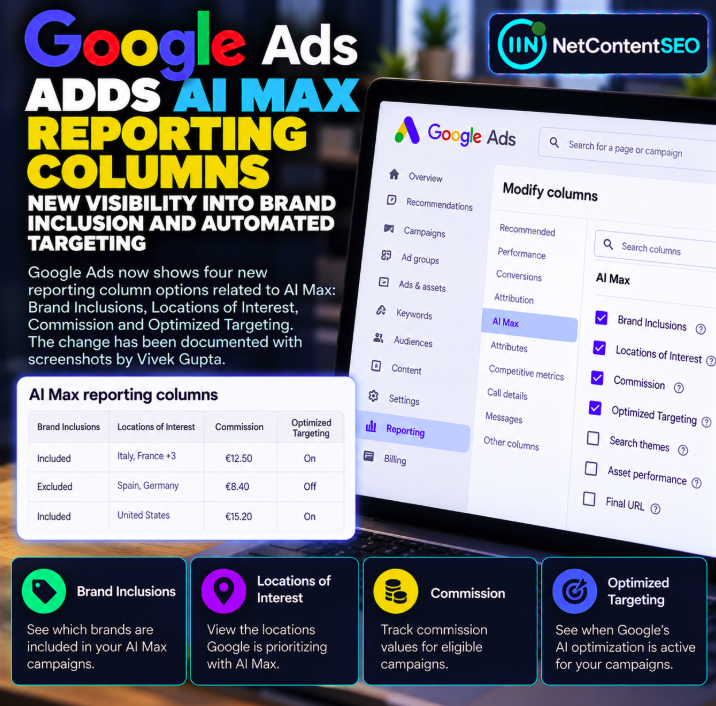

Four reporting column options have been spotted in Google Ads: Brand Inclusions, Locations of Interest, Commission and Optimized Targeting. The interface change was documented in screenshots shared by Vivek Gupta and covered by Search Engine Roundtable on October 8, 2026.
The discovery may be relevant to advertisers working with AI Max and automated campaign settings, but the screenshots do not establish general availability, the precise behavior of every column or whether all four are exclusive to AI Max. Google has not been shown in the cited report to have announced a universal launch of these options.
Source: Search Engine Roundtable — Google Ads New AI Max Columns, October 8, 2026.
What was observed in Google Ads?
In the reporting column configuration interface, four labels appeared as selectable options: Brand Inclusions, Locations of Interest, Commission and Optimized Targeting. Screenshots offer evidence that these labels were visible in at least one account or interface state.
That is a narrower finding than a product announcement explaining every metric's calculation, supported campaign types, geographic rollout and historical data coverage. Until those details are documented, analysts should avoid treating the column names as fully specified new metrics.
The four column labels
| Observed label | What advertisers should verify |
|---|---|
| Brand Inclusions | Whether the column describes a campaign setting, its status or another reported attribute |
| Locations of Interest | Which geographic targeting or interest configuration it represents and how values are displayed |
| Commission | What commission concept or calculation applies to the account and eligible campaign type |
| Optimized Targeting | Whether it reports an enabled setting, eligibility or another aspect of automated targeting |
The table describes questions to check, not confirmed metric definitions. A label alone is insufficient to determine whether a column reports performance, a configuration state or a calculated value.
Why Brand Inclusions may interest AI Max advertisers
Brand-related controls matter when advertisers want to understand how automation interacts with branded queries and campaign intent. A column called Brand Inclusions could make a relevant configuration easier to see alongside other campaign information, depending on its documented meaning.
However, the observed label does not prove that Google now provides a new brand-level attribution report, nor does it establish which campaign types can use the column.
Locations of Interest: context matters
Location settings and geographic reporting have long been important in Google Ads. The presence of a Locations of Interest column may help surface some aspect of targeting or campaign configuration, but the screenshots alone do not establish the data type or geographic attribution logic.
Advertisers should distinguish a campaign's configured location settings from the locations of people who saw or clicked ads. Those are not necessarily interchangeable concepts.
What does Commission mean?
The Commission label deserves particular caution because it could refer to a specific bidding, commerce or account context rather than a universal monetary charge applied to every AI Max campaign.
Without an official definition in the relevant interface or documentation, advertisers should not assume that the column reports Google Ads platform fees, affiliate commissions or a new AI Max billing model. Any financial interpretation must be confirmed before it is used in client reporting.
Optimized Targeting and automated campaign oversight
Automated targeting can affect how advertisers configure and review campaigns. A visible Optimized Targeting column may offer a convenient way to inspect a relevant setting in supported contexts.
But the appearance of the label does not demonstrate that Google changed targeting algorithms, expanded eligibility or began exposing a new breakdown of incremental performance. These would require separate evidence.
Reporting columns are not necessarily new features
A reporting interface can add a column for an existing setting without launching a new underlying capability. Similarly, a label may appear in a menu before it becomes broadly available or before its meaning is documented for all accounts.
This distinction is especially important for AI Max coverage: the four options were reported in connection with AI Max, but that does not prove each is a newly introduced AI Max-only feature.
How PPC teams should check availability
- Open the Google Ads reporting view. Inspect the column customization interface in the relevant account.
- Search for the four labels. Note which options appear and which campaign types or views support them.
- Read interface tooltips. Look for definitions before interpreting the data.
- Check displayed values. Determine whether the column contains a setting, status, currency amount or another data type.
- Compare across accounts cautiously. Differences may reflect rollout, permissions or campaign eligibility.
- Document screenshots and dates. Preserve evidence of availability and any explanatory text.
- Consult Google documentation. Confirm official definitions before adding the fields to automated client dashboards.
Why the change matters for agencies
Agencies often manage numerous campaigns with different targeting and brand controls. If these fields become consistently available, they could make campaign configuration easier to review in tables and exported reports.
That is a potential workflow benefit, not an established result. The current observation does not demonstrate improved advertising performance, lower costs or better conversion attribution.
Could the columns improve AI Max transparency?
Possibly, if Google documents the definitions and exposes them reliably across relevant campaign views. Greater visibility into configuration can help analysts explain how a campaign is set up and identify discrepancies.
But transparency depends on what the values actually mean. A column that merely shows whether a setting is enabled is not equivalent to a report proving how much incremental traffic that setting generated.
What is not confirmed
- A universal rollout to all Google Ads accounts.
- That all four options are exclusive to AI Max.
- Exact metric definitions or calculation methods.
- A new Google Ads commission charge or billing policy.
- Any change in ad auction, ranking or targeting algorithms.
- A measurable improvement in campaign performance.
FAQ
Which four Google Ads columns were observed?
Brand Inclusions, Locations of Interest, Commission and Optimized Targeting.
Who documented the interface change?
Vivek Gupta shared screenshots, which were covered by Search Engine Roundtable on October 8, 2026.
Are the columns available to every advertiser?
General availability has not been verified.
Are all four columns new AI Max-only features?
The observation does not establish that.
Does Commission mean Google introduced a new fee?
No such conclusion follows from the label alone. Its meaning needs official confirmation.
Do the columns change campaign targeting?
The report documents interface options, not an announced change to targeting algorithms.
NetContentSEO analysis
The appearance of four Google Ads reporting columns is worth tracking because it may improve visibility into campaign configuration and automation. For now, the evidence supports a documented UI observation rather than a sweeping claim about new AI Max metrics. Advertisers should verify availability, read the definitions and avoid assigning financial or performance meaning to unfamiliar labels without documentation.
Source: Search Engine Roundtable, October 8, 2026.