

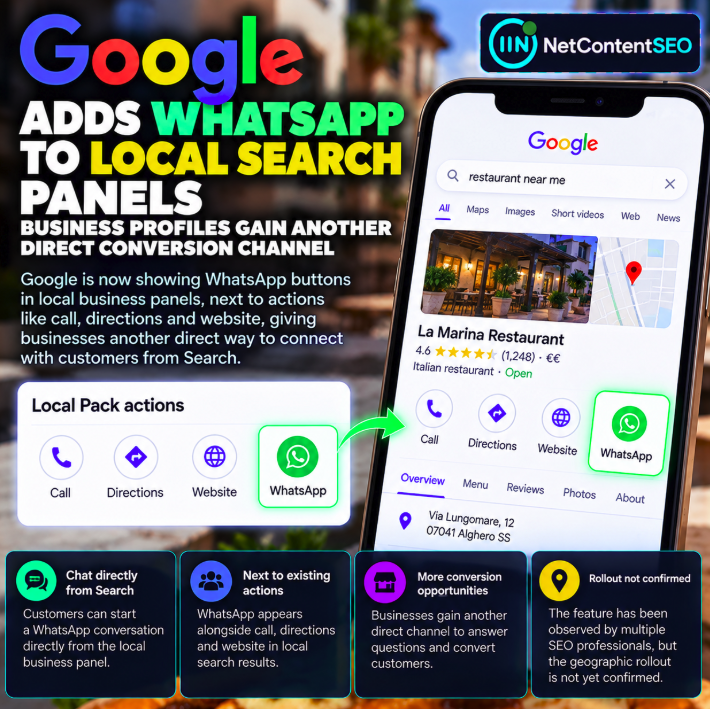

Google is showing WhatsApp contact buttons in some local business panels, placing the messaging option alongside familiar actions such as calling a business, getting directions and visiting its website. The interface was observed by SEO professional Sachin Patel and independently reproduced by Barry Schwartz, with reporting published on October 7, 2026.
The observation is significant for local businesses because it creates another potential route from search discovery to direct customer contact. But the geographic extent of the rollout has not been confirmed, and the reported interface change is not evidence of a new local ranking factor or a guaranteed increase in leads.
Source: Search Engine Roundtable — Google Local Panel WhatsApp Button, October 7, 2026.
What changed in Google's local search interface?
In observed local business panels, Google displayed a WhatsApp action among the standard ways users can interact with a business. These panels already commonly feature actions such as calling, navigating to the location or opening the business website.
The additional messaging option gives eligible users a possible way to start a WhatsApp conversation from the search interface. The screenshots and independent reproduction establish that the interface has appeared, but they do not establish availability for all businesses, devices or countries.
Why WhatsApp matters for local businesses
Many local customer questions are short and practical: Is an item available? Can I book an appointment? Is there parking? Can I get a quote? A messaging action can offer a different interaction from a phone call or website visit.
For businesses equipped to respond promptly, direct messaging may be useful for answering questions before a customer commits to visiting or purchasing. However, the presence of a button alone does not demonstrate that more conversations, bookings or sales occurred.
How the action fits alongside existing buttons
| Local panel action | Typical user intent |
|---|---|
| Call | Speak with the business by phone |
| Directions | Navigate to a physical location |
| Website | Explore services, menus, products or booking information |
| Start a messaging conversation where supported |
These actions serve different needs. A WhatsApp button does not replace a well-maintained website, accurate business details or responsive telephone support.
What has actually been verified?
The interface was first highlighted by Sachin Patel and independently reproduced by Barry Schwartz. That is stronger evidence than a single uncorroborated screenshot, but it remains an observation of a specific user interface rather than an official statement defining rollout scope.
The available reporting does not establish a universal launch date, a complete country list or a precise set of eligibility conditions. Businesses should check their own live Google presence before assuming the action is available.
Does this mean every Google Business Profile can enable WhatsApp?
Not necessarily. A visible feature in some local panels does not prove that every profile can configure it immediately. Availability may depend on product rollout, market, business category, account settings or other conditions that have not been established by the reported observation.
Operators should consult current Google Business Profile documentation and their own profile controls rather than rely on an assumed universal setup process.
Could this affect local SEO rankings?
There is no evidence in the cited report that the WhatsApp button is a new ranking factor. Google showing another contact action is a user-interface development, not an announced change to the local ranking system.
Businesses should not infer that adding WhatsApp, where available, will automatically improve their Local Pack position.
Why the change may matter for conversion measurement
Local search performance is not only about clicks to websites. Some users call a business, request directions or interact with a profile without visiting the website. A direct messaging action could add another type of contact that businesses may want to monitor.
However, measurement depends on what data is actually available from Google and the messaging platform. The UI observation does not establish a new Search Console report or a dedicated WhatsApp conversion metric inside Google Business Profile.
Practical steps for local businesses
- Check the live panel. Search for the business on relevant devices and record whether the WhatsApp action appears.
- Review official settings. Use documented Google Business Profile options where available, rather than assuming the observed button can be manually activated everywhere.
- Keep contact information accurate. Make sure customers can reach the correct business team.
- Prepare for messages. Set expectations for response times and ensure incoming questions can be handled.
- Protect customer information. Follow applicable privacy requirements when receiving messages.
- Track actual outcomes. Monitor meaningful conversations, bookings and inquiries where measurement is possible.
- Watch rollout updates. Recheck Google's documentation for supported markets and eligibility.
What this means for agencies managing multiple locations
Agencies and multi-location brands may need to treat messaging availability as a location-specific feature until Google confirms wider coverage. A chain might observe the action on some listings but not others, without that necessarily indicating a configuration error.
Before rolling out operational changes, teams should confirm which locations display the action and whether those locations can reliably handle incoming messages.
Does a WhatsApp button replace the business website?
No. Messaging is suited to conversational questions, while websites can provide detailed service descriptions, product catalogs, policies, accessibility information and structured booking experiences.
The two channels can complement each other. A user may prefer a quick message for availability, then visit the website for full details.
Why local search is becoming more action-oriented
Google's local results have long combined business discovery with actions such as calls and directions. Adding WhatsApp in some panels extends that action-oriented design to another communication channel.
For local SEO professionals, this is a reminder to evaluate how users contact a business, not only where the business ranks. Yet any claim about increased conversion rates must be supported by actual data rather than inferred from a new button.
What is still unknown?
- The full list of countries where the WhatsApp action is available.
- Whether all eligible business categories receive the same interface.
- The exact account-level requirements for displaying the action.
- Whether Google will announce a broader rollout.
- Any measurable effect on calls, messages, website clicks or bookings.
FAQ
Has Google added WhatsApp to local business panels?
WhatsApp buttons have been observed in some Google local panels, with independent reproduction reported in October 2026.
Is the feature available globally?
The geographic extent of availability has not been confirmed.
Does WhatsApp appear alongside call and directions?
Yes, that is the interface arrangement described in the reported observations.
Will WhatsApp improve a business's Local Pack ranking?
No ranking benefit has been established by this UI change.
Can every business activate the button today?
Universal eligibility has not been established. Businesses should check their live profiles and official documentation.
Does the change guarantee more leads?
No. A contact option creates a possible interaction, not a guaranteed conversion.
NetContentSEO analysis
WhatsApp in Google's local panels is an example of search becoming a more direct point of customer interaction. For businesses, the useful next step is to verify availability and prepare to handle messages effectively. For SEO professionals, the right distinction is between an observed interface change, actual contact behavior and proven business outcomes. None should be mistaken for a newly announced local ranking signal.
Source: Search Engine Roundtable, October 7, 2026.