

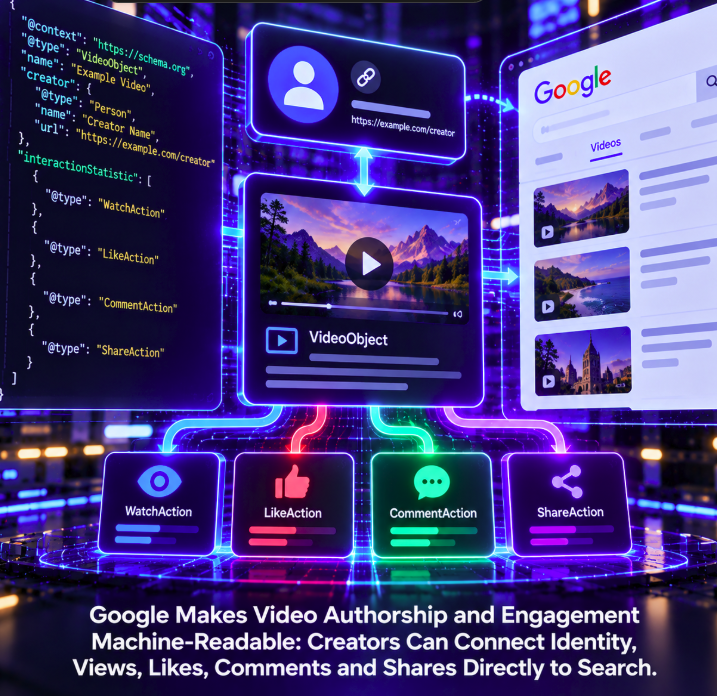

Google has expanded its documented vocabulary for video structured data in a way that makes two increasingly important attributes machine-readable: who created the video and how people interact with it. A September 24 update to Search Central now documents creator—with author also supported—and explicitly defines four engagement types that publishers can supply through interactionStatistic.
Google recorded the change in its official Search documentation changelog, describing the update as the addition of the creator property and a clarification of supported interaction types for VideoObject. The corresponding VideoObject structured-data documentation now shows how a video can identify its creator as a person or organization and attach structured counts for views, likes, comments and shares.
This is a documentation update rather than an announcement of a new ranking factor or a new video rich result. Google does not say that adding creator identity or engagement counts will improve rankings. What has changed is the supported semantic layer: publishers can now give Google explicit, structured relationships between a video, its identifiable source and several forms of audience interaction.
A VideoObject can now point directly to an identifiable creator
Google documents creator or author as a Person or Organization representing the entity that created or published the video. The nested entity can provide a name or alternateName, while the optional url can point to a page that uniquely identifies that person or organization, such as a profile page or homepage.
That URL is the strategically interesting field. A creator name is text; a creator URL gives the name an identity endpoint. A publisher can connect a video to a stable profile page rather than leaving Google to infer authorship from surrounding page copy, channel branding or other indirect signals.
Google’s own example now marks a video as created by an organization and provides both its name and identifying URL. The same structure can be used for an individual creator with @type: Person.
This does not mean Google will automatically merge that entity with every other representation of the same creator across Search. The documentation makes a narrower claim: the URL should uniquely identify the creator or organization. Publishers should therefore treat it as explicit identity markup, not as a guarantee of Knowledge Graph reconciliation or enhanced ranking.
Engagement is no longer documented as views alone
interactionStatistic is not new to VideoObject. Google has recommended it instead of the older interactionCount property since 2019. What changed on September 24 is the documentation of the interaction types Google supports.
The list now contains four Schema.org actions. WatchAction represents the number of times a video was watched. LikeAction represents likes or upvotes. CommentAction represents comments. ShareAction represents reshares. Each is expressed through an InteractionCounter with userInteractionCount containing the corresponding integer.
That turns a generic engagement field into a more descriptive data model. A publisher no longer has to collapse audience response into one ambiguous interaction total. Views, positive reactions, discussion and redistribution can be represented as different behaviors attached to the same video.
The markup can describe several interaction dimensions at once
Schema.org permits interactionStatistic to be repeated, allowing a publisher to describe multiple counters for one piece of content. In practical JSON-LD, a video can therefore carry separate InteractionCounter objects for watching, liking, commenting and sharing, with each counter declaring its own interactionType and userInteractionCount.
The important implementation principle is that the structured values should describe the real content visible or supported by the page. Google’s general structured-data guidelines require markup to be representative of the page and warn against misleading structured data. The new support should not be interpreted as permission to manufacture social-proof numbers simply because a schema field exists.
Publishers with their own video platforms have the cleanest implementation path because they control both the engagement database and the page markup. Sites embedding videos from third-party platforms need to be more careful about whether they can reliably expose current interaction counts and whether those values accurately correspond to the video being marked up.
Creator identity and engagement now sit beside core video metadata
Video structured data already gives Google a machine-readable description of fundamental attributes such as the video name, description, thumbnail, upload date, duration, content URL and embed URL. Additional structures can describe live broadcasts, key clips and seek behavior.
The September update adds another layer of meaning around that media object. The video can now be explicitly tied to the person or organization behind it, while interaction statistics describe how audiences have responded to it.
This creates a richer entity graph than a basic media file description. Instead of “this page contains a video with this title and thumbnail,” the markup can express “this identifiable creator made or published this video, and these are the measured interaction types associated with it.”
Google has not said these counts are ranking signals
The temptation will be to read the change as evidence that likes, comments or shares have become direct Google Search ranking factors for video. The documentation does not establish that. Google says the update documents supported properties and supported interaction types; it does not say that the values are used as ranking weights.
The same caution applies to creator markup. Google’s video documentation describes recommended properties that provide additional information about a VideoObject and can contribute to a better understanding or experience. It does not promise that attaching a creator profile URL will increase visibility.
For SEO teams, the defensible reason to implement the fields is semantic completeness and machine readability. If Google supports an explicit representation of information that is accurate, visible and maintained by the publisher, providing it reduces ambiguity. Any performance effect should be measured rather than assumed.
The change arrives as Google expands video and social measurement
The timing is notable because Google has been broadening the amount of creator and visual discovery data exposed through Search Console. NetContentSEO recently covered how Instagram, TikTok, X and YouTube accounts can become Search Console platform properties, allowing creators to measure their content’s Google impressions and clicks independently from a website.
Google has also introduced multimodal Search Console reporting for visual discovery. Those reporting changes and the VideoObject documentation update solve different problems, but together they point toward a Search ecosystem in which visual content, creator identity and off-domain media are increasingly represented as measurable, structured objects.
For publishers that own both a website and active video channels, the practical SEO surface is consequently wider than a conventional article URL. A video can have its own structured metadata and creator relationship on the publisher’s site while the creator’s external platform identity can separately accumulate Search Console visibility.
Identity URLs can reduce ambiguity around who made the video
The new creator documentation is especially useful for publishers with many contributors. A video page can already display a byline or channel name to users, but structured data allows the relationship to be declared in a predictable machine-readable form.
A stable creator URL also gives publishers a natural reason to maintain durable profile or organization pages. Those pages can serve as identity anchors containing consistent names, biographies, organizational information and links to the creator’s body of work.
Again, Google does not say that this architecture produces a ranking benefit. But from a data-model perspective, it is cleaner than repeating an unlinked creator name across hundreds of videos. The same entity can be referenced consistently rather than recreated as isolated text on every page.
Engagement markup creates a freshness problem publishers must manage
Unlike a video’s upload date or duration, engagement statistics change continuously. Adding view, like, comment and share counts therefore introduces a maintenance obligation. A structured value that was accurate at publication can become stale quickly on a popular video.
Sites implementing the expanded interactionStatistic support should generate counters from the same authoritative data source used by the visible experience wherever practical. That keeps the structured representation synchronized with what users see and avoids turning JSON-LD into a frozen snapshot of old engagement.
The operational challenge will vary by platform. A first-party video service can update JSON-LD dynamically from its own database. A publisher embedding externally hosted media may have limited access to reliable live counts or may face API quotas and platform-specific definitions of views and engagement.
Machine-readable video is becoming more entity-centric
The broader significance of the update is not the addition of six schema terms to a documentation table. It is the way those terms change what a video can communicate to a machine.
Core VideoObject properties describe the media asset. creator or author describes the entity responsible for it. interactionStatistic describes observable audience behavior around it. Together, those layers provide a more complete representation of content, provenance and response.
That structure is useful beyond any single Search feature because modern retrieval systems increasingly need to understand not just what a document or video is about, but where it came from and how it relates to other entities. Structured data cannot guarantee how Google or an AI system will use those relationships, but it gives the publisher a standardized way to state them.
The SEO opportunity is precision, not engagement-score speculation
Publishers should resist turning the September 24 update into a new “likes are a ranking factor” checklist. Google has made no such announcement. The actionable change is much more concrete: its VideoObject documentation now accepts a richer description of authorship and explicitly recognizes four interaction categories.
For a video publisher, that means verifying that every eligible watch page has accurate core VideoObject markup, adding a stable creator or author entity where appropriate, linking that entity to a uniquely identifying URL, and exposing truthful interaction counters when the data can be maintained reliably.
The result is a video object that carries more of its own context. Google does not have to infer the creator solely from surrounding text, and engagement does not have to be represented as one undifferentiated number. Identity, views, likes, comments and shares can now travel with the video as structured data.
That is a modest documentation change with a larger semantic consequence: the video itself becomes a better-defined machine-readable entity, connected both to the creator behind it and to the audience activity around it.