

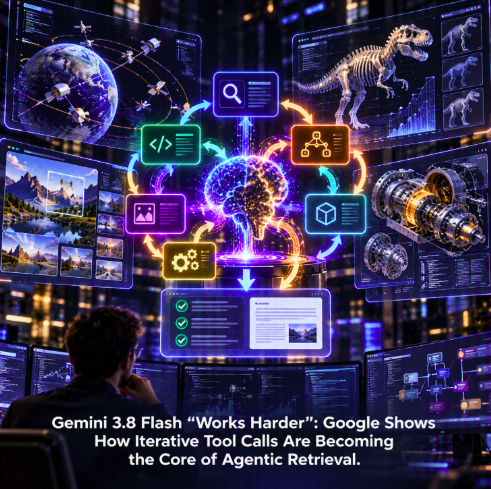
Google has published a new showcase of what developers are building with Gemini 3.8 Flash, and the most revealing part is not any single demo. It is Google's explanation for why the model performs better on difficult work: Gemini 3.8 Flash “works harder,” taking additional reasoning steps and calling tools iteratively before settling on an output. The September 28 Google post highlights four community experiments spanning orbital simulation, multimodal animation, paleontology and mechanical engineering.
This is not a new Gemini 3.8 Flash launch. Google introduced the model on September 2 as its most intelligent Flash workhorse for software engineering, agentic tasks and critical multistep reasoning. The September 28 article is a developer showcase demonstrating how those capabilities are being used after launch.
For AI search and retrieval, however, the wording around iterative tool use matters. It points toward a model of answer generation in which the system does not simply retrieve once and generate once. It can reason about what it has, call another capability, inspect the result and continue until it has enough information or computational support to produce the output.
Google says the model takes extra reasoning steps and calls tools iteratively
Google attributes Gemini 3.8 Flash's gains to what it calls a core design choice: on complex tasks, the model shows greater diligence by executing extra reasoning steps and calling tools iteratively to reach a more accurate result.
That description is more consequential than a generic claim that the model is smarter. It identifies process as part of the capability. Instead of assuming the first interpretation or first tool result is sufficient, the model can perform additional work before returning the answer.
The pattern resembles an agent loop: inspect the problem, choose an action, observe what comes back, update the working state and decide whether another action is necessary. The model remains responsible for coordinating the sequence, while external tools provide capabilities or information that cannot be obtained reliably from generation alone.
The four demos make multistep execution visible
Google's first example comes from Ashutosh Shrivastava, who used Gemini 3.8 Flash with Google Antigravity to map live paths for satellites, space stations and orbital rockets. The project combines model reasoning with an environment capable of building and running an interactive simulation rather than stopping at a textual explanation.
A second experiment by Noctus uses the model's multimodal capabilities to transform Seigaiha waves, a traditional Japanese pattern, into an animated ink-painting-like result. Google presents it as an example of multimodal creation rather than a retrieval system.
The third example pushes multistep reasoning more explicitly. A builder identified as Emily asked Gemini 3.8 Flash to construct a T. rex skeleton through a four-phase prompt containing strict requirements, prohibited shortcuts and accuracy checks. Google's framing emphasizes the model's stronger multistep reasoning in STEM tasks.
The fourth demo asks Gemini to build an interactive automatic-transmission simulation from scratch. Google says the resulting prototype contains ten camera views, four display modes, smart labels and an educational side panel for individual transmission components.
These projects are demonstrations rather than controlled benchmarks, and Google does not claim that all four depend specifically on web retrieval. Their value is architectural: they show a Flash model being used as the coordinator of extended, structured work rather than as a one-turn text generator.
Agentic retrieval is increasingly a loop, not a lookup
The same architecture has direct implications for search. Traditional retrieval can be pictured as a relatively simple sequence: issue a query, receive documents and generate an answer. Agentic retrieval can be recursive. The model can inspect the first evidence set, discover that something is missing, formulate another search or tool call, inspect that result and repeat.
Google already describes query fan-out in AI Mode and AI Overviews as a process that can issue multiple related searches across subtopics and data sources. NetContentSEO recently examined how parts of that query expansion are becoming visible in AI Mode interfaces. The Gemini 3.8 Flash showcase is not a Search announcement, but Google's emphasis on iterative tool calls fits the same broader movement from single-query retrieval toward multi-action information gathering.
The distinction is important because iterative retrieval changes the path by which a source can enter an answer. A page may be irrelevant to the initial broad query but highly relevant to a narrower question generated by the agent during a later step.
The first retrieval is no longer necessarily the decisive one
In a one-pass system, publishers can imagine a relatively direct competition: the system retrieves a candidate set and selects evidence from it. In an iterative system, the candidate set can evolve as the model reasons.
An initial search may establish the broad topic. A second call may verify a technical claim. Another may look for pricing, recency, a primary source or a contradictory account. A code or data tool might then process the retrieved information before the model decides whether additional evidence is required.
Google's September 28 post does not disclose the internal retrieval pipeline of Google Search, nor does it say that every Gemini answer follows this exact sequence. The SEO implication is therefore an inference from the documented agentic pattern, not a newly announced ranking mechanism.
More tool calls can create more opportunities for source discovery
If an agent decomposes a problem into several subproblems, each subproblem can create a different retrieval opportunity. This is one reason AI visibility cannot be reduced cleanly to a single traditional ranking position.
NetContentSEO has already documented how Google AI Mode can turn a conversation into successive machine-generated follow-up queries. In Google AI Mode Is Testing an Endless Search Journey Built From Automatic Follow-Up Queries, the observed interface showed the system generating a new query from the user's prior response and continuing the journey through additional steps.
Iterative tool use extends the same conceptual shift below the interface. Some additional information needs can be generated by the model itself while it works, even when the user never explicitly types those subqueries.
This changes what “relevant” can mean for a publisher
A page optimized only for a broad head query may not contain the evidence required by later stages of an agent's investigation. Conversely, a highly specific technical page, dataset, pricing table, documentation page or original experiment may become valuable when a later tool call asks precisely the question it answers.
This does not imply that publishers should manufacture hundreds of speculative pages for imagined agent subqueries. It strengthens a more durable strategy: make useful evidence available at the level of specificity where an investigating system might need it.
For AI visibility, that can mean explicit facts, dates, technical constraints, original measurements and clear source provenance. The objective is not to guess every hidden prompt. It is to make the underlying information retrievable when an agent's reasoning creates a need for it.
Iterative retrieval also makes freshness more important
Tool use allows an AI system to reach beyond what was present in model training. When an agent can repeatedly search or query external systems, current information can be introduced at the exact stage where it becomes relevant.
That makes stale pages more vulnerable in time-sensitive tasks. If one source describes a product as it existed six months ago and another provides a current specification with an explicit date, a later verification step has the opportunity to discover the newer evidence.
This aligns with controlled GEO research covered by NetContentSEO. A 252,000-trial study found that topical relevance, source position, explicit price information and recent timestamps were among the most consistent factors affecting first-citation outcomes in its experimental setup. That study did not test Gemini 3.8 Flash's agent loop, but it reinforces the broader point that concrete, current evidence can matter more than cosmetic formatting.
Tool use makes provenance more important, not less
An agent that performs more steps can potentially produce a better researched answer, but it also creates a longer causal chain. The final output may reflect several searches, a code execution, a transformation step and intermediate model judgments.
That makes provenance critical. A system needs to retain enough information to distinguish what came from an external source, what came from a calculation and what was inferred by the model. Otherwise additional tool calls can increase complexity without increasing auditability.
For publishers, this is another reason to make primary evidence easy to identify. A clearly dated original announcement, specification or dataset gives an agent a stronger object to retrieve and verify than an unattributed secondary assertion.
“Works harder” has a cost side too
Extra reasoning and iterative tool calls are not free. Every additional step can add latency, model tokens, tool execution and external API costs. Google launched Gemini 3.8 Flash at the same introductory token price as 3.7 Flash—$0.75 per million input tokens and $3.75 per million output tokens—while positioning the Flash family around speed and cost efficiency.
The agentic design therefore involves a trade-off. More work can improve the probability of resolving a difficult task correctly, but indiscriminately calling tools would undermine the latency and cost advantages that make a Flash model attractive.
The engineering challenge is not simply to maximize the number of calls. It is to make additional calls when the expected information gain justifies them.
Fast models are becoming orchestration engines
Flash-class models were once easy to frame as cheaper alternatives for simpler prompts. Google's description of Gemini 3.8 Flash points toward a different role. A fast model can coordinate complex workflows precisely because agentic work consists of many intermediate decisions where latency compounds.
If an agent needs to reason, call a tool, inspect the result and repeat that loop several times, the speed of each individual model turn matters. A slightly slower model can become substantially slower across a long trajectory.
This makes “fast but capable enough to orchestrate” a strategically important model category. The system can reserve heavier computation for genuinely difficult stages while using the faster model to maintain the workflow.
The September 28 post is a showcase, not a new model release
Google's wording could easily be misread because the post celebrates what builders are making with Gemini 3.8 Flash. The model itself was announced on September 2 alongside Gemini 3.8 Flash Cyber. The newer article explicitly says developers have been building with 3.8 Flash since its launch earlier in the month.
That distinction matters editorially. There is no new September 28 model SKU or newly announced Gemini 3.8 Flash generation in the source. The news is Google's demonstration of the model's behavior and the four applications it selected to illustrate that behavior.
The deeper signal is how Google now describes intelligence
The most interesting sentence in Google's showcase is its explanation that performance gains stem from the model working harder through additional reasoning and iterative tool calls.
That framing shifts the concept of model quality away from what the neural network can produce in isolation. Intelligence increasingly includes the ability to recognize when internal knowledge is insufficient, select an external capability, inspect what comes back and keep working.
For search and GEO, that means the unit of visibility is likely to become more dynamic. A source can be discovered at different stages of an agent's trajectory, for different subquestions and through different retrieval calls. The answer is assembled through a process rather than pulled from one static ranked list.
Google has not published a new SEO rule in this developer showcase, and publishers should not treat iterative tool calling as a confirmed Search ranking factor. What Google has made explicit is the architectural direction: its latest Flash model is designed to do additional reasoning and repeatedly use tools when complex work demands it. As AI systems become more agentic, retrieval increasingly looks less like one search followed by one answer and more like an investigation that keeps asking what it needs next.