

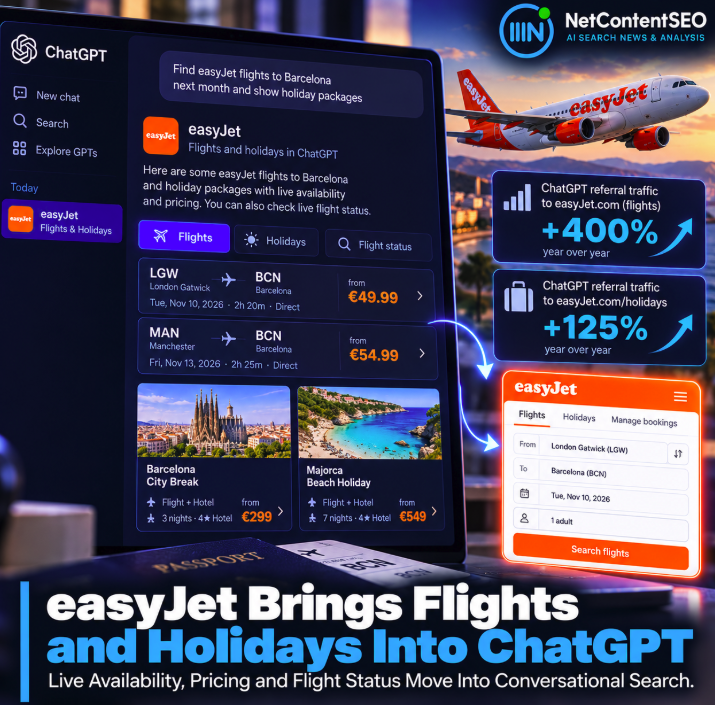

easyJet has launched a ChatGPT Plugin for flights and package holidays, bringing live travel search directly into the conversational interface. Customers can search easyJet flights, browse easyJet holidays, view live availability and prices, and check flight status without beginning on a conventional airline search page.
The airline announced the integration on October 5, 2026. Booking itself is not completed inside ChatGPT: after finding an option, users continue to easyJet.com for flights or easyJet.com/holidays for package holidays. easyJet's official announcement
ChatGPT can now query live easyJet inventory
The most important part of the launch is that the integration is not limited to destination inspiration or static travel information. easyJet says the Plugin returns live availability and pricing.
That moves ChatGPT closer to the transactional layer of travel search. A user can discuss a destination conversationally, search actual available flights or holiday packages and then move to easyJet's own website when ready to complete the purchase.
The Plugin covers four core travel tasks
According to easyJet, customers can use the integration to search flights, search package holidays, view live availability and pricing, and check live flight status.
The Plugin can be connected through ChatGPT on the web or mobile app. Once connected, easyJet search becomes part of the conversation rather than a separate airline-site workflow.
Booking still happens on easyJet
The distinction between discovery and transaction is important. easyJet is exposing search and operational information inside ChatGPT, but the final purchase remains on its own properties.
Flight customers are directed to easyJet.com, while package-holiday customers continue to easyJet.com/holidays.
This preserves easyJet's booking infrastructure while turning ChatGPT into a new acquisition and product-discovery surface.
ChatGPT referral traffic to easyJet is already growing rapidly
easyJet supplied unusually useful data explaining why it is investing in the integration.
The airline says organic traffic from ChatGPT to easyJet.com for flights has grown 400% year over year. ChatGPT traffic to easyJet.com/holidays has increased 125% over the same period.
Those numbers do not describe total easyJet traffic, but they provide direct first-party evidence that conversational AI is already becoming a measurable referral source for a major travel brand.
More than half of surveyed travelers have used AI to plan a trip
easyJet also commissioned research into AI travel planning. The airline says 51% of respondents had already used AI to plan a trip, while another 17% were considering doing so.
Among respondents using AI for travel planning, ChatGPT was the most popular platform, used by 62%.
The figures come from easyJet-commissioned research and should therefore be understood in that context, but they help explain the commercial logic behind placing live inventory inside ChatGPT.
Travel search is moving from links to inventory
For years, search engines and travel aggregators mediated discovery by returning pages that users could click. AI assistants initially followed a similar information model: suggest destinations, summarize hotels or explain when to travel.
Integrations such as easyJet's change the unit of discovery. The assistant can now surface an actual available flight or package with a current price.
That means the competitive question is no longer only whether a travel brand is cited in an AI answer. It is whether the brand's inventory is directly accessible to the AI interface.
This creates a new layer of AI visibility
Traditional GEO measurement focuses on mentions, citations and recommendations. Transactional integrations add another category: AI-native product availability.
An airline may rank well on Google and be frequently mentioned by ChatGPT, but a competitor whose inventory can be searched directly inside the assistant may have a shorter path from discovery to purchase.
For travel brands, visibility increasingly means both being represented correctly in generated answers and making live commercial data accessible through AI-native interfaces.
Plugins can become distribution channels
The easyJet launch also illustrates the strategic role of ChatGPT Plugins. They are not simply utilities added around a chatbot; they can function as distribution endpoints for a company's existing products and services.
easyJet retains the transaction while ChatGPT handles part of the discovery and search journey. This resembles the relationship brands have historically had with search engines, metasearch platforms and aggregators, but the interface is conversational.
First-party referral data may become a critical GEO metric
The 400% and 125% growth figures are particularly relevant for SEO teams because they connect AI visibility to measurable website acquisition.
As more brands expose services through ChatGPT and other assistants, analytics teams should separate AI referrals, monitor landing-page behavior and measure whether conversational discovery converts differently from conventional organic search.
GEO reporting will become more useful when it can connect answer visibility and AI integrations to downstream traffic and revenue.
The NetContentSEO takeaway
easyJet's ChatGPT Plugin marks another step in the transition from AI answers to AI commerce.
ChatGPT can now search live easyJet flight and holiday inventory, show prices and availability, and provide live flight status. The final booking still occurs on easyJet's websites, but much of the discovery journey can begin inside the conversation.
For brands, the next AI-search question may not be “Are we cited?” but “Can the assistant access and recommend what we actually sell?”