
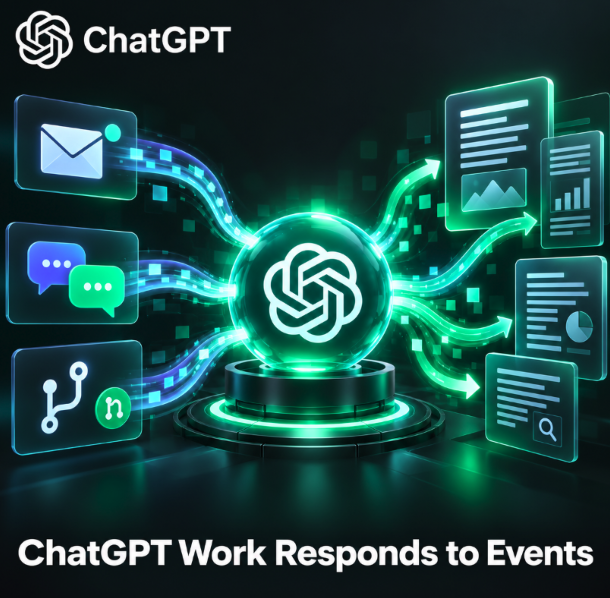
ChatGPT Work can start a task when a supported event occurs in a connected app. For SEO teams, that opens a possible path from an incoming alert or development update to a focused investigation, without waiting for the next scheduled check. The opportunity depends on the supported event, the task’s conditions and the access available to the account.
What the official documentation confirms
OpenAI’s Work and Codex documentation lists new Gmail messages, new Slack channel messages and GitHub pull request activity in an authorized repository as supported event examples. Eligible Plus, Pro, Business, Enterprise, Edu and ChatGPT for Healthcare users can create these webhook-based tasks; Free, Go and FedRAMP workspaces are excluded.
Triggers and conditions can be created or edited on web and supported mobile apps. Desktop can display existing tasks but cannot edit their trigger conditions. Slack monitoring requires adding ChatGPT to the relevant channels. Enterprise, Edu and Healthcare administrators must enable the feature. Healthcare event tasks are outside the BAA and must not process protected health information.
Eligible cloud tasks can also be shared. Recipients schedule separate copies using their own access and app connections; sharing does not transfer the creator’s credentials or history. Availability and existing permissions still apply.
From a timer to a specific signal
Our editorial interpretation is that event triggers can make monitoring more closely aligned with the work that needs attention. A scheduled review asks what changed since the last run. A triggered review begins with a particular signal and asks whether it warrants investigation.
For example, an SEO alert arriving by email could start a task that summarizes the reported change and prepares questions for review. A relevant pull request could prompt examination of proposed changes to page templates. These are proposed workflows, not prebuilt SEO features announced by OpenAI. They require a supported connection, suitable instructions and sufficient access.
A trigger is not a diagnosis
An incoming message does not prove a search problem, and a pull request does not prove that a change has reached a live website. Task instructions should preserve those distinctions. The agent can examine available evidence and describe uncertainty instead of treating the event itself as a verified incident.
Define which signals matter and what result the task should produce. A useful output might be a concise evidence summary, affected URLs when available and recommended checks. This keeps the work focused and helps a reviewer assess whether action is justified.
Conditions help control irrelevant work
A shared channel may contain routine discussion as well as meaningful alerts. A repository may contain changes unrelated to search visibility. Conditions can narrow the intended workflow, while the prompt explains how to handle an event that lacks enough information.
Our recommendation is to start with a limited, observable task and evaluate the results. Track whether the output is useful, whether it repeats work already completed and whether it identifies gaps in its evidence. Event-driven operation does not by itself guarantee faster resolution or better SEO outcomes.
Sharing supports repeatable monitoring practices
The separate-copy model gives teams a way to reuse a task definition while keeping execution tied to each recipient’s own access. A shared instruction should explain its expected inputs and outcome clearly enough for another team member to review before scheduling it.
This can support consistent investigation practices, but it does not establish a jointly running agent with shared history. Teams still need to decide who owns the resulting review and how findings fit into their existing workflow.
The implication for SEO and AI Search
The documented change broadens how Work begins a task. For SEO and AI Search operations, its value lies in connecting supported signals to useful research and review. It does not mean every ticket, site edit or ranking movement automatically becomes a trigger. Build around the events actually available, then judge the workflow by the quality of its evidence and the decisions it helps people make.