

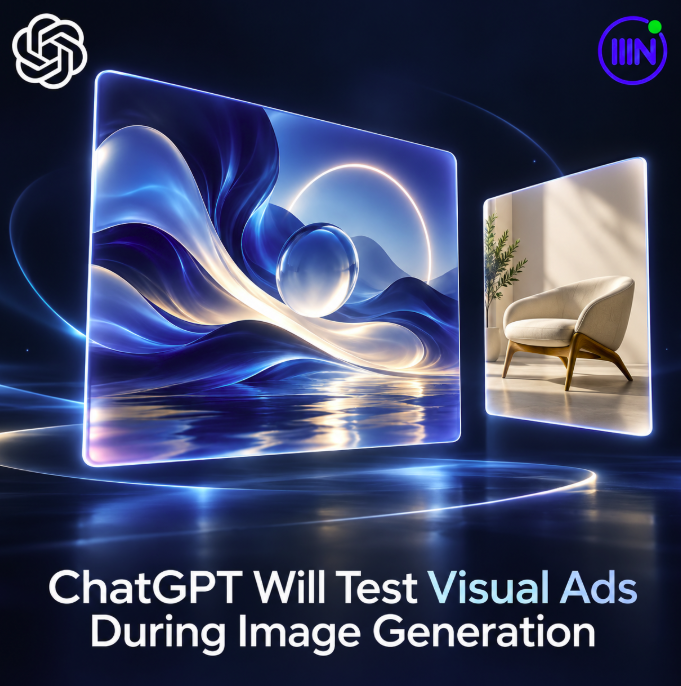

OpenAI will test a visual advertising format during image generation in ChatGPT, starting later in October 2026 in the United States with an initial group of advertisers. The announcement creates a prospective paid discovery opportunity within a creative workflow, beyond the conventional search-results page.
The status matters: OpenAI announced the test on October 5, but did not say that this placement was already broadly available. For SEO and AI Search teams, the immediate task is to understand the proposed surface and its boundaries before assuming a new source of traffic or competition.
Ads alongside image creation
In its official announcement, OpenAI describes visual ads intended to show product inspiration, usage and experiences. It says the advertisements will be clearly labelled and separate from the image being created. Advertising will not influence ChatGPT’s answers, according to the company.
The distinction is important for interpreting visibility. A paid placement displayed during a creative task is different from a product appearing inside a generated image or being recommended in an answer. The announcement does not establish paid product insertion into the image itself.
A creative task can become a discovery moment
The editorial implication is that an advertiser could reach someone while they are visualising an idea, rather than only after an explicit shopping query. That may make visual explanation valuable: an image can communicate an offering’s use or character before a visitor reaches a merchant page.
However, the announced context does not demonstrate purchase intent for every image-generation session. A person creating an illustration, experimenting with a concept or preparing a presentation may have very different goals. Marketers should evaluate relevance to the task instead of treating the entire surface as a shopping audience.
For a furniture brand, for example, a creative showing a chair in a room might communicate a use case more clearly than an isolated product photograph. This is a hypothetical creative strategy, not a confirmed targeting option or a forecast of campaign performance.
Keep paid exposure separate from organic visibility
AI visibility audits should record how a brand appears. An advertisement, an answer mention, a source citation and a generated visual are different observations with different explanations. Combining them into one presence score could obscure whether a campaign bought exposure or the assistant surfaced a source independently.
A useful audit would preserve the task, the observed placement and any visible advertising label. It should also note the date and access conditions, because a limited US test does not establish availability elsewhere. Comparisons need equivalent contexts before changes can be interpreted confidently.
Measure the new format on its own evidence
The wider announcement also discusses measurement partnerships, including work on attribution and early incrementality experiments. Those developments should not be read as performance evidence for a visual format whose test has yet to begin.
Advertisers evaluating access can prepare consistent creative and landing-page information, then determine what reporting is actually available for their campaign. Referral attribution may describe a path to a purchase; a causal claim about additional purchases requires a stronger experiment.
For publishers and brands, the announcement is a reason to expand the map of discovery surfaces they monitor. It is not yet evidence that image-generation ads reduce organic referrals or change citation selection. The useful next step is to observe the test, identify the paid placement accurately and assess its results against the audience and objective it actually reaches.