

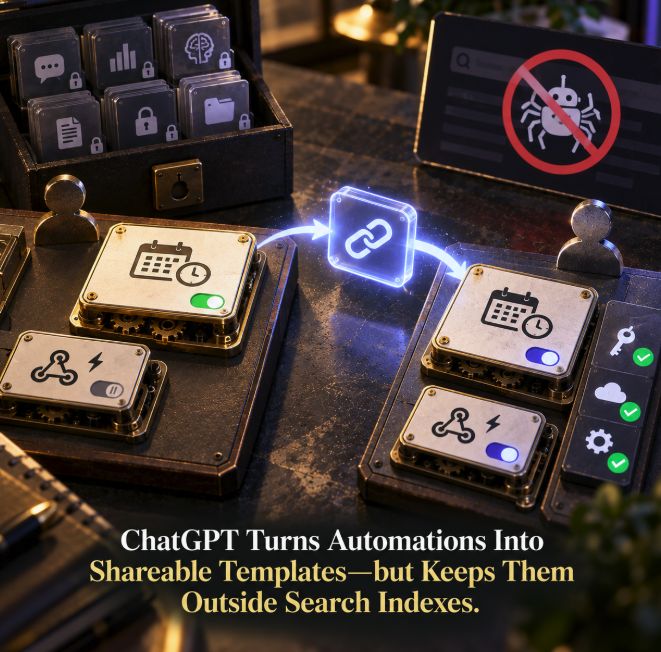

ChatGPT automations can now behave like shareable templates. OpenAI has expanded its shared-link system so eligible users can distribute active or paused scheduled tasks through a link, allowing another eligible user to create an independent copy in their own account rather than rebuilding the automation from scratch.
The capability is documented in OpenAI’s updated guide to sharing conversations and scheduled tasks. Scheduled-task sharing is available to eligible users across ChatGPT plans, explicitly including Free and Go, although the ability to reproduce a particular task still depends on the recipient’s plan, capacity, workspace permissions and connected-app access.
The model is deliberately closer to copying a recipe than sharing a running process. The link exposes the task’s title, full instructions, schedule and original time zone, but it does not hand over the creator’s chat history, previous task results, memories, custom instructions, files, connected-app data or credentials.
The recipient creates a separate automation
When an eligible recipient schedules a shared task, ChatGPT creates a new task in that person’s account. OpenAI says the copy uses the recipient’s own account, app connections and workspace permissions.
That separation is fundamental to the feature. The recipient is not remotely controlling the creator’s automation and is not inheriting the creator’s authenticated sessions. The shared link provides the task definition needed to reproduce the workflow, while execution is rebuilt around the recipient’s own environment.
Deleting the original task later does not delete copies that other people have already created. Likewise, removing the shared link prevents future access through that URL but does not reach into another user’s account and remove an automation they already saved.
The shared object contains the instructions and schedule
OpenAI says a shared scheduled-task page includes the task title, its complete instructions, schedule and original time zone. Depending on the task and what the recipient has access to, the copy may also preserve a selected ChatGPT mode or model.
This makes the link materially different from a screenshot or a short description of an automation. It contains enough of the task configuration for ChatGPT to reproduce the scheduled workflow for another user, subject to that user’s capabilities.
The creator can also update the shared snapshot. Opening the task in Scheduled, selecting Share and copying the link again refreshes the content available at the same URL. Importantly, that update does not retroactively change a task that another person has already scheduled from an earlier version.
Active and paused tasks can be shared
The feature applies to eligible scheduled tasks that are active or paused. Completed tasks cannot be newly shared, according to OpenAI’s documentation.
That distinction reinforces the template model: the shared object represents a task configuration that can still be scheduled, rather than a historical record of a completed automation.
Tasks that run only on a computer also cannot be scheduled from a shared link, creating another boundary around what can be replicated through the system.
Webhook automations are included—but their requirements are stricter
OpenAI explicitly includes event-triggered, webhook-based tasks among the eligible task types that can be shared. These automations can respond to supported events from connected services and run through ChatGPT Work.
However, sharing a webhook task and being able to recreate it are not the same thing. OpenAI’s Scheduled tasks documentation says event-triggered tasks require Work and an eligible Plus, Pro, Business, Enterprise, Edu or Healthcare account. Free and Go accounts cannot create event-triggered tasks.
So the statement that task sharing includes Free and Go should not be read as meaning those plans can reproduce every webhook automation. A recipient must independently satisfy the requirements of the task being copied.
Connected apps are re-authorized on the recipient’s side
For an event-triggered shared task, the recipient needs their own connected app. In managed workspaces, the necessary Work and task-sharing permissions must also be enabled.
This prevents the shared link from becoming a credential-transfer mechanism. If a task depends on Gmail, Slack, GitHub or another supported connected service, the recipient must connect and authorize their own account rather than inheriting the creator’s connection.
The architecture therefore separates reusable automation logic from private authentication state.
The creator’s history and personal context stay out of the template
OpenAI provides a detailed exclusion list for shared scheduled tasks. The shared version does not include the creator’s profile name, chat history, previous task results, saved memories, custom instructions, uploaded or local files, connected-app data or connected-app credentials.
That means the instructions themselves need to be reviewed carefully before sharing, because anything explicitly written into the task title or instructions can still be visible. The privacy boundary protects surrounding account context; it does not automatically redact sensitive information that the creator manually placed inside the shared task definition.
OpenAI specifically advises users not to include passwords, account numbers, financial information, health information or other sensitive personal data in shared content.
Sharing an automation does not share its execution history
The exclusion of previous results is particularly important. A task that has run for weeks may have accumulated useful outputs, but those outputs are not bundled into the shared template.
The recipient starts with the configuration, not the creator’s operational history. Their copy will generate its own future results under their own account and permissions.
That makes shared tasks easier to distribute as reusable workflows without automatically exposing the creator’s prior activity.
Free and Go broaden distribution, but capability still matters
OpenAI says scheduled-task sharing is available to eligible users across ChatGPT plans, including Free and Go. This significantly widens the potential audience for reusable task templates.
But eligibility remains conditional. Before scheduling a shared task, the recipient must sign in, have access to scheduled tasks, have available task capacity and satisfy any workspace or connected-app permissions the automation requires.
A share link therefore does not override plan limits or administrator controls. It transfers the task definition into an environment that must independently support it.
Personal-account links are effectively bearer links
For personal accounts, anyone who has the shared link can view the shared scheduled task. OpenAI does not currently offer recipient-by-recipient access controls for these links, nor can users configure an expiration date.
That makes distribution simple but places responsibility on the creator to control where the URL is sent. If access is no longer appropriate, the creator can delete the shared link.
Removing the link stops future access through it, but it cannot revoke copies that recipients have already created in their own accounts.
Managed workspaces impose a tighter boundary
Links created inside eligible Business, Enterprise, Edu or Healthcare workspaces are restricted to eligible members of the originating workspace. People outside that workspace cannot open the shared content.
Enterprise and Edu administrators can also manage the permission to share chats and scheduled tasks. Event-triggered scheduled tasks have an additional Work permission, which OpenAI says is disabled by default in Enterprise, Edu and Healthcare workspaces.
The sharing model is therefore not identical between a personal account and a managed organization. Personal links prioritize easy distribution, while managed-workspace links preserve organizational boundaries and administrative controls.
OpenAI says these pages are not intended for search-engine indexing
One of the most interesting details for publishers and SEO professionals appears in the FAQ. OpenAI says shared-link pages are not intended for search-engine indexing.
That is an explicit design distinction between shareability and public discoverability. A task can be passed around through its URL without being designed as a document that Google, Bing or other search engines should surface in ordinary search results.
OpenAI also cautions that non-indexing does not make the link private. Anyone who can access a personal-account link can forward it to somebody else.
Shareable does not mean searchable
This distinction matters because public links are often assumed to be part of the indexable web. OpenAI is defining a different category: a URL-addressable object intended for direct sharing rather than organic discovery.
For automation creators, that means shared-task distribution is likely to depend on channels outside search engines — direct messages, communities, documentation, newsletters, social posts or other pages that point users to the template.
The shared automation itself is not positioned as an SEO landing page.
The feature creates a new distribution layer for ChatGPT workflows
Until now, reproducing someone else’s ChatGPT automation could require copying a prompt, reconstructing a schedule and separately configuring any necessary tools or apps. Shared tasks package the reusable portion of that setup into a link.
A creator can design a useful recurring workflow, share it, and let recipients instantiate independent versions with their own accounts and permissions. That begins to make automations portable between users without turning them into centralized services operated by the original creator.
The pattern resembles templates in productivity software: copy the structure, then populate it with your own data and integrations.
Webhook sharing makes the template concept more powerful
Scheduled reminders are the simplest example, but event-triggered tasks push the model further. An automation that reacts to an eligible event can encode not just a schedule but a reusable operational workflow.
Because the recipient reconnects their own apps, the same task logic can be replicated across separate environments without sharing credentials. That makes a well-designed automation potentially reusable by teams, clients or communities with similar workflows.
Availability constraints remain important, especially because webhook tasks require Work and are not available for creation on Free or Go. But the sharing mechanism now provides a distribution path for them.
Copies remain independent after installation
OpenAI’s documentation makes clear that the creator does not retain centralized control over copies already scheduled by recipients. Refreshing the shared snapshot updates what future visitors see at the link but does not modify previously installed copies.
This has an important consequence for automation maintenance. A creator who improves instructions or changes the schedule cannot assume every existing recipient automatically receives the update.
Shared tasks therefore behave more like forkable templates than remotely managed applications.
Automation discovery may happen outside search engines
The combination of shareable templates and deliberate non-indexing creates an unusual distribution model. ChatGPT now has an object that can be copied between accounts through a URL, yet OpenAI says the URL is not intended to become part of search-engine indexes.
That may encourage a surrounding ecosystem in which websites, communities and creators publish descriptions of useful automations while the actual ChatGPT task link functions as the installation endpoint.
In that model, the indexable object is the editorial or documentation page explaining the workflow; the shared ChatGPT page is the handoff that lets the user create their own copy.
ChatGPT automations are becoming portable without becoming public search documents
OpenAI’s update establishes a clear architecture for reusable automations. Eligible active and paused scheduled tasks can be shared, including webhook-based tasks. Recipients create independent copies under their own accounts, permissions and connected apps. The creator’s history, previous results, memories, files and credentials stay outside the shared object.
At the same time, OpenAI draws a boundary around discoverability: shared-link pages are not intended for search-engine indexing, even though anyone with an accessible personal-account link may forward it.
ChatGPT automations are therefore becoming shareable templates, not search-indexed public artifacts. The workflow can travel between users, but the recipient supplies the identity, permissions, integrations and execution environment that make the copied automation their own.