

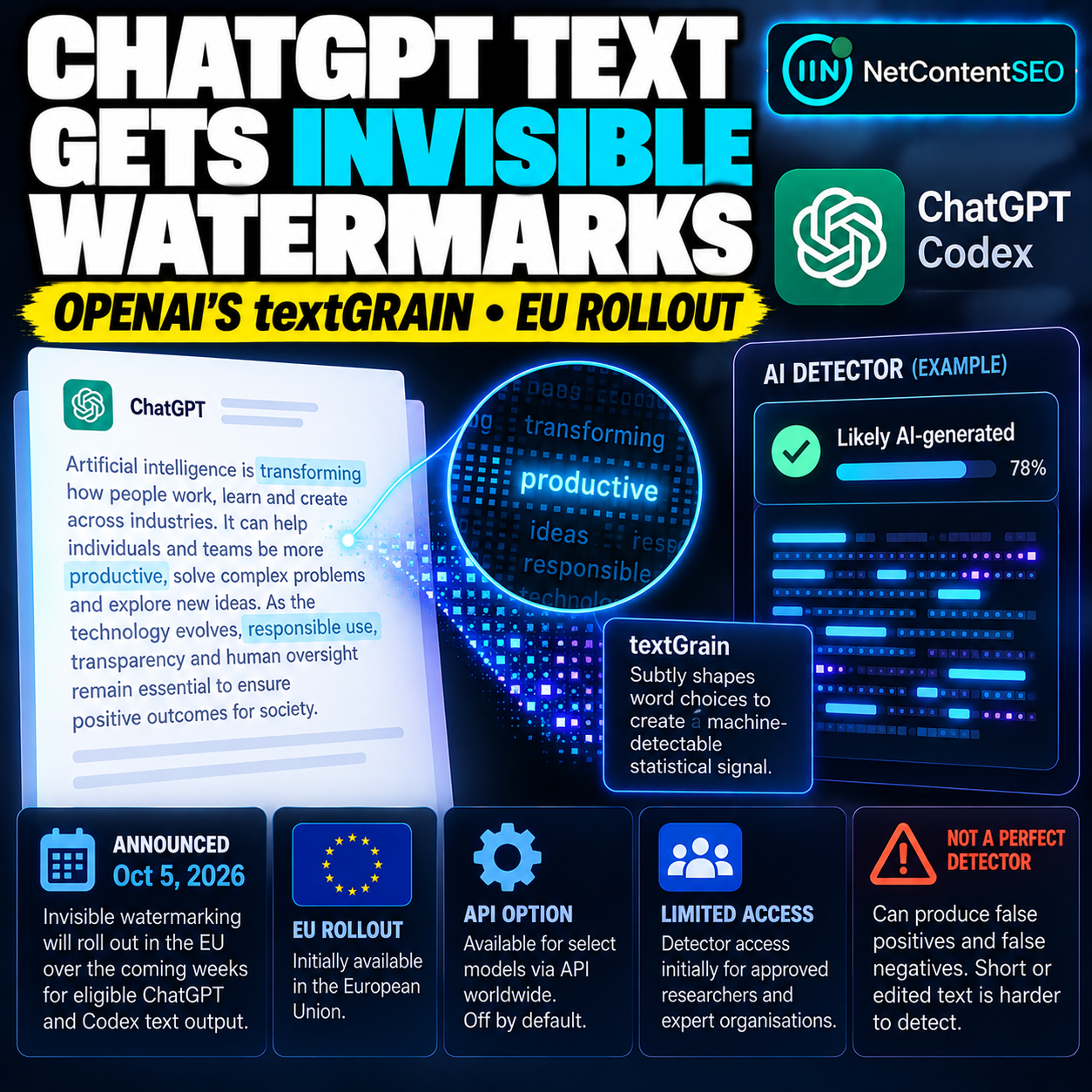

OpenAI has announced plans to add invisible statistical watermarks to eligible ChatGPT and Codex text generated in the European Union, as part of its response to the EU AI Act's transparency requirements. The technology, called textGrain, subtly changes the statistical pattern of word and token choices so a specialised detector can look for a signal associated with OpenAI-generated text. The watermark is not visible to readers and does not insert hidden characters or unusual spaces.
OpenAI's announcement, published on October 5, 2026, describes a phased rollout: watermarking will be introduced to eligible ChatGPT and Codex text in the EU over the coming weeks. Separately, API customers worldwide can opt in for selected models; API text watermarking remains off by default. Access to the text detector is initially restricted to approved researchers and expert organisations.
What is changing in ChatGPT text?
Unlike an image watermark or a metadata record attached to a file, textGrain works through the model's choices between plausible words or word pieces as it generates a passage. Across enough text, those choices create a statistical pattern that a detector with the corresponding settings can test for.
The text itself looks ordinary. OpenAI says the method does not add hidden characters, invisible spaces or watermark-only tokens. The signal is embedded in the wording's statistical pattern, rather than inserted as a separate visible or copyable marker.
Where and when will watermarks apply?
- ChatGPT and Codex in the EU: OpenAI says it will add invisible watermarks to eligible text outputs over the coming weeks, across plans in the EU.
- OpenAI API: customers globally can opt in to text watermarking for selected models. It is off by default and can be enabled in project or organisation settings.
- Text detector: access is initially available only to approved researchers and expert organisations, with applications assessed case by case.
- Other distribution channels: OpenAI says it is working with cloud and distribution partners to extend provenance signals to eligible outputs; availability may vary by partner and output.
The announcement does not say that every ChatGPT text output worldwide is already watermarked. The consumer rollout is regional and phased, while API watermarking is opt-in.
Why OpenAI is introducing textGrain
The EU AI Act requires providers of generative AI systems to make generated text identifiable in a machine-readable way. OpenAI says its approach is intended to support that transparency obligation and the EU Code of Practice on the Transparency of AI-Generated Content.
Watermarking is one signal of provenance, not a complete record of authorship. A detected watermark can indicate that an OpenAI model likely generated or processed some text, but it does not establish who wrote it, how much a person contributed, who owns it or whether a disclosure was legally required in a particular situation.
How reliable is the watermark?
OpenAI stresses that text watermarking and detection remain early technologies with important limitations. Detection depends on the amount and type of text, how much freedom the model has to choose wording, and whether the passage has been edited.
In OpenAI's reported evaluations, detection was stronger for longer passages with flexible wording than for short or highly constrained text. At a target false-positive rate of 1%, the detector identified watermarks in about 80% of 200-token passages and about 95% of 400-token passages for content such as psychology. Results were substantially lower for mathematics, where there is less flexibility in word choice.
Editing can also weaken the signal. In one evaluation of 400-token passages, replacing 10% of words with synonyms reduced detection from about 92% to 66%; replacing 25% reduced it to 17%. These are results from OpenAI's own evaluations, not a guarantee of real-world performance for every language, topic or text length.
What a watermark can—and cannot—prove
- It can provide a provenance signal: when detected reliably, it is evidence that an OpenAI model likely generated or processed the text.
- It does not identify a user: OpenAI says the detector will not reveal the user or their prompts and conversations.
- It does not measure the amount of AI assistance: a detected signal does not show whether the model wrote the entire passage or assisted with part of it.
- It is not infallible: false positives and false negatives are possible, and editing, paraphrasing or translation can make detection less reliable.
- It does not replace disclosure: watermarking is a machine-readable provenance signal, not a substitute for visible labels or other notices that may be required.
Will text watermarking affect answer quality or speed?
OpenAI says its evaluations did not show meaningful performance differences with and without watermarking across the benchmarks it uses for its latest frontier model. It also reports negligible impact on model speed. These findings reflect OpenAI's own testing; they do not mean every possible prompt or workload has been independently evaluated.
What this means for publishers, educators and SEO teams
Text watermarking could provide another signal when assessing whether text may have been generated or processed by an OpenAI model. But it should not be treated as a universal AI detector or used alone to make high-stakes decisions about a writer, student or publisher.
- Keep evidence proportional: do not infer authorship, intent or misconduct from a detector result alone.
- Preserve context: retain source drafts, revision history and other evidence when provenance matters.
- Expect incomplete coverage: short passages, constrained text, unsupported models and text created before rollout may not contain a detectable watermark.
- Do not confuse watermarking with SEO policy: the announcement concerns provenance and transparency, not a new Google ranking signal or a guarantee that AI-generated content will rank differently.
- Follow regional and product scope: eligible ChatGPT and Codex text in the EU is being rolled out in phases; API customers must opt in for supported models.
Frequently asked questions
Will all ChatGPT answers have invisible watermarks?
No. OpenAI says it will roll out watermarking to eligible ChatGPT and Codex text in the EU over the coming weeks. It is not announcing a global default for all ChatGPT outputs.
Can API users enable text watermarking?
Yes. API customers worldwide can opt in for selected models through project or organisation settings. It remains off by default.
Can anyone use the detector?
Not initially. OpenAI is limiting access to approved researchers and expert organisations to help evaluate and improve the technology.
Does the watermark add hidden characters or spaces?
No. OpenAI says textGrain changes the statistical pattern of word choices; it does not insert hidden characters, invisible spaces or special watermark tokens.
Can a detector prove that someone cheated or that an entire article was AI-written?
No. A watermark is a provenance signal, not a complete authorship record. Detection can miss watermarked text or report a false positive, and it does not reveal how much a person contributed.
The takeaway
OpenAI is introducing textGrain, an invisible statistical watermark for eligible ChatGPT and Codex text in the EU, while giving API customers worldwide an opt-in option for selected models. The move responds to AI transparency requirements, but the technology has meaningful limits: detection varies by length and subject, editing can weaken the signal, and access to the detector is restricted during evaluation. A watermark can contribute evidence about provenance, but it cannot by itself establish authorship or misconduct.
Sources
OpenAI — Our approach to EU text provenance rules (October 5, 2026); OpenAI Help Center — Provenance signals in OpenAI-generated content; Yahoo News UK — ChatGPT texts receive invisible watermarks.