

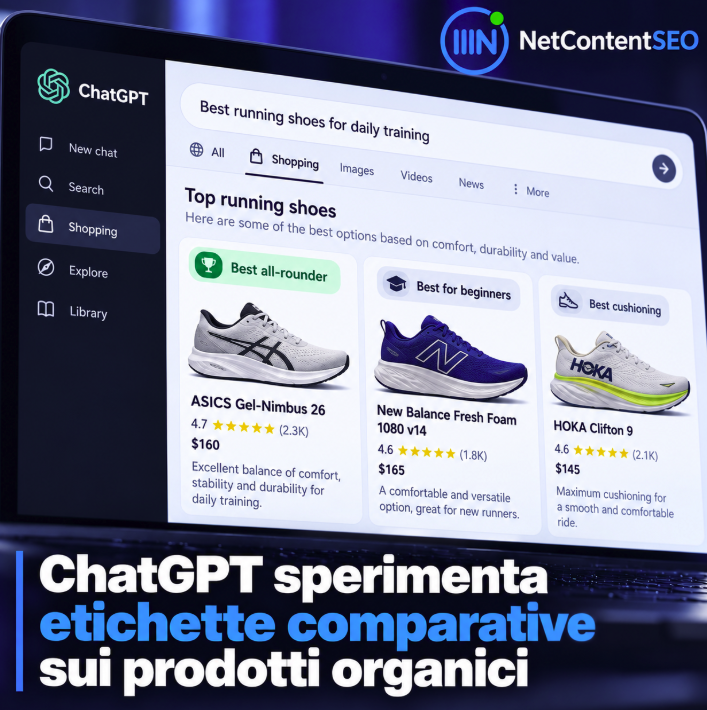

ChatGPT appears to be testing a new classification layer in organic shopping results: highlighted comparative labels that explain why a particular product may be a strong fit for a specific type of buyer or use case.
The observed interface includes labels such as “best all-rounder,” “best for beginners” and “best cushioning,” presented as prominent green or gray badges above individual products. The test was observed on October 6, 2026 and has not been confirmed by OpenAI as a permanent or broadly released shopping feature.
From product citations to product classification
This is more significant than a cosmetic badge experiment. Traditional product visibility in AI answers has largely focused on whether a brand or product is mentioned, cited or included in a recommendation set. Comparative labels introduce another layer: the model is not simply retrieving a product but assigning it a role inside the recommendation.
A product described as the “best all-rounder” occupies a different semantic position from one classified as “best for beginners.” The first suggests broad suitability; the second associates the product with a specific audience. In both cases, ChatGPT is potentially converting product attributes, reviews and contextual evidence into a concise commercial judgment.
The new GEO question: why does a product earn a “best for” badge?
For ecommerce SEO and GEO teams, the important question becomes how those classifications are formed. If this interface expands, product optimization will not be limited to achieving inclusion in an AI shopping response. Brands will also want their products to be associated with desirable use cases and buyer segments.
That means product information needs to communicate more than generic quality. Structured specifications, clear audience positioning, comparison data, expert reviews, retailer descriptions and consistent third-party evidence can all help AI systems understand what differentiates one product from another.
Category-level entities become more important
Comparative shopping answers require a model to understand relationships between products within a category. A running shoe might be associated with cushioning, stability, beginner suitability, racing or everyday training. A laptop could be classified around battery life, gaming, portability or professional workflows.
These associations are effectively entity attributes. The stronger and more consistent the evidence across trusted sources, the easier it becomes for an AI system to connect a product with a specific need.
Organic shopping visibility may become more competitive
A conventional list of products gives several brands roughly comparable visual exposure. A recommendation interface with explicit “best” labels creates hierarchy. Even when multiple products appear organically, the badge can direct attention toward a particular option and provide an immediate reason to prefer it.
That could make classification visibility as important as citation visibility. Being present in the answer is valuable; being presented as the strongest option for the user's exact intent may be considerably more valuable.
What brands should monitor
Because this is an observed test rather than a confirmed OpenAI rollout, brands should avoid treating the current labels as a fixed ranking system. The useful approach is to monitor which products receive comparative labels, which wording appears, what queries trigger them and which sources consistently support those products.
For AI visibility research, this creates a new measurement opportunity: track not only whether a product appears in ChatGPT shopping results, but also the qualitative role assigned to it.
The evolution is subtle but important. AI shopping discovery is moving beyond citations toward classifications. If “best for” labels become a stable part of the experience, ecommerce GEO will increasingly be about earning the right association—not merely earning a mention.