

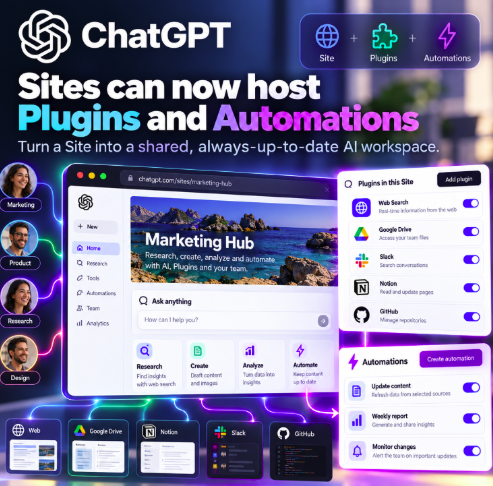

OpenAI is turning ChatGPT Sites into more active shared workspaces by allowing Sites to host Plugins and automations directly.
Announced on September 29, 2026, the feature lets a Site include Plugins that colleagues can use while retaining their own data access and permissions. Automations can also keep shared information updated, moving Sites beyond static collections of content toward continuously refreshed AI workspaces.
Plugins can live inside a shared Site
The key change is that a Site can become a common interface for tools used by a team. Instead of every colleague separately assembling the same workflow, a Site can expose relevant Plugins in the context where the work happens.
Individual permissions still matter. Team members can interact with embedded Plugins using the data and access rights available to them, helping preserve user-level controls even when the surrounding Site is shared.
Automations add a persistent update layer
Automations make the model more interesting from an information-discovery perspective. A shared Site no longer needs to depend entirely on someone manually refreshing its content. Automated processes can update information as underlying sources or workflows change.
This creates a structure closer to an agentic hub: a persistent destination containing information, tools and processes that can continue operating between individual user interactions.
Why this matters for enterprise AI
For organizations, one of the persistent problems with AI adoption is fragmentation. Useful prompts, tools, documents and workflows can become scattered across individual chats or personal setups.
Embedding Plugins and automations into Sites provides a way to package those capabilities around a shared purpose: research, marketing, support, product work, internal knowledge or other recurring team activities.
A new kind of information surface
For AI visibility researchers, Sites also represent an emerging information layer that differs from the open web. Information can be assembled from multiple connected sources, refreshed automatically and exposed through tools that operate under individual permissions.
That means an AI system's answer may increasingly depend on a combination of public web retrieval, private connected data, Plugin behavior and continuously maintained workspace context.
The NetContentSEO view
The evolution of Sites suggests that AI discovery is moving beyond documents and pages toward living information environments. A Site can provide context, Plugins can perform actions or retrieve data, and automations can keep the environment current.
For publishers, SEO teams and AI visibility researchers, this is another reminder that the retrieval landscape is expanding. The systems deciding what information reaches an AI answer increasingly include platform-native workspaces and connected tools alongside traditional search indexes.