

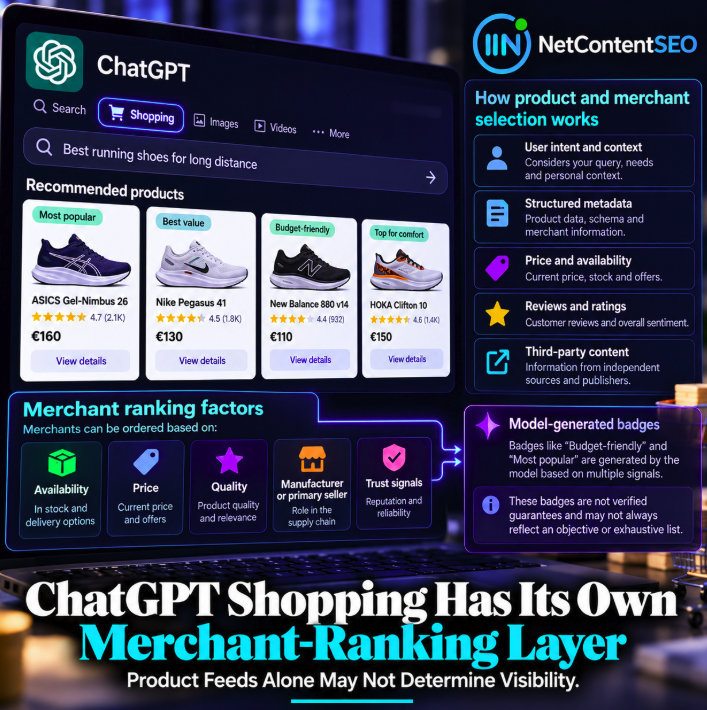
Getting product data into ChatGPT is only one part of shopping visibility.
OpenAI's official Shopping with ChatGPT Search documentation now provides a clearer picture of what happens after product information becomes available to the system: ChatGPT independently decides which products are relevant to the user's request and can then apply a separate ranking process when multiple merchants sell the same item.
For ecommerce teams, that creates at least two distinct visibility problems: product selection and merchant selection.
ChatGPT first decides whether a product is relevant
OpenAI says a product can appear when ChatGPT considers it relevant to the user's shopping intent.
The system considers the current query together with available context, which can include information from Memory or Custom Instructions.
That makes product visibility contextual rather than purely catalog-based. A product that fits one user's constraints may be excluded for another user asking a superficially similar question.
Structured product data matters, but it is not the whole system
OpenAI says product selection can consider structured metadata from first-party and third-party providers, including information such as product descriptions and prices.
It can also consider other third-party content and model responses generated before new search results are evaluated.
OpenAI's safety standards and product policies are another input.
The implication is important: a direct feed can improve the freshness and completeness of product information, but the feed itself does not function as a guaranteed placement mechanism.
User intent changes the weighting of signals
OpenAI gives a simple example: if a shopper explicitly states a $30 budget, price becomes more important. If price is not mentioned, other attributes may carry more weight.
ChatGPT may also use contextual preferences to exclude otherwise relevant options.
For AI commerce optimization, this means there is no single static “best product” independent of the task. Visibility depends on how well the product matches the user's expressed and contextual needs.
Reviews and third-party information can influence the product layer
OpenAI's documentation makes clear that product selection is not limited to merchant-supplied fields.
ChatGPT can use public reviews and third-party information when forming shopping results and summaries.
This expands ecommerce visibility beyond traditional feed optimization. The information ecosystem surrounding a product — reviews, independent coverage and other public descriptions — can contribute context that the model uses to interpret the product.
Product labels are model-generated, not verified awards
ChatGPT can display labels such as “Budget-friendly” or “Most popular.”
OpenAI explicitly says these labels are generated by ChatGPT from information available to the model, which may include third-party data.
They are not guarantees or verified statements and may not represent an exhaustive view of the market.
A “Budget-friendly” label, for example, does not necessarily mean the product has the lowest available price. It could reflect reviewers frequently describing the product as good value.
Review summaries are also generated by the model
ChatGPT may summarize reviews from public websites to highlight common positive and negative themes.
OpenAI notes that those reviews and ratings are not verified by OpenAI.
Brands therefore need to distinguish between factual merchant-supplied product attributes and synthesized descriptions or sentiment derived from public sources.
Then comes a second layer: merchant ranking
When a user opens a product that is sold by multiple merchants, ChatGPT can show a list of sellers offering that item.
OpenAI says this merchant list is generated using merchant and product metadata supplied either directly by merchants or through third-party providers.
The merchants can then be ranked using factors including availability, price, quality and whether the seller is the product's maker or primary seller.
This is effectively a merchant-selection layer sitting beneath the initial product recommendation.
The first merchant is not necessarily the cheapest
OpenAI says the price shown in ChatGPT's initial product response generally reflects the first listed merchant and may not be the lowest available price.
On the product detail page and in merchant rankings, ChatGPT attempts to highlight the lowest-priced option it knows about.
When several merchants offer the product, that option may receive a “Best price” label, although another applicable label such as Instant Checkout can affect which badge is displayed.
Price freshness can affect what users see
OpenAI also acknowledges that changes to merchant prices or shipping terms may take time to propagate into ChatGPT.
The company says it is working on faster methods for updating this information.
For merchants, freshness is therefore operationally important. A technically correct product feed that is stale at the moment of recommendation can still create a weaker or inaccurate shopping experience.
Manufacturer and primary-seller status are explicit merchant signals
One particularly interesting detail is OpenAI's explicit reference to whether a merchant is the maker or primary seller of an item.
That means merchant ranking is not described as a simple price sort.
Seller role and product relationship can be part of the ordering alongside price, availability and quality.
For manufacturers selling direct, that potentially creates a different visibility profile from an undifferentiated reseller offering the same SKU.
Direct feeds improve data access, not guaranteed ranking
OpenAI invites eligible merchants to provide direct product feeds so ChatGPT can reflect more current product information.
That is valuable for product discovery and data freshness.
But OpenAI's own documentation describes selection and merchant ordering as separate model-driven processes. A direct feed should therefore not be interpreted as a guarantee that a product will be surfaced or that a merchant will rank first.
Shopify has a special data integration
OpenAI says product information for Shopify merchants is already integrated through Shopify Catalog, helping products appear more accurately and completely in relevant conversations.
Individual Shopify merchants do not need additional work for that catalog integration.
Again, however, data availability and ranking are different questions. Catalog integration gives ChatGPT product information; relevance and merchant-selection logic determine how that information is used.
Shopping results are organic, not ads
OpenAI states that ChatGPT product results are selected independently, are not advertisements and are not influenced by OpenAI partnerships.
Ads, where present, are separate from organic product results.
That distinction makes the merchant-ranking documentation particularly important for ecommerce SEO: organic shopping visibility inside ChatGPT has its own selection logic rather than being described as a paid placement auction.
What ecommerce teams should optimize
The documentation suggests a broader AI-shopping optimization stack.
First, maintain complete, accurate and fresh product metadata: identifiers, descriptions, prices, stock and merchant information.
Second, make product differentiation explicit enough for the system to understand which user needs the item satisfies.
Third, monitor the public information environment around important products, including reviews and independent coverage.
Fourth, treat merchant-level competitiveness — availability, price, quality and seller identity — as a separate visibility problem from product inclusion.
Product visibility and merchant visibility should be measured separately
A brand can win the product recommendation but lose the merchant selection.
For example, ChatGPT might recommend a manufacturer's product but present another retailer as the more attractive seller for a particular user.
Conversely, a retailer may be highly competitive at the merchant layer without having any influence over which product ChatGPT recommends first.
AI commerce reporting therefore needs to distinguish at least three states: whether the product appears, how the product is characterized and which merchant receives the preferred selling position.
Feeds are becoming infrastructure, not the complete optimization strategy
Traditional shopping optimization has often concentrated heavily on feed quality because feeds determine what search and advertising systems know about inventory.
ChatGPT still needs reliable product data, but OpenAI's documentation describes a richer decision layer built around intent, context, third-party information and merchant characteristics.
That means feed optimization remains necessary while becoming less sufficient as a complete strategy.
NetContentSEO take
ChatGPT Shopping now has a clearly documented distinction between product relevance and merchant ranking.
The first layer decides which products make sense for the user's task using context, structured metadata and broader information. The second can decide how sellers of the same product are ordered using availability, price, quality and seller role.
For ecommerce SEO, that changes the optimization question from “Is my catalog available to the AI?” to two harder questions: Does the AI choose my product, and if it does, does it choose me as the merchant?
Product feeds are foundational. But OpenAI's own documentation shows that visibility does not end with the feed.