

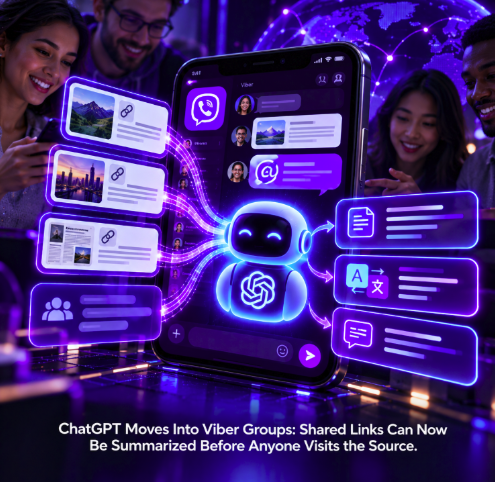

ChatGPT is moving into another layer of the discovery journey: the group conversation where people exchange links before deciding whether to open them. An official integration between OpenAI and Rakuten Viber lets supported users summarize shared links and unread group messages, translate content, invoke ChatGPT inside chats and open a dedicated ChatGPT conversation without leaving Viber.
OpenAI documents the integration in its official Using ChatGPT in Viber guide. The Help Center page confirms that ChatGPT-powered features are available through an integration between Viber and OpenAI, although availability varies by region, Viber app version, account and chat type. OpenAI does not identify a release date in the documentation, so the September 27 observation should be treated as a detection date rather than a launch date. citeturn0search1
For publishers, the most consequential feature is deceptively simple: a link shared in a Viber conversation can be summarized by ChatGPT. The recipient can therefore consume an AI-mediated representation of the source before deciding whether the original page deserves a visit. citeturn0search1
The link preview is becoming an answer layer
Messaging apps have long shaped referral traffic. A user finds an article, product or guide somewhere else, copies the URL into a private conversation or group, and recipients decide whether to click. The shared link traditionally acts as a gateway to the publisher’s page.
AI summaries alter that sequence. If the recipient can ask ChatGPT to summarize the shared URL inside Viber, some of the source’s informational value can be delivered before the click. The page remains the underlying source, but the first consumption event can happen inside the messaging interface.
This is structurally similar to the shift search publishers experienced when answer engines began synthesizing webpages directly in the results experience. The difference is location: the intermediary is now embedded in a private or group conversation rather than a search results page.
ChatGPT can summarize the conversation around the link as well
The integration is not limited to webpages. OpenAI says Viber can use ChatGPT to summarize unread messages in a group chat. That means the assistant can compress both the source being discussed and the conversation that accumulated around it. citeturn0search1
A user returning to a busy group could therefore receive a summary of what people said without reading every message, while also summarizing one of the URLs they shared. The AI becomes an interpretation layer over both external content and social context.
That is a meaningful expansion of discovery. The decision to visit a publisher can now be influenced not only by the headline, thumbnail and comments from friends, but by an AI-generated account of what the page contains.
@ChatGPT turns the group itself into an AI interface
OpenAI also confirms that users can mention @ChatGPT in supported private or group chats and receive a response directly inside the conversation. Responses generated in a group are visible to that group. citeturn0search1
This removes another context switch. Instead of copying a question into a separate AI app, users can bring the model into the conversation where the question arose.
From a discovery perspective, that means an informational need does not necessarily become a conventional search query. A discussion can produce an @mention, and the AI response can satisfy or reshape the need without the group leaving Viber.
Viber gets a dedicated ChatGPT conversation surface
The integration also includes a ChatGPT tab for direct conversations. OpenAI emphasizes that using ChatGPT inside Viber is not identical to using ChatGPT directly: Viber controls the precise features, limits and user interface exposed in its app. citeturn0search1
That distinction is important when measuring ChatGPT as a discovery channel. “ChatGPT traffic” increasingly describes multiple surfaces with different capabilities and interaction patterns rather than one application with one uniform journey.
A user can now encounter ChatGPT as a standalone product, as an agent inside other workflows, or as an embedded capability inside a messaging application. Each surface can alter the path between question, source and click.
Translation makes shared content portable across language boundaries
OpenAI lists message translation among the Viber integration’s supported capabilities. It also includes AI Polish for improving a draft message before sending and Image Remix for transforming images with prompts or preset styles. citeturn0search1
Translation is especially relevant to content distribution because group conversations frequently cross language boundaries. A shared article can circulate in a community whose members do not all use the source language, while AI helps mediate the surrounding discussion.
This does not guarantee that ChatGPT translates the full content of every linked page; OpenAI’s documentation separately identifies message translation and shared-link summarization. But together they show how the messaging layer is gaining tools that reduce friction around multilingual information exchange.
The integration receives the content needed to perform the feature
The privacy architecture is important because these features operate inside personal and group conversations. OpenAI says Viber sends it the information necessary to provide the requested ChatGPT-powered feature. Depending on the feature, that can include a message, draft, image, prompt, link content, messages containing an @ChatGPT mention, a Viber-generated hashed user ID, timestamps and approximate location such as country or city. citeturn0search1
That means link summarization is not merely a decorative UI feature. The content required for the summary is supplied into the OpenAI-powered workflow.
OpenAI advises users to treat information shared through these capabilities as information they are choosing to provide directly to ChatGPT, particularly when it contains sensitive or personal data. citeturn0search1
Training treatment differs between the ChatGPT tab and Viber chats
OpenAI makes a notable distinction in how data may be used. If a user links a ChatGPT account, conversations in Viber’s dedicated ChatGPT tab are stored in that account’s ChatGPT conversation history, can inform memory when memory is enabled, and may be used to improve OpenAI’s models when training is enabled in the user’s settings. citeturn0search1
Outside the dedicated ChatGPT-tab conversations, OpenAI says it does not use data sent from ChatGPT-powered features in Viber personal and group chats to train its models. Viber remains responsible for its own data handling, retention and permissions under its policies. citeturn0search1
For users and organizations, that distinction matters when deciding which surface to use for sensitive conversations.
Some users can access the AI features without linking a ChatGPT account
OpenAI says some ChatGPT-powered Viber features can be used without connecting a ChatGPT account. Viber can impose daily limits, and users may be prompted to connect or create a ChatGPT account when they reach those limits or want higher usage where supported. citeturn0search1
This lowers the distribution barrier for OpenAI. ChatGPT functionality can reach people through an application they already use, even before they establish a direct account relationship with ChatGPT.
For discovery ecosystems, embedded distribution matters because it increases the number of places where an AI-generated answer can intervene between a user and a source.
Publishers can influence a group conversation without receiving the first click
The Viber integration creates another example of a distinction NetContentSEO has been tracking across AI search: content can influence an AI-mediated interaction even when the publisher does not immediately receive a visit.
NetContentSEO explored that broader retrieval-versus-click dynamic in “Your Page Can Influence an AI Answer Without Receiving a Citation”. Viber introduces a social variation. A publisher’s URL can enter a private conversation, be summarized by ChatGPT and shape what the group understands before any participant opens the original source.
The value chain therefore becomes harder to measure with referral analytics alone. The URL may matter in the conversation even when the visit happens later—or never happens.
Private sharing becomes an AI-mediated discovery surface
Dark social has always been difficult to quantify because links move through private messages, groups and copied URLs without clean referral attribution. AI summaries add another invisible layer.
A publisher can observe a page view when someone opens the source, but it generally cannot see every private discussion in which the URL appeared. When ChatGPT summarizes the link inside Viber, the publisher also cannot infer from ordinary analytics how many recipients consumed that intermediate summary.
This means AI visibility measurement is expanding into surfaces where direct observation is structurally limited. Citation tracking on public answer engines captures only part of the picture.
Content extractability matters before the click
If users increasingly encounter AI summaries of shared links, publishers have another reason to make the central claim of a page clear, well-supported and easy to interpret. A confusing page can produce a confusing intermediate representation. A page whose essential facts are buried or poorly qualified can be harder for an AI system to summarize accurately.
This does not justify writing exclusively for machines. The source still needs to serve the person who eventually opens it. But clear structure, explicit claims, strong context and unambiguous sourcing become useful at multiple stages: search retrieval, AI summarization, social sharing and the final human visit.
The messaging app is becoming part of the answer engine
ChatGPT’s Viber integration illustrates a broader distribution shift. AI answers are moving out of dedicated search and chatbot interfaces and into the applications where conversations already happen.
For the user, this is convenient: summarize the URL, catch up on unread messages, translate a message or ask @ChatGPT without leaving the thread. For publishers, it creates another intermediary between distribution and destination. citeturn0search1
The important point is not that shared links will stop generating visits. OpenAI provides no evidence supporting such a universal claim, and the integration’s availability itself varies by region, account, Viber version and chat type. The more defensible conclusion is that a click is no longer required for a shared link to deliver some of its informational value inside a supported Viber conversation.
That changes the unit of social visibility. A successful piece of content can now be discovered, shared, summarized and discussed in an AI-assisted group before the publisher sees any conventional referral event at all.