

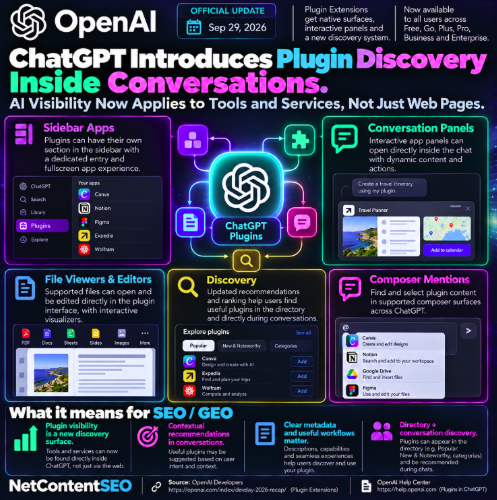

OpenAI is turning plugins into a native discovery surface inside ChatGPT. New Plugin Extensions let developers place plugin experiences across the ChatGPT interface, while updated discovery can surface useful plugins not only in the directory but also as recommendations during conversations.
For AI visibility, this broadens the competitive landscape: discovery inside ChatGPT can now apply to tools, services and workflows, not only webpages retrieved as sources.
Plugins can have their own place in the ChatGPT sidebar
Plugin Extensions support sidebar apps that give a plugin a dedicated entry point and can launch its interface fullscreen. OpenAI describes extensions as a way to make plugins feel like native, first-class ChatGPT features.
This moves a plugin beyond a background tool call. Once installed and supported on the relevant surface, it can become a persistent destination inside the ChatGPT interface.
Interactive panels can live beside conversations
Extensions can also open interactive panels alongside a conversation, allowing users to keep the plugin interface and ChatGPT context together.
For developers, that creates room for richer experiences than a text response alone: structured interfaces, interactive content and workflow-specific controls can remain visible while the conversation continues.
Plugins can open and edit supported files
OpenAI also supports file viewers and editors through Plugin Extensions. Supported files can open in the plugin's own interface, with reading, live updates and saving handled as part of the experience.
That means plugin visibility can extend into document workflows where the user's intent is centered on a file rather than a conventional prompt or web search.
Discovery now happens inside conversations
OpenAI's current plugin documentation says users can browse categories such as Popular and New & Noteworthy in the plugin directory — or review a plugin suggested during a conversation.
OpenAI's DevDay developer recap separately states that plugin creation and discovery received updates, including recommendations during conversations.
This creates a contextual discovery path: a user may encounter a plugin because ChatGPT considers it relevant to the task being discussed, even if the user did not begin by browsing the plugin directory.
Composer mentions create another entry point
Plugin Extensions can also support composer mentions, allowing users to find and select plugin content directly while composing a request. OpenAI currently documents composer mentions as available in the ChatGPT desktop app.
Together with sidebar apps and conversational recommendations, this gives plugins several different surfaces on which they can be discovered or invoked.
Availability is broad, but individual features still vary
The plugin directory is available across ChatGPT plans. However, OpenAI notes that installing or using a specific plugin depends on plan, workspace, role, region and the capabilities included in that plugin. Some extension surfaces can also vary between web, desktop and mobile.
OpenAI's extension documentation, for example, says web support for Plugin Extensions is still coming to Free and Go users, while existing plugin functionality remains unaffected.
What this means for AI visibility
Web publishers have spent years optimizing how pages are discovered in search results and, more recently, how they are retrieved and cited by AI systems. Plugin discovery introduces another optimization target: whether a tool itself is surfaced when ChatGPT recognizes a relevant user need.
OpenAI has not published a complete ranking formula for plugin recommendations. Developers should therefore avoid treating any individual metadata field as a confirmed ranking factor.
But clear descriptions, well-defined capabilities, reliable workflows and accurate categorization become strategically important because they help users — and potentially ChatGPT's discovery systems — understand what a plugin is designed to do.
The NetContentSEO view
This is the beginning of something analogous to GEO for software distribution. AI visibility is no longer limited to being a source inside an answer. A service can itself become the recommended tool used to complete the task.
The discovery funnel can now run from user intent → conversational recommendation → plugin installation or invocation → connected app or workflow.
For companies building AI-native services, that means visibility strategy increasingly includes plugin discoverability inside ChatGPT alongside web rankings, AI citations and traditional app distribution.