

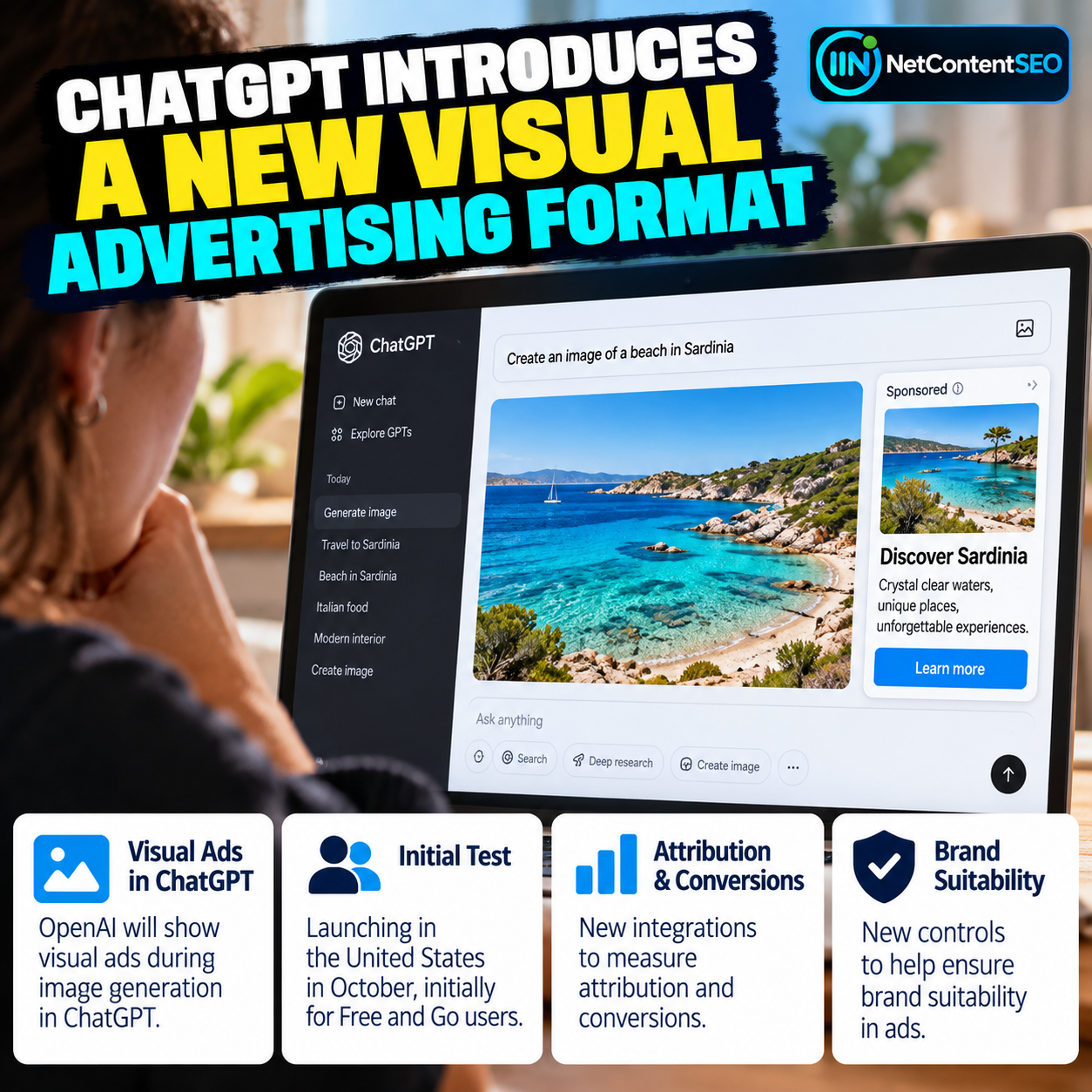

OpenAI has announced a new visual advertising format for ChatGPT, expanding its advertising tests beyond text-based placements. The planned format can show visual ads while ChatGPT generates images, creating a new opportunity for brands to appear alongside an image-generation experience. OpenAI says the initial test is intended for users on the Free and Go plans in the United States, with testing expected to begin during October 2026.
The announcement also covers new integrations for attribution and conversions, alongside additional brand-suitability controls. These elements matter because visual placements need measurement and advertiser controls that go beyond simply counting impressions or clicks.
What OpenAI announced
In its announcement, OpenAI described a new ChatGPT ads format and related measurement capabilities. The company said visual ads would be tested during image generation, initially for eligible Free and Go users in the United States.
The announcement is an official statement of planned testing. It should not be treated as proof that the test has already started or that the format is generally available. As of the announcement described here, the start of the test had not been independently confirmed.
Why visual ads in ChatGPT matter
Image generation is a distinct interaction from a conventional search results page. Users may describe a scene, request variations, or refine an image through multiple prompts. Placing advertising in this context could create a new discovery surface, but the impact will depend on how the ad is presented, how clearly it is labelled, and whether it fits the user's task.
For marketers, the important question is not simply whether an ad can appear during image generation. It is whether the placement reaches a relevant audience without interrupting the creative workflow—and whether advertisers can measure what happens after exposure.
Attribution and conversion measurement
OpenAI also announced new integrations for attribution and conversions. Measurement will be central to assessing a new visual format: advertisers need to understand how a placement contributes to downstream actions, rather than relying only on surface-level engagement.
The announcement signals work in this direction, but the available information does not establish every technical detail, reporting field, partner integration or measurement methodology. Those specifics should be confirmed from OpenAI's documentation as they become available.
Brand suitability becomes part of the format
OpenAI also highlighted additional brand-suitability controls. For advertisers, brand suitability concerns where an ad appears and whether the surrounding content or experience aligns with a campaign's requirements. Such controls can be especially relevant in generative interfaces, where the user's requested output may vary substantially from one interaction to the next.
The announcement does not, by itself, provide a complete list of controls or prove how they will operate in production. Advertisers should wait for the relevant product details before drawing conclusions about targeting, exclusions or placement-level control.
Who will see the initial test?
The announced initial audience is eligible ChatGPT Free and Go users in the United States. OpenAI said testing was planned for October 2026. The announcement should not be interpreted as confirmation of availability to Plus, Pro, Enterprise or users outside the stated initial audience.
Availability, timing and eligibility can change during a test. Advertisers and publishers should refer to OpenAI's official announcement and subsequent product updates for confirmed changes.
What SEO and AI visibility teams should monitor
- Placement and labelling: observe where visual ads appear during image generation and how they are distinguished from generated content or organic recommendations.
- User experience: assess whether ads interrupt the workflow or appear in a context that users find relevant.
- Attribution: follow the measurement integrations and conversion reporting that OpenAI makes available.
- Brand suitability: review the actual controls and documentation rather than assuming that announced controls cover every advertiser requirement.
- Market availability: distinguish the announced US test from a confirmed rollout in other countries or plans.
For SEO and AI visibility professionals, the development is worth monitoring as a new commercial surface inside a conversational AI product. However, it is not evidence that organic visibility, AI citations or search rankings have changed. Advertising and organic discovery should be measured separately.
What remains unconfirmed
The announcement confirms OpenAI's plan to test visual ads and introduce related measurement and brand-suitability capabilities. It does not establish that the test has launched, that all eligible users will see the format, or that the new measurement features are already available to every advertiser. Those points require subsequent confirmation.
The takeaway
ChatGPT's announced visual advertising format could create a new discovery channel around image generation, but the practical impact will depend on rollout, measurement and advertiser controls. OpenAI announced an initial test for Free and Go users in the United States during October 2026, alongside attribution and conversion integrations and additional brand-suitability controls. Until the test and its implementation details are confirmed, marketers should treat this as an official product announcement—not proof of a live, broadly available advertising placement.