

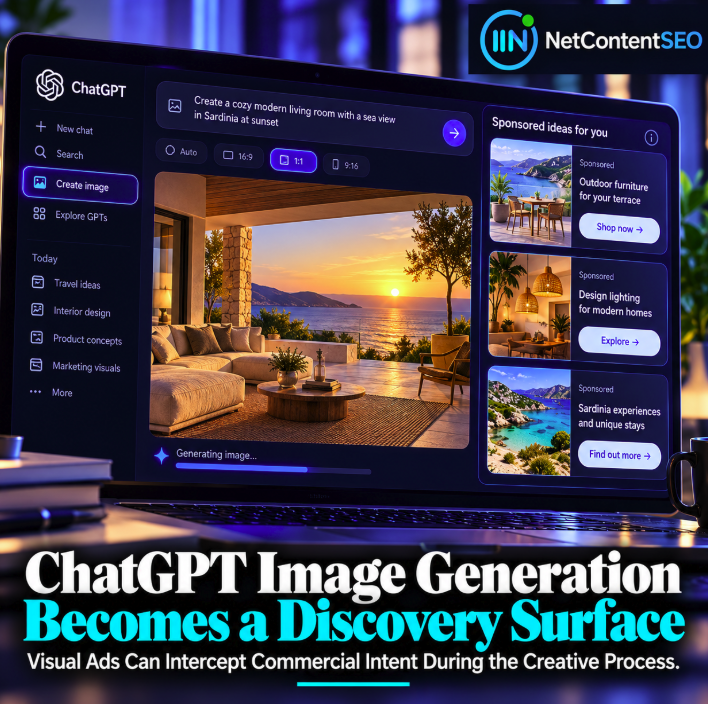
OpenAI is turning image generation into a new commercial discovery surface.
On October 5, 2026, the company announced a new visual advertising format that will initially be tested during image generation in ChatGPT. The test is scheduled to begin later in October in the United States with an initial group of advertisers.
For marketers, the important shift is contextual: an ad can appear while a user is actively imagining, designing or visualizing something — potentially placing a product or service close to the moment when commercial intent is being formed.
Visual ads are coming to image-generation sessions
OpenAI says the new format uses images to help users explore products, see how they might be used and understand the experiences they can enable.
The company positions the format as a way for people to discover brands and evaluate offerings visually rather than relying only on text-based sponsored units.
The initial test will take place specifically during ChatGPT image generation.
The ad remains separate from the generated image
This distinction is critical.
OpenAI says the visual advertisement will be clearly labeled and separate from the image being created.
The advertiser is therefore not buying product placement inside the user's generated image, and OpenAI does not describe the system as modifying the generated creative to include sponsored products.
The ad is an adjacent commercial unit within the image-generation experience.
Ads do not influence ChatGPT's answer
OpenAI reiterates its broader advertising principle that ads do not influence the answers ChatGPT provides.
The company's Help Center says advertising systems are separate from the chat model and advertisers cannot influence, rank or modify ChatGPT's responses.
That separation matters particularly in image generation because a user should not infer that a sponsored product appearing nearby caused the model to generate a particular object, style or recommendation.
The initial audience is US Free and Go users
OpenAI says the visual-format test will initially run for users on Free and Go plans in the United States.
Its current advertising documentation states that Plus, Pro, Business, Enterprise and Edu accounts do not show ads.
The rollout is a test rather than a universal global launch, and OpenAI says it will begin with an initial group of advertisers.
Why image generation creates a different advertising moment
Image prompts often expose intent that would be difficult to capture with a conventional search keyword.
A person may ask ChatGPT to visualize a renovated kitchen, design a home office, plan wedding decorations, create an outfit, imagine a holiday destination or mock up a product concept.
Those prompts can reveal not just a topic but a desired outcome.
That makes the surrounding creative workflow potentially valuable advertising context.
The prompt can sit upstream of a purchase
Consider a user generating an image of a small balcony redesigned for outdoor dining.
The user may not yet have searched for a specific table, lighting system or furniture brand. They are still defining what they want.
A relevant visual ad at that stage can enter the journey before the user reaches a traditional product-search query.
This is why image generation can function as a discovery surface rather than merely a creative tool.
Visual inspiration can create commercial intent
Search advertising traditionally captures intent that already exists.
A query such as “buy outdoor dining table” is explicit.
Generative AI can operate earlier. A user may begin with a non-transactional creative request and develop commercial interest after seeing a concept visualized.
The advertising opportunity is therefore not limited to intercepting existing demand; it can appear while the user is shaping preferences.
OpenAI describes the goal as helping people imagine products in their lives
The company's launch announcement emphasizes product inspiration, product usage and the experiences products or services can make possible.
That language suggests the new unit is designed for a more visual, upper-to-mid-funnel role than a simple text link.
For brands in categories such as travel, home, fashion, beauty, automotive, consumer electronics and entertainment, the creative context could be especially relevant.
This is distinct from OpenAI's measurement expansion
The October 5 announcement also expands ChatGPT Ads measurement, but the two developments should not be conflated.
OpenAI separately announced integrations with Hightouch, Tealium and LiveRamp for sending conversion data from existing systems, plus support for major attribution partners and Conversions API, reporting and click-attribution workflows.
Those integrations concern measurement infrastructure.
The visual image-generation ad is a new placement and creative format.
ChatGPT Ads already operate around conversational intent
OpenAI describes ChatGPT advertising as reaching users while they explore options, compare alternatives and make decisions.
The company's advertiser documentation says ad selection can use the context of the current conversation and, where personalization is enabled, selected signals from the broader ChatGPT experience.
Image generation adds a visually expressive form of intent to that environment.
The creative prompt could be richer than a keyword
A traditional keyword might say “modern sofa.”
An image-generation prompt might specify a compact apartment, Scandinavian styling, a neutral palette, pets, children, a particular room size and a desired budget aesthetic.
That does not mean advertisers receive the conversation or prompt. OpenAI says conversations remain private from advertisers.
But from a platform perspective, conversational context can provide a much richer understanding of the task than a two-word search query.
Advertisers do not get access to private conversations
OpenAI's current advertising documentation states that advertisers cannot see users' chats, chat history, memories or personal data.
Advertisers receive aggregated advertising performance information rather than individual conversation transcripts.
This privacy boundary is especially important when commercial relevance is derived from conversational context.
The ad is not an OpenAI recommendation
OpenAI also states that displaying an advertisement does not mean the company endorses or recommends the advertiser, product or service.
That distinction can become visually important when an ad appears next to an AI-generated creative output that users may otherwise perceive as a personalized recommendation.
Clear labeling and separation are therefore fundamental to the format.
For brands, creative assets may matter more
A visual placement inside an image-generation workflow competes differently from a text ad below a conventional response.
The advertisement needs to communicate quickly through imagery and connect naturally to the user's creative task without pretending to be part of the generated output.
This could increase the importance of lifestyle imagery, use-case visualization and creative that demonstrates an experience rather than merely showing a product packshot.
AI visibility now has paid and organic discovery layers
For GEO teams, ChatGPT is increasingly becoming a mixed discovery environment.
A brand can appear organically in an answer, as a cited source, inside shopping results or as a clearly separated paid advertisement.
Those surfaces should not be merged into one visibility metric.
Organic mention share, citation share, shopping visibility and paid impression share represent different mechanisms and should be measured independently.
Image generation introduces another intent surface to monitor
The broader strategic lesson is that AI discovery does not happen only when users explicitly ask for product recommendations.
Commercial intent can emerge during planning, visualization, comparison, brainstorming and creation.
As ChatGPT expands advertising formats into those workflows, marketers will need to map which AI tasks occur before a purchase rather than monitoring only classic commercial prompts.
This is still a test, not a universal placement
OpenAI has not announced that every image-generation session will contain an ad.
The company says testing will begin later in October in the United States with an initial advertiser group.
Performance, eligibility, targeting and future expansion can therefore evolve as OpenAI learns from the test.
NetContentSEO take
ChatGPT image generation is becoming a commercial discovery surface at exactly the moment users are turning an idea into something they can see.
That timing matters.
A visual ad can potentially reach a user before they formulate a conventional shopping query — while they are still defining the room, trip, outfit, product or experience they want.
For AI marketing, this expands the competitive landscape beyond ranking and citations. Brands will increasingly compete for visibility across organic answers, generated interfaces, shopping layers and clearly separated paid discovery surfaces.
The image itself remains independent. The commercial opportunity is the moment around it.