

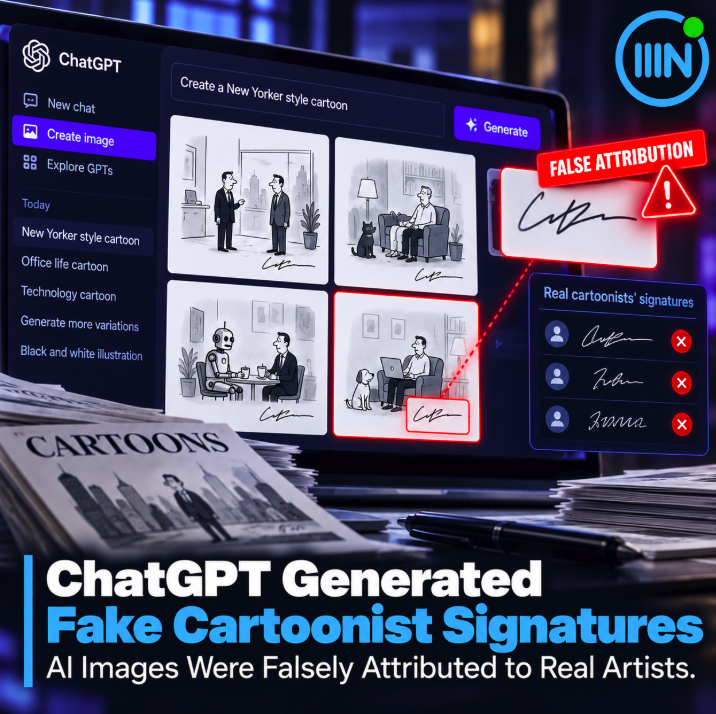

ChatGPT has been generating New Yorker-style cartoons that sometimes carry the signatures of real cartoonists who did not create the images, according to testing and reporting published by Nieman Journalism Lab and subsequently covered by Mashable.
The issue goes beyond stylistic imitation. When an AI-generated image contains a recognizable artist signature, viewers can reasonably interpret that mark as authorship. In documented examples, that attribution was false. Nieman Journalism Lab's investigation
A viral cartoon carried Brendan Loper's signature
The investigation began around a viral AI-generated cartoon that appeared after the deaths of Dolly Parton and Tim Curry. The image carried the pen name “BLOPER,” used by New Yorker cartoonist Brendan Loper.
Loper told Nieman Lab that he had not drawn or signed the cartoon. People nevertheless contacted him asking whether it was his work.
The example was not isolated. Loper had previously been alerted to other ChatGPT-generated images carrying his pen name.
More than 15 New Yorker cartoonists were affected in testing
Nieman Lab reporter Andrew Deck tested ChatGPT and documented signatures associated with more than 15 New Yorker cartoonists, past and present.
The reported examples included names associated with artists such as George Booth, Liza Donnelly, Ellis Rosen and Saul Steinberg. Other generated signatures were nonsensical rather than attributable to a real person.
This variability is important: the system was not simply adding a generic “AI artist” mark. In some outputs, it reproduced identifiers that viewers could associate with actual creators.
False attribution is different from style imitation
The controversy highlights a distinction that is easy to lose in debates about generative imagery.
An image can resemble a recognizable editorial-cartoon tradition without explicitly claiming that a particular person created it. A copied signature changes the meaning of the output because it can attach a real individual's identity to work they did not make or approve.
Several cartoonists interviewed by Nieman Lab emphasized that distinction, describing the attribution problem as particularly troubling.
The New Yorker says its cartoons were not licensed for AI training
Condé Nast, The New Yorker's parent company, has a licensing relationship with OpenAI covering some publisher content. However, a New Yorker spokesperson told Nieman Lab that Condé Nast has not granted an LLM developer permission to train on the magazine's cartoons.
The publication also said reproducing The New Yorker logo alongside generated cartoons is not permitted under its LLM agreements.
The precise training pathway that resulted in the reproduced signatures remains unclear. OpenAI declined to answer Nieman Lab's questions about how the model may have encountered those signatures during training.
OpenAI describes the behavior as unintended
OpenAI told Nieman Lab that its focus is on tools that empower human creativity and said it appreciates reports of “bugs and unintended behavior” so they can be addressed.
After the issue was reported to OpenAI, the reporter observed that some requests for New Yorker-style cartoons began triggering a warning that the prompt might violate guardrails concerning similarity to third-party content.
However, according to the investigation, some generic cartoon generations were still receiving signatures associated with real cartoonists at publication time.
This is also a provenance problem
The episode illustrates why provenance metadata matters as generative media becomes easier to create and distribute.
OpenAI has separately been expanding content-provenance systems including C2PA Content Credentials, SynthID watermarking and verification tools for supported generated media. OpenAI's content provenance initiative
Those systems can help establish that an asset was AI-generated. But the signature case demonstrates a second problem: the content inside an AI-generated asset can itself make a false authorship claim.
AI search and content systems need attribution controls
For publishers and brands, this is not merely an image-generation issue. Generative systems increasingly create summaries, quotations, citations, product recommendations and attributed statements.
A system that associates the wrong person with a generated image creates the same fundamental trust problem as a system that attributes a quotation or claim to someone who never made it.
Attribution therefore needs to become a first-class quality metric for generative systems.
Brands should verify names and signatures in generated assets
Organizations using AI-generated visuals should inspect outputs for more than visual quality. Signatures, logos, watermarks, publication marks and artist names can appear as incidental-looking details while carrying significant attribution implications.
Editorial workflows should reject or remove unexplained real-person signatures before publication and should never assume that a mark generated by the model is fictional.
The NetContentSEO takeaway
The important issue here is not whether ChatGPT can approximate the visual conventions of a magazine cartoon. It is that AI-generated content can accidentally manufacture authorship signals.
As generative content enters search results, social feeds and publisher workflows, users will need ways to distinguish three different questions: Who generated the asset? What material influenced it? And whose name or identity does the asset claim is responsible for it?
AI provenance cannot stop at identifying the model. It also has to prevent generated content from falsely identifying a human creator.