

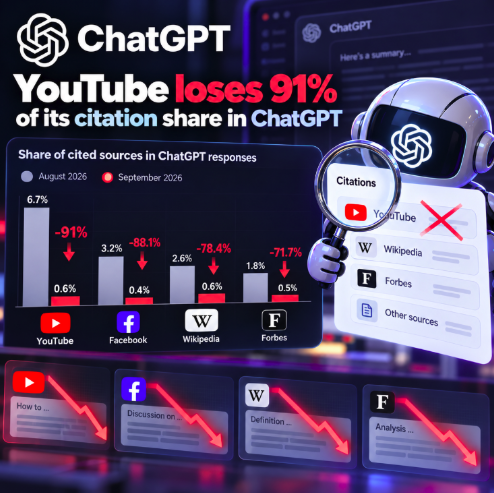

An independent analysis published on September 24, 2026 reports a dramatic shift in the sources visibly cited by ChatGPT, with YouTube's citation share reportedly falling 91% compared with August.
The same analysis reports declines of 88.1% for Facebook, 78.4% for Wikipedia and 71.7% for Forbes. These figures describe changes in visible attribution in answers; they do not establish that ChatGPT stopped retrieving, reading or otherwise considering content from those sources.
Citation loss is not necessarily retrieval loss
This distinction is crucial for AI visibility measurement. A source can potentially participate in retrieval or influence an answer without appearing as a visible citation in the final response. Conversely, citation frequency measures only the attribution users can observe.
That means a sharp decline in visible citations should not automatically be interpreted as an equivalent decline in underlying retrieval.
YouTube shows the largest reported decline
Among the sources highlighted in the analysis, YouTube recorded the steepest reported change at 91%. Facebook followed at 88.1%, Wikipedia at 78.4% and Forbes at 71.7%.
The pattern is notable because all four are large, recognizable sources frequently encountered across informational searches. However, the analysis is independent and OpenAI has not confirmed a corresponding ranking, retrieval or citation-system change.
Why attribution can change independently
Modern AI answer systems can involve several stages: query interpretation, retrieval, source selection, synthesis and final citation rendering. Changes at any one of those stages can alter what users see.
A platform might therefore remain part of the information pipeline while appearing less frequently in the citations attached to the final answer. Without visibility into internal retrieval logs, visible citations alone cannot reveal the complete path used to construct a response.
A warning for AI visibility tracking
For publishers and GEO teams, the finding reinforces the need to separate different metrics. Citation share, retrieval frequency, brand mentions and answer influence are related but not interchangeable measurements.
Tracking only visible links risks interpreting an attribution change as a complete visibility loss. Ideally, AI visibility research should compare citations with controlled prompt testing, referral behavior, mentions and any available evidence about retrieval.
The NetContentSEO view
The reported YouTube decline is important precisely because it exposes a measurement problem. AI search visibility cannot be reduced to a single citation counter.
If retrieval continues while attribution disappears, publishers may remain present in the model's information chain without receiving a visible link. Understanding that gap between being used and being cited is becoming one of the central challenges of AI visibility research.