

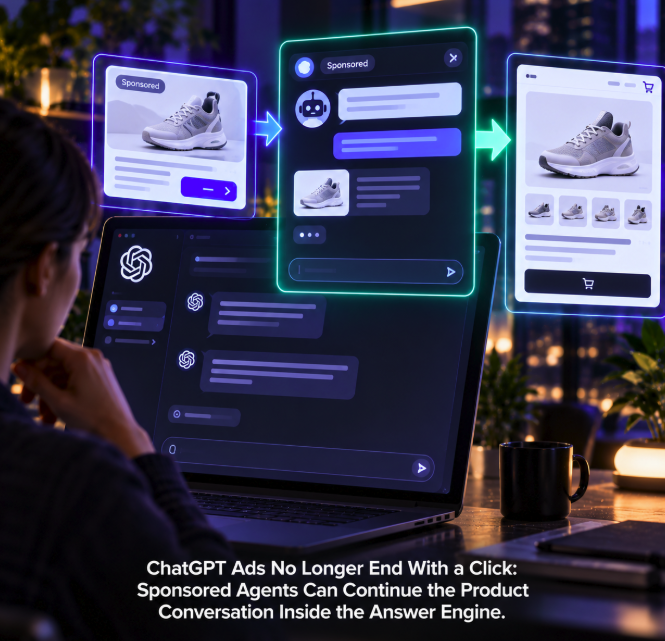

OpenAI is testing an advertising format that changes what happens after a user clicks an ad in ChatGPT. Instead of immediately sending the person to an advertiser’s website, a new Sponsored Agent can open a clearly labeled conversation inside ChatGPT where the user can ask questions about the business, product or service before deciding whether to continue to the advertiser’s site.
The feature was announced in OpenAI’s official September 16 advertising update. OpenAI says Sponsored Agents are currently being tested with select advertisers in the United States. Its Help Center documentation describes the program as a limited alpha and says the format is not yet available to all advertisers.
The distinction from ordinary ChatGPT answers is central to the design. OpenAI says the Sponsored Agent conversation is clearly labeled, separate from the user’s original conversation and distinct from ChatGPT’s independent answers. The company is therefore not presenting the advertiser’s agent as the assistant’s own recommendation; it is creating a separate commercial conversation that begins from an ad.
The ad click can now open another conversation instead of a website
Traditional digital advertising treats the click as a handoff. A platform shows an ad, the user clicks and the advertiser takes over on a landing page. Sponsored Agents insert a conversational layer between those two stages.
OpenAI gives the example of a shopper who sees an advertisement for a dining table but still needs practical information. The person might want to know whether the table fits a particular room, how many people it seats or how to care for the finish. Instead of leaving ChatGPT to search through product pages or FAQs, the user can choose to ask the advertiser-sponsored agent those questions directly.
When the shopper is ready for the next step, the Sponsored Agent can provide a link to the business’s website. The ad therefore becomes the beginning of a guided product conversation rather than simply a traffic-generation unit.
For advertisers, that creates a new objective between impression and site visit: answering enough of the customer’s questions to make the eventual click more informed and commercially valuable.
The Sponsored Agent is explicitly separated from ChatGPT’s own answer
Advertising inside an answer engine creates an obvious trust problem. If users cannot distinguish between what the assistant independently concludes and what an advertiser pays to say, the credibility of the underlying product can erode quickly.
OpenAI’s announcement addresses that boundary directly. The company says a conversation with a Sponsored Agent is distinct from ChatGPT’s independent answers and separate from the original conversation the user started in ChatGPT.
The sponsored conversation is also clearly labeled. That means a user should be able to understand that the agent is representing a business rather than acting as an independent ChatGPT response.
This separation is more important than it might initially appear. A Sponsored Agent can explain a product from the advertiser’s perspective, but OpenAI is not saying that the agent’s claims alter what ChatGPT independently recommends when answering the user outside that sponsored context.
This is an alpha test, not a generally available ad format
OpenAI’s Help Center says Sponsored Agents are available only to selected advertisers in a limited alpha. The company is not currently accepting general early-access requests and says it will announce additional availability details when it is ready to expand the program.
That means businesses should not assume they can open Ads Manager and add a Sponsored Agent to an existing campaign today. The September 16 announcement establishes the format and the test, but pricing, broad eligibility requirements and a general rollout schedule have not been publicly defined.
The geographic scope is also limited. OpenAI’s announcement says the current test involves select advertisers in the United States, even as other parts of ChatGPT Ads are expanding internationally.
The safest way to interpret the launch is therefore as a product-direction signal. OpenAI is testing whether conversational advertising can extend beyond a static ad unit, but it has not yet turned Sponsored Agents into a standard self-service format.
ChatGPT Ads is moving deeper into the consideration stage
Most digital advertising platforms are strong at generating awareness and clicks. The advertiser’s website then handles the detailed consideration stage: feature comparisons, sizing questions, compatibility, shipping information and other objections that stand between interest and purchase.
Sponsored Agents move some of that work into ChatGPT. The user can remain inside the answer engine while asking product-specific follow-up questions, potentially reducing the need to navigate several pages of an advertiser’s site before understanding whether the offer fits.
This matters because ChatGPT is already a conversational environment. A user who has spent several turns describing a need may prefer another conversational interaction over switching into a conventional ecommerce navigation structure.
The advertiser can therefore participate in the consideration process in the same interaction style the user is already using, while the sponsorship label preserves a visible boundary around who is providing the information.
The landing-page click could become later but more qualified
If Sponsored Agents work as intended, the advertiser’s site may receive fewer purely exploratory clicks and more visitors who have already resolved basic questions. A user can ask about dimensions, use cases or product characteristics before following the link.
That could change how advertisers interpret click-through rate. In a traditional campaign, maximizing the number of visits is often treated as an important intermediate goal. In a conversational ad format, the commercial value may lie in letting some users determine that a product is not suitable before consuming a website session, while sending better-qualified prospects downstream.
OpenAI has not published performance data demonstrating that Sponsored Agents increase conversion rates or improve traffic quality. The format is still being tested, so those effects remain hypotheses rather than established outcomes.
But the architecture clearly creates room for a different measurement model: not only whether someone clicked an ad, but whether they opened the agent, what kinds of questions they asked, whether the conversation progressed and whether they ultimately visited the business.
Advertisers may need a new kind of content strategy
A Sponsored Agent cannot be useful if it has nothing reliable to say. Businesses participating in conversational advertising will need accurate product information, policies and supporting content that allow the agent to answer detailed questions without inventing claims.
That creates an overlap between advertising operations and the content systems normally used for customer support, ecommerce and product information management. Specifications, compatibility information, dimensions, return policies and usage guidance can become inputs to a paid conversational experience.
For marketers, this is a significant change from writing a headline and description for an ad unit. The advertisement may start the interaction, but the quality of the subsequent experience depends on whether the agent can sustain a useful multi-turn conversation.
Advertisers may therefore need to think in terms of answer coverage: which questions a prospective customer is likely to ask, what evidence supports the answers and where the agent should hand the user to a human or to the website rather than overstate what it knows.
Sponsored Agents create a paid layer inside conversational product research
ChatGPT is increasingly used to compare products and services before a purchase. That makes the boundary between organic AI visibility and paid placement strategically important.
A business can already be mentioned in an independent ChatGPT answer because the model or retrieval system considers it relevant. ChatGPT Ads creates a separate paid opportunity, and Sponsored Agents extend that paid opportunity into a follow-up conversation.
The two should not be conflated. OpenAI explicitly says the Sponsored Agent conversation is separate from ChatGPT’s independent answers. Buying an ad does not mean the advertiser controls what ChatGPT says organically about the market or which products it independently considers relevant.
For measurement teams, that suggests maintaining separate views of organic AI visibility and paid conversational engagement. A brand may perform strongly in one and weakly in the other, just as organic search visibility and paid search performance require different analysis.
The format could change what an advertising landing page is
The traditional landing page performs several jobs at once. It explains the offer, answers common questions, establishes trust and pushes the user toward a conversion. A Sponsored Agent can potentially perform some of those jobs before the website loads.
That does not make landing pages unnecessary. OpenAI’s own flow still ends with the option to follow a link to the business’s website, where the advertiser can provide deeper information or complete the transaction.
But the role of the page may shift. If a user has already discussed the product with an agent, repeating generic introductory copy may be less valuable than immediately continuing the task—showing the relevant configuration, availability, booking flow or checkout.
Over time, advertisers may want landing pages that recognize the context of an AI-assisted journey rather than treating every visitor as someone arriving cold from a banner or search ad.
Conversation quality becomes part of advertising quality
Sponsored Agents introduce failure modes that static ads do not have. A banner cannot contradict itself over five turns, hallucinate a specification or misunderstand a complex customer requirement. An AI agent can.
That makes conversational quality a new advertising risk. Businesses will need to care about factual accuracy, policy compliance, escalation behavior and the boundaries around claims the agent is permitted to make.
The sponsorship label helps users understand the commercial context, but it does not eliminate the advertiser’s responsibility for the experience. If an agent provides poor or misleading answers, the damage can extend beyond a failed click to the user’s perception of the brand.
The limited-alpha approach gives OpenAI and participating advertisers room to test those issues before making the format widely self-service.
ChatGPT Ads is evolving from placement inventory into an AI advertising platform
Sponsored Agents were announced alongside a broader set of OpenAI advertising tools. The company is adding AI-assisted campaign creation through ChatGPT Work, creative tools in Ads Manager and integrations with HubSpot and Shopify.
The combined direction is clear: OpenAI wants advertising to use the same conversational and agentic capabilities that define the rest of ChatGPT rather than simply reproducing conventional display ads inside a new interface.
The Shopify integration turns product feeds into campaign inputs. HubSpot connects advertising workflows to customer data and CRM operations. Sponsored Agents add a conversational experience after the ad itself.
Together, those pieces begin to form a full advertising stack spanning campaign creation, targeting and delivery, product data, customer systems, conversation and measurement.
The click is becoming the start of the ad experience
Sponsored Agents invert one of digital advertising’s oldest assumptions. Historically, the click marked the moment the advertising platform’s job largely ended and the advertiser’s website took over.
In OpenAI’s test, the click can instead begin another advertising experience inside ChatGPT. The user enters a labeled conversation with an agent sponsored by the business, asks follow-up questions and decides when—or whether—to proceed to the advertiser’s site.
That creates a new commercial layer inside the answer engine. ChatGPT can remain the interface through awareness and consideration while preserving a visible separation between independent assistant responses and advertiser-sponsored conversation.
For now, the format is a limited U.S. alpha with selected advertisers. But the product direction is significant: ChatGPT Ads is no longer being designed only to generate clicks. OpenAI is testing whether the ad itself can become an ongoing product conversation.