

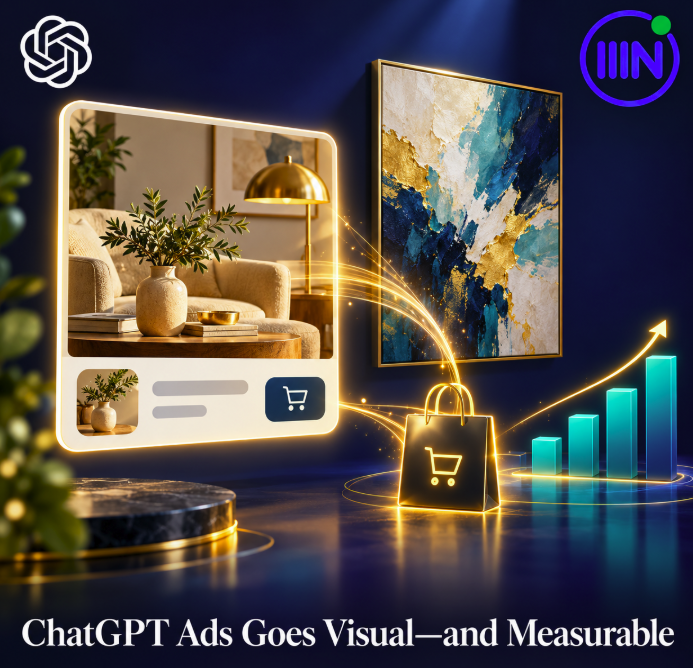

OpenAI is expanding ChatGPT advertising with a visual format, measurement integrations and brand-suitability controls. Its 5 October 2026 announcement puts creative presentation and evidence of business impact in the same conversation: advertisers need to show why a product matters and understand what happens after someone sees the ad.
The visual format is scheduled for testing later in October in the US with an initial advertiser group. OpenAI says ads will appear during image generation, carry clear labels and remain separate from the image being created. The company also says advertising does not influence ChatGPT’s answers. This is a planned test, not a global launch of the placement.
Creative designed for a task in progress
The official announcement describes images that communicate product inspiration, use and experiences. Our interpretation is that this gives advertisers a reason to develop creative around what someone is trying to achieve, rather than simply reusing a product thumbnail.
A home brand, for example, could prepare imagery that helps explain how a product fits a room or a project. That is a creative-planning example, not confirmation of a targeting option or an approved campaign. Teams should distinguish the capabilities OpenAI has announced from the audience controls and placement details actually available in their accounts.
The practical preparation is to assemble accurate product visuals, a clear proposition and a landing page that carries the same message. An attractive image creates a weak journey if the destination contradicts the offer or fails to answer the buyer’s next question.
Measurement extends beyond the last click
The separate OpenAI Ads measurement update describes Pixel and Conversions API signals for purchases, leads, installs and sign-ups. Integrations include Hightouch, Tealium and LiveRamp. Attribution partners span web and app measurement, including AppsFlyer, Adjust, Branch, Triple Whale and Northbeam.
The platform supports reporting with a chosen click-through window and an optional one-day view-through window. OpenAI says these reporting settings do not change campaign optimisation. It also describes Event Quality Score as a way to assess conversion-signal quality.
For an advertiser, those capabilities make the conversion definition a priority. Decide what counts as a qualified lead or completed purchase, align it with your own records and check the implementation before interpreting campaign results. Where multiple measurement methods are used, investigate overlapping event reports rather than adding their totals together.
Attribution asks which interaction receives credit. Incrementality asks whether advertising caused additional outcomes. OpenAI is exploring geographical experiments with Haus, Measured and WorkMagic, while describing this work as early-stage. A platform-attributed sale and an experimentally estimated extra sale should not be presented as the same finding.
Brand suitability is becoming part of campaign planning
OpenAI says qualifying advertisers can use Negative Phrases for narrower placement requirements. It is also developing suitability-evaluation pilots with DoubleVerify and Integral Ad Science in controlled environments without giving those partners access to private user conversations.
Our recommendation is to document the brand’s requirements before evaluating those controls. Identify the contexts your business considers unsuitable and confirm what the available settings actually exclude. A named pilot should not be described as a completed, universal independent certification of every placement.
What this means for SEO and AI visibility
These announcements concern paid discovery. They do not establish that buying ChatGPT Ads improves organic citations, recommendation frequency or search rankings. Keep paid campaign reporting and organic AI visibility monitoring separate, then compare them where a shared business question makes that useful.
For example, a retailer might track paid conversion outcomes alongside whether AI answers describe its products accurately. The two measures can inform the same commercial strategy without implying that one caused the other. Product information, imagery and landing-page clarity become practical shared assets for the teams involved.
The editorial implication is a broader measurement discipline around conversational discovery. Creative teams need to explain the offer, analytics teams need trustworthy event definitions, and search teams need to understand which visibility is paid and which is organic. The next useful evidence will be account-level availability and results from clearly described tests—not an assumption that a new format already works equally well for every advertiser.