

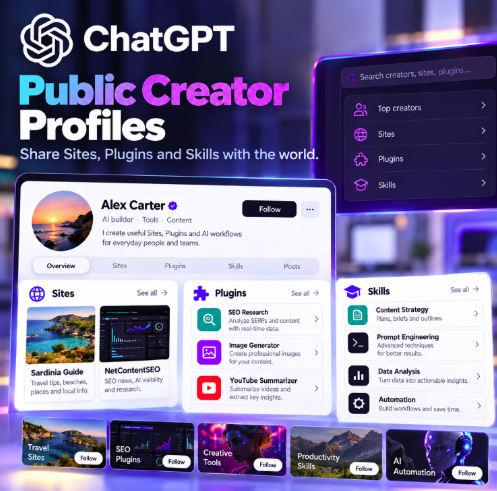

OpenAI is adding Shareable Profiles to ChatGPT, creating a new discovery surface for the Sites, Plugins and other resources people build inside the platform.
Announced on September 29, 2026, the feature allows creators to present their work through a reusable profile rather than relying only on individual links. In workspaces, shared Skills can also become discoverable, extending the concept beyond public-facing tools to reusable organizational capabilities.
A new distribution layer inside ChatGPT
The change matters because creation and distribution are increasingly happening inside the same AI environment. A Site or Plugin can now be associated with a persistent creator identity, giving users another path to discover related tools and content.
That creates an AI-native equivalent of a creator or developer profile: one destination can expose multiple assets and make it easier for users to move from one useful tool to another.
Sites and Plugins gain a discovery surface
Until now, distribution of AI tools has often depended on direct links, external promotion or discovery through individual product surfaces. Shareable Profiles introduce another layer where a creator’s Sites and Plugins can be presented together.
For publishers and brands, that could make profile-level visibility increasingly relevant. Discovery may no longer be limited to whether a single Site or Plugin appears for a query; the identity behind those assets can itself become a navigational and discovery object.
Shared Skills inside workspaces
OpenAI is also extending discovery to shared Skills within workspaces. That is particularly relevant for teams building reusable research, editorial, coding or operational workflows.
Instead of requiring colleagues to know that a Skill exists or receive a direct link, workspace discovery can make reusable capabilities easier to find and adopt.
Why this matters for AI visibility
For SEO and AI visibility teams, Shareable Profiles introduce another entity surface to monitor. Traditional search visibility revolves around pages, domains, authors and structured entities. AI platforms are now creating their own native objects: agents, plugins, skills, sites and creator profiles.
If these objects become searchable or recommendable within ChatGPT, optimization may increasingly involve more than web pages. Clear naming, recognizable authorship, topical consistency and relationships between a creator and their tools could all become useful signals for discovery.
The NetContentSEO view
The larger trend is the emergence of platform-native discovery ecosystems. ChatGPT is not only an interface that retrieves information from the web; it is also becoming a place where creators publish reusable experiences and users discover them directly.
Shareable Profiles give those experiences a persistent home. For anyone studying AI-native visibility, that makes profiles, Sites, Plugins and Skills worth tracking as distinct discovery surfaces alongside conventional search results and model citations.