
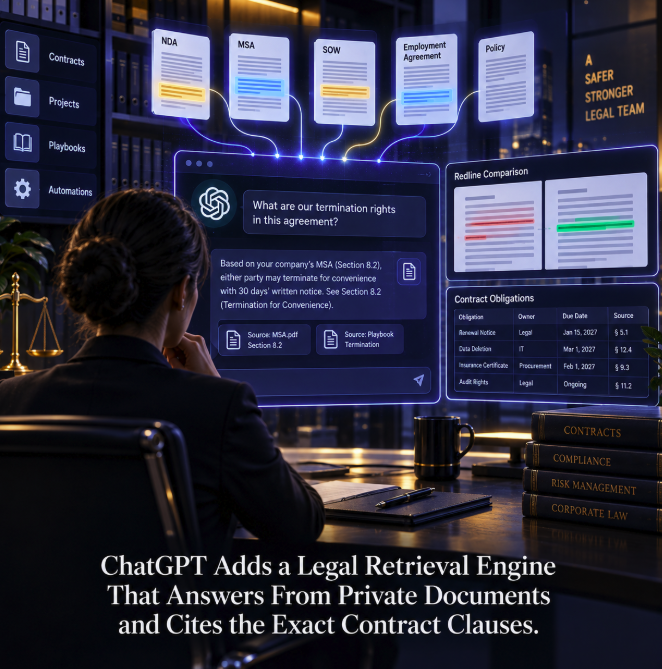
ChatGPT's enterprise plugin catalog now includes a legal integration designed to answer questions from a company's own contracts, playbooks, files and projects rather than relying only on general model knowledge. The new GC AI plugin connects a GC AI workspace to ChatGPT, giving in-house legal teams a retrieval layer for private legal material while keeping the resulting work tied to the systems and standards their organization already uses.
The official GC AI plugin page from OpenAI describes the integration as an AI assistant for legal teams. Once connected, users can ask legal questions grounded in their own documents, draft contracts and memos, review and redline agreements against internal standards, run existing playbooks and automations, and work with files and projects stored in the GC AI workspace. Availability is not universal: OpenAI says plugin access depends on the specific plugin, the user's plan and workspace settings, and some connections require administrator setup or approval.
The important shift is from generic legal prompting to private retrieval
Legal teams have been able to ask general-purpose AI systems questions about contracts for years, but enterprise legal work usually depends on context that a public model does not possess. The operative NDA playbook may define acceptable fallback language. A master services agreement may contain negotiated termination rights that differ from the company's standard position. A portfolio of customer contracts may assign renewal dates and obligations to different internal owners. Without access to those private materials, an AI assistant can produce plausible legal language while still missing the facts that determine what the organization should actually do.
GC AI changes that interaction by making the organization's own legal workspace available inside ChatGPT. OpenAI says users can ask a question and receive an answer grounded in their documents. The examples on the plugin page emphasize traceability: an NDA review can identify deviations and propose redlines tied to company standards while referencing the relevant clauses, and a contract-analysis task can produce an obligations table containing responsible parties, due dates, renewal terms and the source clauses from which those obligations were extracted.
That source-level grounding is particularly important in legal workflows because the value of an answer often depends on being able to inspect the underlying language. A statement such as “this agreement permits termination for convenience” is materially more useful when the lawyer can immediately verify the provision in the original contract and see how it compares with the organization's playbook. Retrieval does not eliminate the need for legal review, but it can reduce the time spent locating the relevant document and clause before that review begins.
Contract review becomes a workspace-aware task
One of OpenAI's showcased workflows asks GC AI to apply an organization's NDA playbook to an agreement, prioritize deviations, propose redlines and summarize unresolved decisions for the legal team. The significant part is not merely that an AI model can edit contractual language. It is that the requested edits can be evaluated against standards already maintained by the legal department rather than an invented or generic negotiating position.
The same principle applies to vendor negotiations. OpenAI demonstrates a prompt that asks the plugin to evaluate a vendor's redlines against company standards and deal priorities, separate acceptable changes from issues requiring escalation, explain the tradeoffs and draft a proposed response. For an in-house team, this can turn ChatGPT from a blank drafting surface into an interface over the organization's accumulated negotiating knowledge.
That distinction also makes the integration relevant to legal operations teams. Playbooks are often created precisely to make routine review more consistent, but their usefulness depends on lawyers and business partners applying them reliably. A conversational interface that can retrieve the applicable standard while examining the agreement may reduce the friction between maintaining a playbook and actually using it during day-to-day contract work.
Obligation tracking shows why clause citations matter
OpenAI's second major example goes beyond drafting and redlining. The plugin can be asked to review multiple agreements and construct an obligations table with responsible parties, due dates, renewal terms and source clauses, while highlighting conflicts and missing information that need follow-up. That is a retrieval-and-structuring problem rather than a conventional chatbot task.
Contract portfolios contain commitments that are easy to lose once the signature process is complete. Notice periods, data-deletion duties, insurance requirements, audit rights, renewal windows and reporting obligations may sit across different documents and sections. Extracting those commitments into a structured table can make them easier to assign and monitor, but accuracy is crucial. Linking an extracted obligation back to its source clause gives the legal team a way to validate the interpretation before relying on it operationally.
The feature therefore illustrates a broader direction for enterprise AI: generated output becomes more valuable when it remains connected to evidence. In a legal setting, the ideal result is not simply a fluent summary. It is a summary whose assertions can be traced to the contract language, internal standard or project file that supports them.
Plugins bring governed company context into ChatGPT
GC AI is part of OpenAI's broader plugin system for connecting business data and tools to ChatGPT. OpenAI's enterprise plugin catalog says plugins can bring live context from organizational systems into ChatGPT and the API while preserving access controls. Workspace administrators can control which plugins are enabled and which users or role-based groups can access them.
OpenAI also states that plugins should only access information a user is authorized to view in the connected service. For Business, Enterprise and Edu customers, plugin data is not used to train OpenAI models by default. These controls are particularly relevant to legal departments, where contracts can contain commercially sensitive information, personal data, privileged material and confidential negotiation history.
Even so, enabling a legal plugin is not merely a convenience decision. Administrators should review the permissions and data access of the integration, the connected provider's terms and the organization's own policies for confidential and privileged material. OpenAI's plugin security guidance notes that third-party and prompt-injection risks are reduced through safeguards but are not eliminated, reinforcing the need for appropriate governance around connected enterprise systems.
This is retrieval infrastructure, not an autonomous legal department
The strongest use case for GC AI is not replacing legal judgment. It is reducing the retrieval, comparison and structuring work required before that judgment can be applied. A lawyer can ask for the relevant termination provision, compare vendor language with the company's standard, assemble obligations across agreements or prepare a negotiation draft without manually moving between ChatGPT and a separate repository for every step.
The presence of clause references is especially important here. Retrieval-augmented answers can still be incomplete or misinterpreted, and a redline proposed by an AI system may not account for every commercial or jurisdictional consideration. A source citation gives the professional reviewing the work a concrete place to verify what the system relied on. It makes the output auditable rather than automatically correct.
That human verification remains essential for consequential legal decisions. The plugin can surface information, apply configured playbooks and prepare drafts, but organizations still need lawyers to evaluate legal risk, confirm factual assumptions and decide which negotiating tradeoffs are acceptable. The useful automation boundary is therefore not “AI decides the contract.” It is “AI finds, compares and organizes the relevant legal material so the team can decide faster.”
ChatGPT is becoming an interface over specialized enterprise systems
The GC AI integration also signals a larger product shift. ChatGPT is increasingly positioned not just as a destination where employees paste information, but as an interface capable of reaching into specialized business systems with the user's existing permissions. In this model, the domain-specific application remains important because it stores the structured workspace, files, projects, playbooks and automations, while ChatGPT becomes a conversational layer through which that context can be queried and acted upon.
For legal technology, that architecture may be more consequential than another standalone contract chatbot. Legal departments already have repositories, review standards and operational workflows. Connecting those assets to a general AI workspace means users can move from a question to the underlying clause, from the clause to a redline, and from a portfolio of agreements to a structured obligations table without treating each step as an isolated AI session.
The result is a narrower but more defensible promise than “AI lawyer.” GC AI brings private legal context into ChatGPT and lets teams use that context for research, drafting, review and operational analysis, with source clauses available for verification. For in-house departments evaluating enterprise AI, that grounding may matter more than the fluency of the model itself: the question is no longer only whether ChatGPT can produce a legal answer, but whether it can show the internal documents and contractual language that make the answer relevant to the company asking it.