
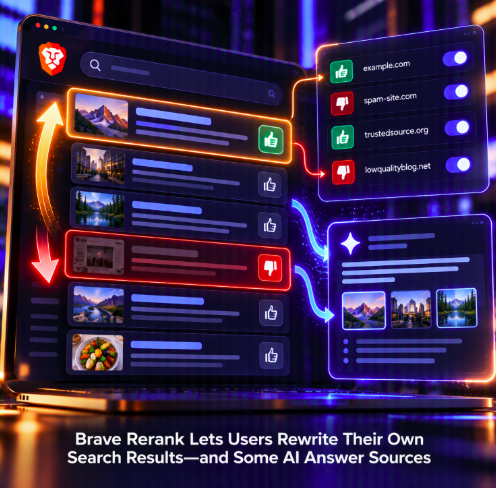
Brave Search gives users something search engines usually keep for themselves: a direct control over ranking. Rerank lets an individual boost domains they prefer or remove domains they do not want to see, changing future Brave Search results on that device. Brave’s official Rerank announcement describes the feature as an explicit alternative to opaque personalization, with users deciding which domains should rise or disappear rather than leaving those preferences entirely to an unseen personalization system.
The feature is free across searches on Brave Search, but its significance extends beyond a customized SERP. Brave also says its generative Answer with AI feature can benefit from Rerank changes: some, though explicitly not all, of the information used to generate an AI answer can come from the user’s newly modified search results.
That creates an unusual visibility model. A domain can have one position in Brave’s baseline ranking, a different position for a user who has explicitly boosted it and potentially a different chance of participating in that user’s AI answer. Search ranking becomes partly user-editable, and part of the generative retrieval layer can inherit those edits.
Rerank operates at the domain level
Brave’s implementation is deliberately simple. A Rerank panel on the search results page lists domains and gives users controls to raise or discard them. Once a domain is raised, Brave boosts it higher in the results that particular user sees. Once discarded, the domain is no longer included in that user’s results. Either preference can later be changed or undone.
This is not a publisher-facing ranking tool. A site owner cannot use Rerank to raise a domain for the broader Brave audience, and one user’s preference does not modify Brave Search globally. Brave explicitly says the changes apply only to the user who makes them and only on that user’s device.
That distinction prevents an obvious misinterpretation: receiving a thumbs-up does not create a conventional ranking signal that other users inherit, at least according to Brave’s published description.
Brave is making personalization explicit instead of inferred
Most search personalization is difficult for a user to inspect. Location, language, account history, previous activity and inferred preferences can change results without exposing a simple list of ranking adjustments.
Brave’s approach is intentionally different. The company frames Rerank as explicit input under the user’s control and contrasts it with opaque personalization. A professional interior designer, for example, could suppress consumer DIY sites that repeatedly add noise to work-related searches and boost specialist publications the designer already values.
The result is closer to a personal domain preference layer applied on top of the underlying search ranking than to an invisible behavioral profile.
The most important detail for GEO is the connection to AI answers
Rerank becomes more than a SERP customization feature because Brave says Answer with AI can source some of its information from the modified result set. The wording is important: Brave says “some (though not all)” information, so a user’s domain preferences do not completely determine the AI answer’s sources.
Still, the connection demonstrates a concrete mechanism by which personal ranking preferences can reach the generative layer. A domain that one user boosts may receive greater prominence in that person’s conventional results and may also become part of the search results feeding some AI synthesis.
Conversely, a discarded domain can disappear from that user’s visible results. Brave does not say that Rerank guarantees the domain can never influence any AI answer through any other mechanism, so that stronger conclusion would not be supported by the announcement.
The same query can therefore have a user-specific source environment
SEO rank tracking assumes that, after controlling for variables such as country, device and language, a query has a reasonably reproducible result set. Rerank adds a variable that external measurement cannot infer from the query text alone.
Two people can type the same words into Brave Search while one has raised a specialist domain and the other has discarded it. Their result pages can diverge by design. If they trigger an AI answer, some of the underlying source environment can diverge as well.
This resembles a broader measurement problem NetContentSEO has examined in its analysis of personalized AI Search recommendations: a reproducible query does not necessarily imply a reproducible answer environment. Brave’s implementation is different because Rerank is explicit and locally controlled, but the measurement consequence is similar.
Rerank is powered by Brave’s older Goggles technology
Rerank did not require Brave to invent a new ranking-customization layer from scratch. The company says the feature is powered by Goggles, technology introduced in June 2022 that lets people create, apply and share custom filters capable of changing how Brave Search results are ranked.
Goggles can support more elaborate configurations, including community-created ranking perspectives and niche search use cases. Rerank is designed as the easier interface: users do not need to create a Goggle or understand its configuration language to tell Brave that they want more of one domain and none of another.
Brave explicitly says Rerank is not a replacement for Goggles. It is a faster, more accessible way for an individual to achieve a related form of ranking customization.
This creates a form of domain-level loyalty inside search
Search engines traditionally make publishers compete again on every query. Strong authority and relevance can make a domain recur frequently, but the user usually does not have a persistent “show me more from this publisher” ranking switch.
Rerank creates exactly that kind of explicit preference. Once a user raises a domain, that choice can influence subsequent searches rather than only the current result page. For publishers with distinctive expertise, this introduces a new type of value: earning enough trust that a user deliberately asks the search engine to prioritize the domain in the future.
There is no public Rerank optimization program and no evidence that publishers can directly measure how many users have raised or discarded their domains. The strategic point is therefore behavioral rather than tactical. Brand trust can become an explicit personal ranking preference instead of remaining only an indirect engagement signal.
Discarding a domain is stronger than simply ignoring it
A poor search result can normally be skipped while remaining eligible to appear again on another query. Rerank lets the user make that rejection persistent: Brave says discarded domains will no longer be included among that user’s results until the preference is changed.
That makes repeated dissatisfaction potentially more consequential for the individual search experience. A site that consistently produces irrelevant listicles, intrusive pages or weak answers can be removed from that user’s future result set with one explicit action.
Again, this is not described as a global quality penalty. The domain remains eligible for other Brave users. Rerank converts an individual judgment into an individual ranking rule.
Privacy is part of the implementation
Brave says Rerank does not track users. The technical note in its announcement says the preferences are stored locally in browser cookie storage and passed to Search through a cookie. The modifications can be cleared from Search settings or by clearing the relevant local storage.
Brave also says it does not use the Rerank cookie to track user queries. This architecture fits the company’s broader positioning: personalization exists, but the preference is explicit and stored as a user-controlled configuration rather than being presented as the output of a hidden behavioral profile.
Rerank complicates the meaning of “ranking position”
For SEO teams, a Brave ranking can now have at least two meanings. There is the baseline ranking generated by Brave Search, and there is the result an individual user sees after applying personal Rerank preferences.
Rank trackers can reasonably measure the first. They cannot know the second without reproducing the user’s local configuration.
This does not make rank tracking useless. It changes the interpretation of the number. A clean browser with no Rerank preferences provides a baseline, not a guarantee that every Brave user sees the same ordering.
AI citation monitoring inherits the same limitation
If some Answer with AI sources can be drawn from Rerank-modified search results, AI visibility measurement also needs a baseline concept. A monitoring platform can test Brave’s default environment, but it cannot claim that every user will receive identical sources when individual Rerank configurations are unknown.
This reinforces the distinction between ranking and AI citation already visible across other search systems. NetContentSEO’s review of a large Google AI Overview study found that AI sources and first-page organic rankings can diverge substantially. Brave adds another layer: a user can explicitly modify the upstream result set itself.
Rerank predates Ask Brave, but the architecture is newly relevant
The publication date is important. Brave introduced Rerank on January 23, 2025, so it should not be reported as a new 2026 launch. At the time, Brave’s generative feature was called Answer with AI, and the company documented the connection between Rerank preferences and some of the sources used by that system.
That earlier design has become more strategically interesting as Brave has expanded its conversational search stack. The underlying idea is durable: search personalization can happen before generative synthesis, meaning changes to retrieval can propagate into the AI layer.
Any claim about precisely how Rerank interacts with newer Brave AI experiences beyond what Brave has documented would require newer technical confirmation. The 2025 announcement specifically supports the relationship with Answer with AI.
Search personalization becomes visible and inspectable
The most distinctive part of Rerank may be that it exposes a ranking preference that users can see, modify and reverse. Search engines have always made ranking choices, and personalization has long introduced additional variation. Brave turns part of that process into a control panel.
For users, the value is straightforward: suppress domains that repeatedly waste time and favor sources they trust. For publishers, the implication is less about manipulating a new signal and more about earning durable preference. A domain that becomes a user’s chosen source can receive an explicit advantage inside that person’s search experience.
And because Brave says some AI answer information can be sourced from those modified results, the preference can reach beyond the blue-link ranking. Rerank demonstrates a model of AI search in which the user does not merely personalize the answer after generation—the user can alter part of the retrieval environment that helps produce the answer in the first place.