
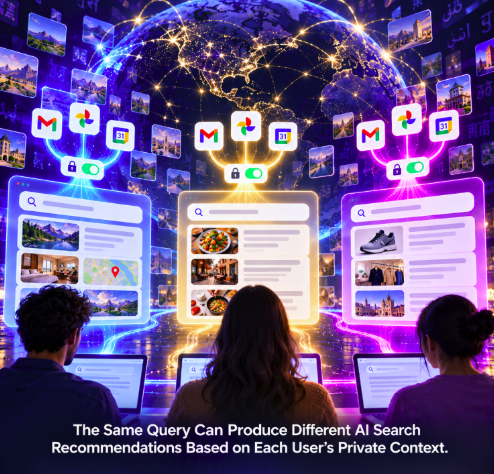
Google is globalizing a form of Search personalization that makes the idea of one reproducible answer to one query increasingly fragile. Personal Intelligence in AI Mode is expanding to nearly 200 countries and territories across 98 languages with no subscription required, allowing users who opt in to connect personal Google data so Search can tailor answers and recommendations to their individual context.
Google announced the expansion at I/O 2026, stating that AI Mode can securely connect apps such as Gmail and Google Photos, with Google Calendar coming next. The company describes Personal Intelligence as a way to combine the world’s information with insights that are uniquely relevant to the person asking the question. citeturn0search1turn0search4
The implications for SEO and GEO go beyond personalization as a convenience feature. Two people can express the same broad need while carrying different histories, purchases, travel plans and preferences inside their connected Google accounts. AI Mode can use that private context to decide which recommendations make sense for each person, making identical prompt wording an increasingly incomplete predictor of what Search will show.
Personal Intelligence moves from a premium U.S. experiment to global free availability
Google first brought Personal Intelligence to AI Mode in January 2026 as an opt-in Labs feature for Google AI Pro and Ultra subscribers in English in the United States. At that stage, users could connect Gmail and Google Photos so AI Mode could use details from those apps to produce more tailored Search responses. citeturn0search0
In March, Google expanded Personal Intelligence in the U.S. and made it available in AI Mode for free-tier users. The I/O announcement then widened the footprint dramatically: nearly 200 countries and territories, 98 languages and no subscription requirement. citeturn0search2turn0search1
This progression matters because personalization is no longer confined to a small population of paid early adopters. Google is turning private-context reasoning into a broadly distributed layer of AI Search.
The same public web can produce different recommendations for different people
Personal Intelligence does not replace Google’s public information systems. It adds a private context layer to them. Search can still retrieve information from the web, but it can interpret that information against what it knows from the user’s connected data.
Google’s early examples make the mechanism tangible. Someone searching for sneakers could receive a recommendation influenced by a brand they recently purchased. A person planning a family trip could have AI Mode reference a hotel booking in Gmail and travel memories in Google Photos to suggest an itinerary suited to that family rather than a generic list of attractions. citeturn0search0
The public candidate set may overlap between users, but the relevance of each candidate can change once private context enters the reasoning process.
Ranking observation becomes harder when the user is part of the query
SEO measurement has always dealt with personalization variables such as location, language, device and search history. Personal Intelligence adds a qualitatively richer source of variation because the system can reason across private content rather than merely apply a small set of contextual signals.
A rank tracker can reproduce the visible words in a query. It cannot reproduce another person’s inbox, photo history, remembered preferences or upcoming calendar commitments. Even if two tests use the same language, country, device and prompt, they may not represent the experience of an opted-in user whose private context changes the recommendation problem.
This does not make measurement impossible. It changes what a benchmark means. A clean, non-personalized prompt test becomes a baseline rather than a universal representation of what every user will see.
Google’s own Help documentation makes personalization broader than connected apps
Google’s current Search Help documentation says Personal Intelligence in AI Mode can also reference previous searches and activity saved in Search Services History to tailor suggestions to a user’s tastes and preferences. Connecting Google content apps then enhances that personalization further. citeturn0search5
The documentation currently describes the connected-content layer as beginning with Workspace apps including Gmail and Calendar plus Google Photos. It also notes that users can connect or disconnect those apps and that personalization requires the relevant settings and eligibility conditions. citeturn0search5
This is important because Personal Intelligence should not be reduced to “Search reads Gmail.” It is a broader personalization architecture in which Search activity, explicit preferences and connected content can all contribute context.
Calendar turns personalization from historical preference into future constraint
Gmail and Photos can reveal purchases, confirmations, memories and recurring preferences. Calendar adds another dimension: what the user plans to do next.
Google’s I/O announcement says Calendar connectivity is coming to AI Mode alongside Gmail and Photos. That can make future commitments part of the relevance problem—for example, whether a recommendation fits an upcoming trip, meeting, event or available time window. citeturn0search1turn0search4
Google has not documented every way Calendar context will affect Search recommendations, so specific ranking effects should not be invented. The strategic direction is nevertheless clear: AI Mode is gaining access, with permission, to context that can explain not only what a user liked before but what they are preparing to do.
Personalization can change which commercial option is useful
This becomes particularly consequential in shopping, travel and local discovery. A generic recommendation system can ask which product, hotel or restaurant is broadly relevant. Personal Intelligence can ask which one fits this person.
A traveler’s existing hotel reservation can alter which restaurants are convenient. Past photographs can suggest the kinds of activities the family actually enjoys. Previous purchases can make one brand more relevant than another. Calendar context could make an otherwise attractive option impractical because it conflicts with an existing commitment.
The result is a form of AI Search where relevance increasingly includes personal compatibility.
Brands cannot optimize directly for someone’s private inbox
This creates an obvious limit for GEO. Publishers and merchants cannot see or target the private context Google uses for another person’s Personal Intelligence experience, and they should not try to infer sensitive personal information from individualized results.
The controllable side of the equation remains the public information a brand provides: accurate product details, clear entities, current availability, useful reviews, strong first-party evidence and content that explains who an offering is appropriate for.
Those details give AI Mode material it can match against user-specific constraints without the publisher needing access to those constraints.
Specificity becomes more valuable when the matching happens privately
Generic marketing language is difficult to match precisely against a detailed personal need. Concrete attributes are more useful.
A hotel that clearly documents accessibility, neighborhood, family facilities, transport links and check-in constraints gives the system distinct facts it can evaluate. A product page with dimensions, compatibility, price, materials and use cases supplies similarly precise evidence.
Google has not announced a special Personal Intelligence ranking checklist. The logic is more fundamental: if personalization depends on matching public options to private constraints, the public options need to be described clearly enough to distinguish them.
Search recommendations become less reproducible across screenshots
This also changes how marketers should interpret screenshots of AI Mode. A single result captured from one account can demonstrate that a brand appeared for that user at that moment. It cannot establish that every user asking the same question will receive the same recommendation.
The problem becomes especially acute when Personal Intelligence is enabled. The private context that helped produce the response is not available to an external observer, and the user may not even know which individual memory or preference influenced the recommendation unless the interface explains it.
Google acknowledges that Personal Intelligence can make mistakes or connect unrelated topics. Users can correct the system through follow-up responses and feedback. citeturn0search0
Privacy controls are part of the product, not an optional footnote
Google repeatedly describes connected-app personalization as opt-in. Users choose whether to connect apps and can turn connections off. The company also says AI Mode does not train directly on a user’s Gmail inbox or Google Photos library; Google has described training as using limited information such as specific AI Mode prompts and model responses to improve functionality. citeturn0search0turn0search2
Current Search Help documentation adds an important scope detail: when a user consents to connecting Google content apps to Search services, that permission can apply across services including Search, AI Mode, Discover, Maps, Shopping, News, Flights, Hotels and Translate. citeturn0search5
That makes the personalization architecture larger than one AI Mode answer surface. Publishers should follow Google’s documented controls and product behavior rather than assuming that private data is universally active for all users.
The private context layer compounds AI Mode’s existing query fan-out
AI Mode already decomposes complex questions through query fan-out, issuing related searches across subtopics and data sources. Personal Intelligence can influence the problem before or during that retrieval process by supplying constraints that were never typed into the prompt.
A user may ask a simple question such as where to eat during an upcoming trip. Gmail can establish where the hotel is, Photos can reveal previous preferences, and the resulting information need can become much more specific than the visible wording suggests.
NetContentSEO has documented how AI Mode’s query fan-out expands one request into multiple retrieval paths. Personal Intelligence adds another source of hidden variation to those paths: user context that is unavailable to publishers and conventional keyword tools.
Follow-up queries make personalization cumulative
The personalization effect also unfolds across a conversation. AI Mode preserves context as users ask follow-up questions, meaning a personalized starting point can lead into increasingly specific later turns.
NetContentSEO recently covered how AI Overview follow-ups can flow directly into a persistent AI Mode journey. Personal Intelligence makes those journeys even less reducible to a single keyword because the system can combine conversational context with account-level context.
A brand invisible in the broad first answer may become relevant after personal constraints surface. Another may disappear because the system learns that it does not fit the user’s situation.
Personal Intelligence complicates share-of-voice metrics
AI visibility platforms commonly estimate brand presence by running standardized prompts repeatedly and measuring citations or mentions. That remains useful for comparing public, reproducible conditions, but it cannot fully represent a system that deliberately personalizes outputs using inaccessible private data.
A brand could perform strongly in neutral prompt tests while being filtered out for many personalized users because its offering conflicts with their constraints. The reverse is also possible: a niche product might appear infrequently in generic tests but become highly relevant to the smaller group whose personal context matches it precisely.
That means AI share of voice should increasingly be interpreted as a sampled visibility measure, not a universal probability that any individual user will see the same answer.
Google is making Search more personal at the same time it makes it more agentic
The Personal Intelligence expansion is arriving alongside a broader redesign of Search around persistent agents, multimodal prompts, generated interfaces and action-taking capabilities.
NetContentSEO has covered how Google’s information agents can monitor the web continuously and how Local Search can gather pricing and availability and call businesses. Personal Intelligence gives those increasingly agentic experiences a richer understanding of the person they are helping.
The combination matters. An AI system that knows public information, can retrieve continuously, can take actions and can reason over private user context is operating under a very different relevance model from a static ten-blue-links SERP.
The optimization target becomes eligibility for many personal contexts
Publishers cannot know which email confirmation, photo memory or future calendar event will shape an individual AI Mode session. They can make their own information precise enough to remain useful across many possible contexts.
That means documenting differentiating attributes, keeping changing facts current, establishing clear entity relationships and publishing evidence that helps the system determine when an offering fits—and when it does not.
The goal is not to produce one page that “wins” every personalized answer. Personal Intelligence makes that objective increasingly unrealistic. The more durable objective is to be a strong candidate whenever the user’s private constraints genuinely match what the publisher offers.
There is no longer one complete answer to “what does Google show for this query?”
Google’s expansion of Personal Intelligence makes that question harder to answer without specifying the user context. Nearly 200 countries and territories and 98 languages are being brought into a free, opt-in system that can connect Gmail and Photos, with Calendar joining the experience. citeturn0search1turn0search4
The visible query still matters. Public web content still matters. Search history, conversation state and location can still matter. Personal Intelligence adds another layer in which private information can change which recommendation is most appropriate for the person asking.
For SEO and GEO measurement, the implication is straightforward but profound: identical prompts no longer imply identical relevance conditions. The same query can lead to different AI Search recommendations because the user has become part of the query.