

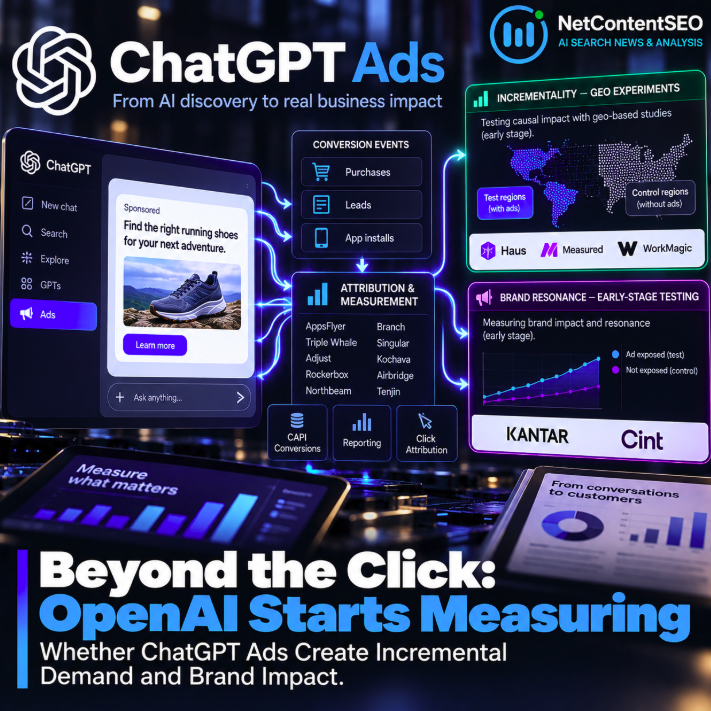
OpenAI is moving ChatGPT Ads beyond conventional click attribution by beginning to test whether advertising inside ChatGPT creates incremental business demand and measurable brand impact.
In an official October 5, 2026 measurement update, OpenAI announced early-stage incrementality work with Haus, Measured and WorkMagic, alongside brand resonance testing with Kantar and Cint. The initiative expands ChatGPT Ads measurement from direct response into causal and upper-funnel questions that conventional click reporting cannot answer on its own.
OpenAI wants to measure what would not have happened without the ad
Incrementality is different from attribution.
Attribution asks which advertising interaction receives credit for a purchase, lead, install or signup. Incrementality asks a harder causal question: would that outcome have happened if the advertising had not been shown?
OpenAI says its incrementality work is still in the early stages. The company is partnering with Haus, Measured and WorkMagic to explore geo-based experiments designed to estimate the causal impact of ChatGPT Ads.
These experiments can compare outcomes between geographic test and control groups, helping advertisers distinguish demand generated by the campaign from conversions that might have occurred anyway.
Brand resonance enters the ChatGPT Ads measurement stack
OpenAI is also beginning early-stage testing with Kantar and Cint to measure the effect of ChatGPT Ads on brand resonance metrics.
This extends measurement beyond immediate performance outcomes. A ChatGPT ad may influence awareness, consideration or preference even when the user does not immediately click the sponsored placement.
That distinction is particularly relevant in a conversational environment where users may be researching a problem, comparing alternatives or working through a purchase decision over multiple interactions.
ChatGPT Ads is becoming a full measurement stack
The incrementality and brand measurement pilots sit alongside a broader expansion of OpenAI's advertising infrastructure.
OpenAI now supports Pixel and Conversions API signals for actions such as purchases, leads, installs and sign-ups. Hightouch, Tealium and LiveRamp can help advertisers send conversion data from existing systems into ChatGPT Ads.
The platform also supports attribution partners including AppsFlyer, Triple Whale, Adjust, DV Rockerbox, Northbeam, Branch, Singular, Kochava, Airbridge and Tenjin for capabilities including CAPI, reporting and click attribution.
OpenAI additionally names Fospha, Measured and INCRMNTAL among its full-funnel and advanced measurement partners.
Why clicks alone are especially weak in conversational discovery
OpenAI explicitly argues that people often use ChatGPT to work through a task or decision without clicking an ad immediately.
The company's early analysis of global campaigns optimized for deeper-funnel outcomes found that 52.7% of eligible one-day view-through conversions occurred within one hour of the matched ad impression.
That does not prove that every impression caused the conversion. It demonstrates why OpenAI is building incrementality measurement alongside attribution: view-through attribution can identify a relationship, while controlled experiments are intended to estimate causal lift.
An early geo-lift study shows why the distinction matters
OpenAI also highlights an independent WorkMagic geo-lift study involving Dose. According to the announcement, the study estimated 2.3 times more incremental orders than were captured through last-click attribution.
The result should be interpreted as an individual partner study rather than a universal benchmark for ChatGPT Ads. But it illustrates the measurement gap OpenAI is attempting to address.
If conversational advertising influences a purchase without generating an immediate qualifying click, last-click reporting can understate its contribution.
AI discovery is becoming measurable against business outcomes
This development matters beyond paid media.
AI discovery has frequently been difficult to connect to downstream business outcomes because users can encounter brands inside generated or conversational experiences without following a traditional search-result click path.
ChatGPT Ads gives OpenAI a controlled environment in which exposure, conversion signals, attribution settings and experimental measurement can be connected.
For advertisers, that means the value of appearing during an AI-assisted decision can increasingly be evaluated using purchases, leads, app installs, sign-ups and experimentally estimated incremental outcomes rather than clicks alone.
Brand impact may become as important as direct conversion
The Kantar and Cint pilots introduce another dimension.
When a user is asking ChatGPT to understand a category or compare possible approaches, an advertisement may influence how a brand is perceived before the user is ready to transact.
If OpenAI can reliably measure that effect, ChatGPT Ads could be evaluated not only as a performance channel but also as a discovery and consideration channel.
This is still experimental. OpenAI describes both the incrementality work and brand resonance measurement as early-stage initiatives, so advertisers should not interpret them as mature, universally available measurement products yet.
The NetContentSEO takeaway
ChatGPT Ads is beginning to answer a question that will matter across AI discovery: what business value exists when influence happens before or without a click?
Attribution can connect exposures and clicks to reported conversions. Incrementality experiments can test whether advertising actually created additional demand. Brand studies can measure effects that occur before conversion.
Together, those layers move ChatGPT advertising toward a much more complete measurement model.
For GEO and AI visibility research, the broader implication is significant. As AI becomes a discovery surface, measurement is starting to follow the user journey beyond referral traffic. The future value of AI visibility may increasingly be evaluated not only by visits and citations, but by incremental demand, conversion behavior and brand impact.