
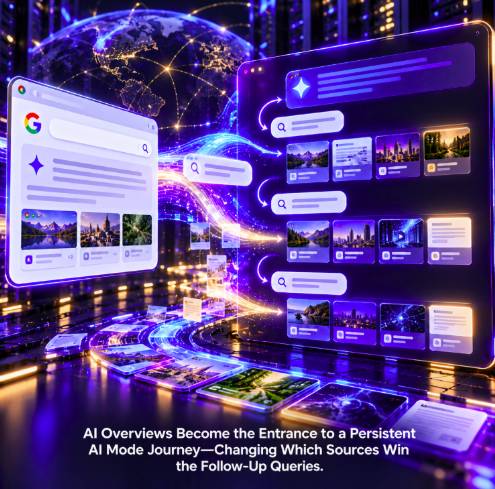
Google has removed another boundary between the traditional search results page and conversational search. Users can ask a follow-up question directly from an AI Overview and continue the exploration in AI Mode with the context of the original search preserved, turning what once looked like a self-contained generated summary into the entrance to a longer AI-mediated discovery journey.
The feature is official, not an interface experiment. Google announced the change on January 27, 2026 in its Search update introducing a more seamless AI experience, and later said at I/O that users can move from a search-results page with an AI Overview into an AI Mode conversation without losing context. Google describes the experience as available globally on mobile and desktop.
For publishers, the most important consequence is that the source competition does not necessarily end with the links attached to the first AI Overview. Once the user asks a follow-up, Google has a new information need to resolve. Different pages can become relevant as the conversation narrows, changes direction or introduces new constraints.
The AI Overview is no longer necessarily the final answer surface
AI Overviews were initially easy to conceptualize as an enhanced search-result feature: Google synthesized information above or among conventional results and attached supporting links. The new handoff makes that model incomplete.
A user can now begin with an ordinary Google query, receive an AI Overview, ask another question from that interface and enter AI Mode. The conversation retains the context already established, so the user does not need to reconstruct the original query or repeat the relevant details.
Google says this makes it easier to move from a quick snapshot into deeper exploration. In its I/O 2026 Search announcement, the company added that links and supporting articles become more relevant as users go deeper into a topic.
That statement is particularly important for GEO. It means the set of useful sources is expected to evolve with the conversation rather than remain fixed around the first query.
A follow-up is a new query for Search Console measurement
Google’s Search Console documentation gives the conversational behavior a concrete measurement consequence. Google says that when a user asks a follow-up question in AI Mode, that interaction is treated as a new query. Impressions, positions and clicks in the resulting response are attributed to that new user query.
A single human research session can therefore generate several distinct Search events even though the person experiences them as one continuous conversation. The first AI Overview can establish the topic, while later turns generate new retrieval opportunities and new source sets.
NetContentSEO recently examined this measurement problem in Google’s evolving definition of position and impressions in generative Search. Persistent conversations make the old idea of one query producing one stable result page increasingly difficult to apply.
The page that wins the opening query may lose the next one
Imagine a user searching for the best laptop for video editing. The initial AI Overview might retrieve broad buying guides and manufacturer specifications. A follow-up asking which option has the quietest cooling system creates a different evidence problem. Another question about battery life while rendering video changes it again. A final question about availability under a specific budget may introduce retailers and current product data.
The topic is continuous, but the source requirements are not. A publisher that appears prominently in the first response may become irrelevant after the user introduces a narrower constraint. Conversely, a specialist page that never had a realistic chance of appearing for the broad opening query can become the best evidence source three turns later.
This is why conversational Search expands the addressable query space for publishers. The opportunity is not only to rank or be cited for the headline topic. It is to supply useful evidence for the questions that emerge after the user begins exploring.
Keyword tools cannot see the whole conversation path
Traditional keyword research is strongest when demand can be represented as repeated, observable query strings. Follow-up conversations are more difficult because the meaning of a short question can depend entirely on what came before it.
“What about battery life?” is not a meaningful standalone keyword. Inside a conversation about video-editing laptops, however, it is a precise request whose context has already been established by previous turns.
NetContentSEO recently explored this problem in The Most Valuable Query May Be the One Keyword Tools Never See. The direct AI Overview-to-AI Mode handoff makes that concept part of Google’s mainstream Search architecture rather than a theoretical chatbot behavior.
Context persistence changes how users formulate searches
When context persists, users can stop writing self-contained queries. They can use pronouns, shorthand and incremental constraints because the system already knows what they are discussing.
This matters for SEO because the visible wording of a follow-up may have little lexical similarity to the pages Google retrieves. The retrieval system must resolve the follow-up against the accumulated conversation state before deciding what information is needed.
A publisher cannot realistically optimize a page for every possible fragment such as “what about the cheaper one?” or “does that apply in Europe?” The more durable strategy is to provide clear, specific evidence that can satisfy the underlying subquestions once Google resolves their context.
Query fan-out can happen again at every stage
AI Mode already uses query fan-out, a technique Google describes as issuing multiple searches across subtopics and data sources to answer complex questions. The visible user prompt is therefore not necessarily the only retrieval query involved even on the first turn.
Follow-ups compound that effect. A user can ask one new question, Google can decompose it into several searches, synthesize another answer and then preserve that expanded context for the next turn.
The result is a branching retrieval journey rather than a linear query-result relationship. NetContentSEO has documented how Google is beginning to expose parts of query fan-out through AI Mode interfaces. Persistent follow-ups make those branches relevant across an entire session.
Google says supporting links become more relevant as the conversation deepens
Google’s own framing is notable because it does not describe conversational depth solely as a way to produce better prose. The company explicitly connects deeper exploration with increasingly relevant links and articles.
That suggests the open web remains part of the retrieval and support layer even as the interface becomes more conversational. It also means source visibility should be evaluated by stage. The best supporting material for an introductory answer is not necessarily the best source for a technical comparison or transactional follow-up.
Publishers should resist turning that statement into an unsupported ranking formula. Google has not disclosed a special “conversation depth” signal or a deterministic method for winning later turns. What it has confirmed is the product behavior: the conversation persists, follow-up questions are supported, and the associated web material can become more relevant as the user explores further.
The follow-up can be more commercially valuable than the first query
Broad opening questions often reveal interest without revealing intent. Later questions can expose constraints that matter much more commercially.
A person may start by asking how heat pumps work, then ask which systems fit a small apartment, what installation costs in a particular region and which providers can install one next month. The commercial opportunity emerges progressively rather than being fully visible in the first search.
In a persistent AI Mode journey, publishers and businesses may therefore compete most intensely at the stage where the user has already supplied several constraints. That stage can contain lower apparent search volume but much higher decision relevance.
The next query may increasingly be shaped by Google itself
Persistent context is only one part of the change. Google has also been testing interfaces in which AI Mode actively proposes or generates follow-up queries, sometimes presenting the conversation as a sequence that users can continue or skip.
NetContentSEO documented that experiment in Google AI Mode Is Testing an Endless Search Journey Built From Automatic Follow-Up Queries. Unlike the official AI Overview handoff, that specific paginated and automatically generated follow-up interface remains a test rather than a confirmed global feature.
The distinction is important, but the direction is coherent. Google has already made the user-authored follow-up a first-class part of Search and is experimenting with taking a more active role in determining what the user might ask next.
Not every link-like element now exits Google
Google has also tested AI Overview interfaces in which some textual links function as follow-up prompts that open AI Mode rather than external publisher destinations. That experiment is separate from the globally available follow-up capability and should not be confused with a universal change to citations.
NetContentSEO covered the test in Google’s AI Overview Links Are Starting to Keep Users Inside Google’s AI Funnel. The broader significance is that Google is creating more pathways from the initial generated answer into continued internal exploration.
For publishers, that makes citation visibility and immediate referral traffic increasingly separate outcomes. A site can contribute information early in the journey while the user’s next interaction stays inside Google and generates a new set of sources.
Analytics needs a conversation model, not only a SERP model
Classic rank tracking asks where a URL appeared for a query. Persistent AI search requires additional questions: at which turn did the source become relevant, what context preceded that turn, and did the citation appear before or after the user introduced a key constraint?
Google’s current reporting does not expose the complete conversation path to publishers. Search Console can count the new query and associated impressions or clicks, but it does not reconstruct the entire preceding AI Mode dialogue for the site owner.
That creates an attribution gap. A publisher may know that a page received visibility for a later query without knowing that the user originally entered Search through a much broader AI Overview several turns earlier.
For GEO measurement, prompt sets should therefore include follow-up paths rather than testing only isolated questions. A page that looks invisible in a one-shot benchmark may become highly visible once the conversation reaches the specific problem the page solves.
Content architecture can mirror the branching questions users ask
Persistent conversations reward depth, but not necessarily page length for its own sake. What matters is whether a site provides distinct, reliable answers to the subproblems that emerge as a user explores a subject.
A strong topic cluster can contain an introductory explanation, comparisons, edge cases, technical specifications, pricing information, troubleshooting and decision-stage guidance. Those resources give retrieval systems multiple opportunities to select the site as the information need evolves.
The objective is not to manufacture hundreds of pages for hypothetical chatbot prompts. It is to map the real questions users ask during research and make sure authoritative evidence exists for the important branches.
AI Overviews are becoming the first turn of Search, not necessarily the last
The most important change is therefore not simply that Google added another follow-up box. It is that the boundary between summary and conversation has been deliberately removed.
A search can begin conventionally, produce an AI Overview and then continue inside AI Mode with the original context intact. Each follow-up can become a new measured query, trigger new retrieval work and surface a different set of supporting sources.
For publishers, the competitive question is no longer only whether a page wins the first answer. It is whether the site contains the evidence Google needs when the user asks the second, third or fifth question.
AI Overviews can now be the entrance to the journey. The source opportunity continues after the first response.