
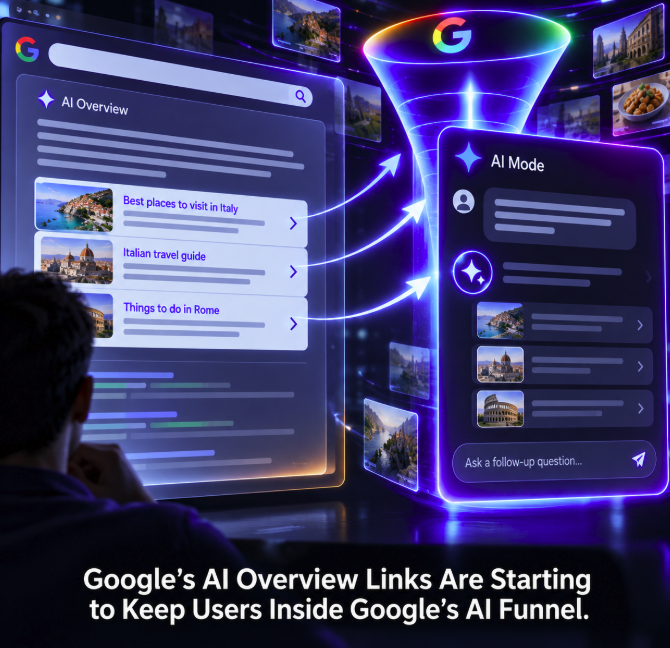
A link inside a Google AI Overview no longer necessarily means a click to the open web. In a newly documented test, Google is displaying normal-looking anchor links near the bottom of AI Overview answers that can open follow-up questions in AI Mode instead of taking the searcher to an external website.
The behavior was spotted by SEO specialist Gagan Ghotra on September 21 and documented the following day by Search Engine Roundtable, which published screenshots and the original video demonstration. The observed links sit inside the AI Overview and visually resemble clickable text, but selecting them continues the research journey inside Google's conversational AI experience.
There is an important qualification: Google has not announced this specific behavior as a broad feature or rollout. The available evidence shows an interface test observed in the wild, not a confirmed permanent change to every AI Overview. Even so, the experiment is notable because it changes the expected destination of one of the web's most familiar interface elements: the hyperlink.
The link is a follow-up question, not a publisher destination
In Ghotra's example, the anchor links appear at the bottom of an AI Overview and function as suggested follow-up questions. Clicking one transfers the user into AI Mode, where the search can continue conversationally. Search Engine Roundtable characterized the behavior as Google placing normal-looking links in AI Overviews that lead to AI Mode rather than webpages.
That distinction matters because AI Overviews already contain several different interaction types, including citations and source cards that can send users to external sites. A searcher scanning the interface may not necessarily interpret every textual anchor as an invitation to remain inside Google. If the experiment expands, publishers and SEO teams will need to distinguish links that cite the web from links that deepen Google's own AI session.
It would be premature to claim that Google is replacing publisher citations with AI Mode links. The observed test concerns specific follow-up anchors, and the AI Overview can still expose external sources. The more precise interpretation is that Google is experimenting with adding internal conversational pathways alongside the outward paths to the web.
Google is building a longer AI search journey
The experiment fits a wider pattern in Google's recent interface testing. AI Mode is increasingly being designed as a place where a search does not end after one answer. Google has been experimenting with query fan-out, automatic follow-ups and controls that allow users to continue exploring related questions without returning to a conventional results page.
NetContentSEO recently documented how AI Mode is turning query fan-out into a more visible, user-steerable interface. Another observed test showed AI Mode automatically generating follow-up queries as part of an extended search journey. The new AI Overview links potentially create another entry point into that same conversational loop.
Instead of a simple sequence—query, answer, website—the journey can become query, AI Overview, follow-up anchor, AI Mode, another generated answer, and only then perhaps an external source. Each additional internal step gives Google another opportunity to satisfy the next information need before the user leaves its environment.
The SEO issue is not just zero-click search
It is tempting to describe every new generative Search feature as another zero-click mechanism, but that framing misses part of what is changing. The more interesting development is the architecture of the search journey itself. Google is not merely answering more questions on the results page; it is connecting its AI surfaces so that one generated experience can lead directly into another.
That creates a different competition for publishers. A page can potentially be selected as evidence for an AI Overview while the most prominent next-step interaction sends the user deeper into Google. The publisher may still gain source visibility and could still receive a later click, but citation exposure and immediate referral traffic become increasingly separate outcomes.
This is already visible in other Google experiments. NetContentSEO recently reported that a “Show more” action inside an AI-enhanced local business panel can open an AI Mode-style conversation. Google is therefore testing similar transitions across more than one Search surface.
Publishers may need to measure the entire funnel
Traditional SEO measurement assumes that a search impression can lead to a click, which can then be connected to behavior on the destination site. Generative interfaces complicate that chain. If a user sees a publisher's information in an AI Overview, follows an internal AI Mode link, asks another question and eventually visits a different source, the original publisher participated in the information journey without receiving the session.
That makes raw citation counts an incomplete performance metric. Publishers increasingly need to know where their content appears, whether it contributes materially to the generated answer, what kinds of interactive elements surround the citation and whether those interfaces encourage an external visit or another Google interaction.
The challenge becomes even more significant if visually similar links can have fundamentally different destinations. One anchor may be a source citation; another may be a suggested query that launches AI Mode. For users, both are ways to continue reading. For publishers, only one necessarily begins with a referral opportunity.
This remains a test, not a declared Google policy
The evidence should be kept proportional to what has actually been observed. Ghotra documented the behavior in a video, and Search Engine Roundtable reported it on September 22. Google has not, based on the available reporting, announced that AI Overview follow-up links will universally route into AI Mode, nor has it published data about how frequently the experiment appears or how users interact with it.
There is consequently no basis yet for estimating traffic impact. An internal follow-up could reduce immediate outbound clicks if it satisfies the next question inside Google. It could also deepen a user's research and ultimately create additional source clicks later in the session. Without controlled traffic data, either effect remains possible.
What can be said with confidence is narrower and strategically important: Google is testing an AI Overview interface in which some normal-looking textual links are not exits to websites at all. They are entrances to another Google AI experience.
The hyperlink itself is becoming ambiguous
For more than two decades, the basic promise of search has been easy to understand: Google organizes information and links users to destinations on the web. AI search is making that boundary less obvious. A citation can still lead outward, but a related anchor can now function as a prompt, a follow-up query or a transition into another generated interface.
That does not mean the open web has disappeared from Google's AI products. AI Overviews and AI Mode continue to surface web sources, and Google has repeatedly emphasized links as part of its AI Search experiences. But the observed test shows that external navigation is no longer the only role a hyperlink-shaped element can play inside an AI answer.
For publishers, the strategic question is therefore shifting. It is no longer only whether a site appears in an AI Overview. It is where the user is invited to go next. If more of those next steps point from one Google AI surface to another, the search funnel becomes longer, more conversational and increasingly controlled before the publisher click ever occurs.