
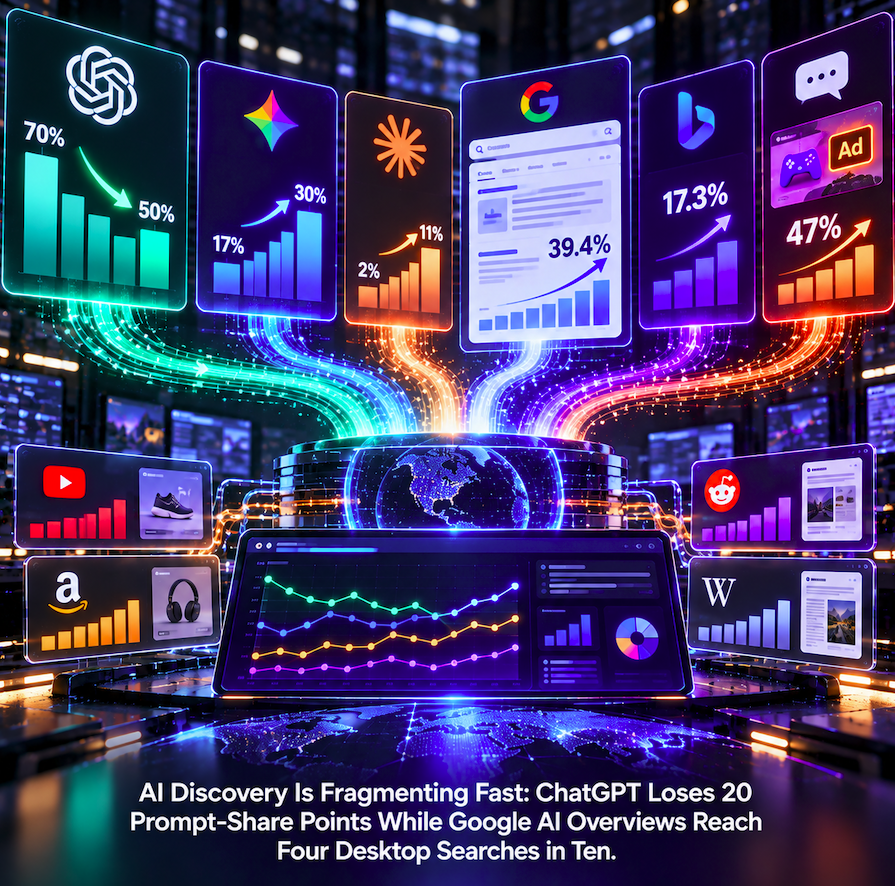
AI discovery is fragmenting in two directions at once. Users are spreading their prompts across more standalone assistants, while generative interfaces are appearing inside a growing share of conventional search sessions. Comscore’s Q2 2026 AI Intelligence Report captures both movements: ChatGPT’s share of measured AI prompts fell from roughly 70% in January to 50% in June, while Google AI Overviews appeared in 39.4% of measured Google desktop searches by June.
The findings come from Comscore’s official Q2 AI Intelligence Report 2026, released September 22. Comscore says the report is powered by its panel data and examines assistant adoption, prompts, citations, AI search and the early appearance of sponsored ads in ChatGPT. The measurements describe behavior observed in Comscore’s U.S. opt-in panels and should not be interpreted as universal market shares for all users, devices or countries.
ChatGPT still leads prompts, but its lead narrowed sharply
In Comscore’s measured prompt distribution, ChatGPT fell from approximately 70% in January to 50% in June 2026. That is a decline of 20 percentage points in share over five months, even though the figure by itself does not establish that the absolute number of ChatGPT prompts declined.
The lost share was accompanied by rapid growth among alternatives. Gemini rose from 17% to 30%, while Claude increased from 2% to 11%. The result is a substantially less concentrated prompt market by June: ChatGPT remained the largest individual assistant in the panel, but competitors collectively accounted for roughly half of measured prompts.
This is an important denominator distinction. Prompt share measures how activity is distributed among the AI assistants Comscore observes. It does not measure referral traffic to websites, citation share, total search volume or the number of unique people using each service. A platform can lose prompt share while continuing to grow if the overall category expands faster around it.
Referral dominance and prompt dominance are now telling different stories
The Comscore figures arrive alongside referral datasets that make ChatGPT look much more dominant. NetContentSEO recently covered BrightEdge data putting ChatGPT at 95.1% of measured AI referral traffic. Another current analytics panel from Trakkr puts ChatGPT lower, at 86.9%, but still overwhelmingly ahead of competing AI sources in identifiable website referrals.
Comscore’s 50% prompt share is not inconsistent with those figures because it measures a different event. A user can send many prompts to an assistant without ever leaving it for an external website. Another assistant can represent a smaller portion of prompts while generating outbound links at a different rate. Usage share and referral share therefore describe separate parts of the discovery funnel.
For marketers, this means there is no single defensible “AI market share” metric. The relevant share depends on whether the question is about prompts, users, citations, outbound traffic, commercial conversions or presence inside traditional search.
Google AI Overviews reached 39.4% of measured desktop searches
The second major shift is happening inside Google rather than in standalone chatbots. Comscore reports that AI Overviews appeared on 25.8% of measured Google desktop searches in January and 39.4% in June. That places the generative layer in nearly four out of every ten desktop Google searches observed by the panel at the end of Q2.
The figure should not be generalized to every Google query worldwide. AI Overview triggering varies by query type, market, device and product availability, while Comscore’s report is based on its own measured U.S. environment. It nevertheless illustrates why treating “AI search” as traffic to standalone assistants misses a large part of the transformation.
A user can remain on Google, issue what looks like a conventional web search and receive a generative answer before interacting with organic results. From the publisher’s perspective, that experience sits inside the familiar Google channel even though the discovery interface has materially changed.
Bing is adding its own generative layer to conventional search
Comscore reports a similar, though smaller, pattern for Microsoft. Copilot Search appeared in 17.3% of measured Bing searches in June. The number reinforces the idea that AI discovery is not a separate destination competing cleanly against search engines; it is increasingly a presentation layer embedded inside them.
This complicates channel analysis because a website visit influenced by an AI-generated search interface can still arrive as ordinary search traffic. The user may have received a synthesized answer, followed citations or continued researching within an AI-enhanced interface, while analytics records the eventual session under the same broad source category used before generative search existed.
The practical consequence is that chatbot-referral dashboards can understate AI’s role in discovery. They see the traffic that visibly leaves an assistant, but much of Google and Bing’s AI-mediated behavior remains nested inside traditional search ecosystems.
Retail citations show that discovery power is distributed across source ecosystems
Comscore’s retail citation analysis adds another layer of fragmentation. In the report’s measured retail environment, YouTube led cited sources at 23%, followed by Amazon at 14%, Reddit at 12% and Wikipedia at 11%. These are very different source types: video, commerce, community discussion and reference content.
The distribution challenges any assumption that AI discovery can be optimized entirely through a brand’s own website. A model answering a retail question can construct its evidence from product pages, marketplaces, videos, discussions and reference sources. Brand visibility therefore depends partly on how a company is represented across an external information ecosystem it does not fully control.
This fits a broader pattern NetContentSEO recently documented in research showing that different AI interfaces can expose dramatically different source sets. There is no single universal citation graph waiting to be optimized. The source landscape changes by product, interface, query and retrieval system.
ChatGPT ads are already visible in commercial conversations
Comscore also examined the early penetration of sponsored placements inside ChatGPT. In June, the report found sponsored ads in 47% of measured ChatGPT conversations related to video games. That does not mean 47% of all ChatGPT conversations contained advertising; the statistic belongs to a specific commercial topic in Comscore’s observed sample.
The finding is nevertheless notable because it shows paid discovery becoming measurable inside conversational behavior rather than only as a separate advertising-platform launch. OpenAI is simultaneously building a self-service ad marketplace around contextual conversation signals, creating a paid layer alongside organic AI mentions and citations.
For marketers, this introduces another visibility category that cannot be merged with prompt share or organic citations. A brand can appear because the model selected it organically, because a source mentioning it was cited, or because the advertiser purchased a clearly separated sponsored placement. Those outcomes require different measurement and optimization systems.
The report’s own charts require cautious reading
Comscore’s report is useful precisely because it combines multiple layers of AI behavior, but some of its chart labels and accompanying narrative do not align perfectly. Where a caption, prose statement and plotted value differ, the safest interpretation is to treat the figures as panel estimates rather than false precision about the entire market.
The broader methodological limit is equally important. Comscore’s measurements derive from opt-in panel behavior, not a census of every prompt or search. Panel composition, device coverage, observed services and classification rules can all affect the resulting percentages.
That does not make the directional changes uninformative. A 20-point movement in ChatGPT’s measured prompt share, a 13.6-point increase in AI Overview presence and large gains for Gemini and Claude together describe a clear pattern inside Comscore’s measurement environment: AI discovery is becoming more distributed.
Search visibility now needs multiple denominators
The strategic mistake would be to put all of these numbers into one market-share chart. ChatGPT’s 50% prompt share and its roughly 87% to 95% share in two recent AI-referral datasets can both be true because they answer different questions. Google AI Overviews appearing on 39.4% of desktop searches is yet another denominator, measuring the presence of an AI feature within Google rather than competition among assistants.
A useful AI visibility dashboard therefore needs to separate at least four layers: where people ask questions, which sources models retrieve or cite, which AI products send measurable website traffic, and how often generative interfaces appear inside traditional search. Combining them into a single percentage produces a cleaner chart but a less accurate picture of discovery.
The distinction also matters for resource allocation. A publisher may prioritize ChatGPT when referral traffic is the objective while investing heavily in Google because AI Overviews mediate a much larger existing search audience. A retailer may care about YouTube and Amazon because those ecosystems repeatedly supply cited evidence. The appropriate strategy depends on the business outcome being measured.
The emerging market is not winner-take-all discovery
Comscore’s Q2 data suggests that the next phase of AI discovery will be defined less by one assistant replacing search and more by generative interfaces spreading across multiple products. ChatGPT remains a major prompt destination. Gemini and Claude are taking a larger portion of assistant activity. Google and Bing are embedding AI directly into web search. Advertising is entering conversations. And citation systems are drawing from heterogeneous source ecosystems.
That fragmentation makes simplistic “ChatGPT versus Google” narratives increasingly inadequate. The same person can research a topic through Gemini, encounter an AI Overview on Google, ask Claude for a comparison and later click a ChatGPT citation. Each system can occupy a different stage of the journey.
For GEO and SEO teams, the implication is not that ChatGPT has suddenly become unimportant because its measured prompt share fell. It is that dominance depends on the metric. Comscore’s panel shows a prompt market becoming more competitive at exactly the same time that generative search is becoming more common inside the incumbent search engines.
The discovery layer is fragmenting faster than the analytics vocabulary used to describe it. The teams that adapt will be the ones that stop asking which AI platform “owns” search and start measuring where each platform actually enters the customer journey.