

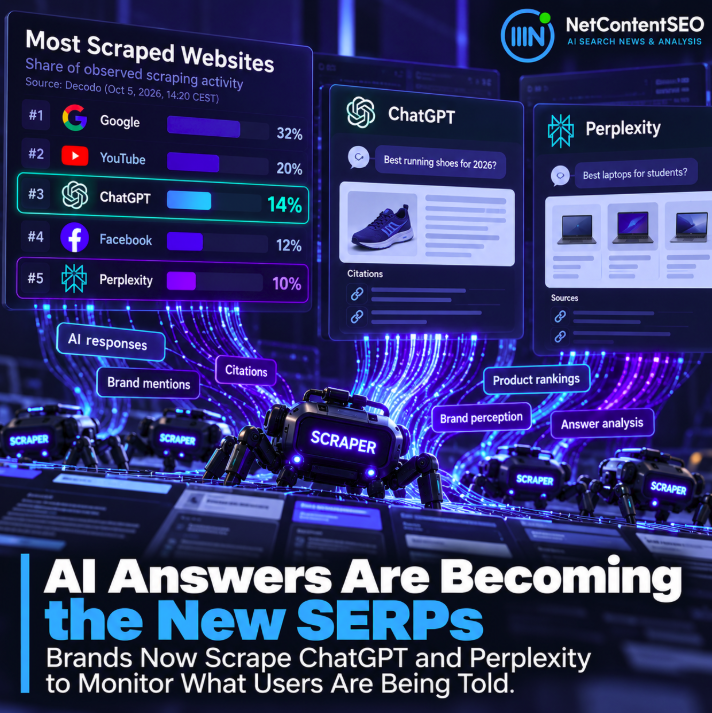
AI answer engines are becoming a new data source for competitive intelligence. ChatGPT and Perplexity have entered Decodo's annual list of the most-scraped websites for the first time, suggesting that companies increasingly want to measure not only what search engines rank, but also what AI systems tell users.
In Decodo's 2026 dataset, ChatGPT ranks third and accounts for 14% of observed scraping activity. Perplexity ranks fifth with 10%. The figures come from anonymized usage data across Decodo's own customer base, so they should be treated as proprietary platform data rather than a measurement of all scraping activity on the web. Decodo's 2026 report
ChatGPT and Perplexity enter the top 10 for the first time
The shift is notable because neither AI answer engine appeared in Decodo's previous top 10. In 2026, ChatGPT moved directly into third place while Perplexity entered at number five.
TikTok leads Decodo's list with 18%, followed by Google at 16%, ChatGPT at 14%, Naver at 11% and Perplexity at 10%. Decodo says only TikTok, Google and Amazon remained in the top 10 from the previous year.
That turnover suggests the targets of automated data collection are changing quickly as user discovery behavior spreads beyond conventional search engines and ecommerce platforms.
AI answer engines and search account for the largest category
Decodo groups AI answer engines and search together and says the category represents 46% of scraping requests in its dataset.
The company explicitly links this activity to GEO tracking and SEO monitoring. That is a useful signal for the emerging AI visibility market: organizations are beginning to treat generative answers as measurable surfaces rather than ephemeral chatbot conversations.
Why would a company scrape ChatGPT?
Traditional SERP scraping answers questions such as: Where does my page rank? Which competitors appear above it? What features are present? Which URL owns the result?
AI answers require a different set of measurements.
A company may want to know whether its brand is mentioned, which competitors are recommended, what product is ranked as the best option, which sources are cited, whether descriptions are positive or negative, and how answers change between prompts, models or locations.
Collecting those answers repeatedly creates the raw dataset needed to measure those patterns.
AI answers are starting to behave like a new SERP dataset
The analogy is not perfect. A generative answer is more variable than a conventional search-result page, and the same prompt can produce different wording or sources across repeated runs.
But commercially, the measurement problem is becoming similar.
Brands want to know what users see at the point of discovery. For years that meant monitoring Google rankings. Increasingly it also means monitoring ChatGPT, Perplexity, Gemini, Copilot and other AI systems.
Mentions alone are not enough
The value of collecting AI answers extends beyond counting brand appearances. A company can be mentioned frequently while being framed as an inferior alternative, criticized for a specific weakness or omitted from recommendation lists where competitors dominate.
That creates several new classes of visibility metric: citation share, recommendation share, sentiment, competitive positioning, product ranking and source attribution.
The rise of tools measuring those dimensions makes large-scale answer collection increasingly valuable.
Product discovery makes this commercially important
AI systems are moving deeper into shopping and recommendation workflows. When users ask for the best laptop, insurance provider, hotel, CRM or running shoe, the generated answer can influence which products enter the consideration set before a user ever reaches a conventional search-results page.
For brands, monitoring those recommendations is therefore not merely a reputation exercise. It can become a form of acquisition and competitive intelligence.
The Decodo figures have an important limitation
The percentages should not be read as a universal ranking of scraping across the entire internet.
Decodo states that its list is based on anonymized user usage data from its own platform. It measures what Decodo customers are collecting, which may differ from scraping patterns across other proxy providers, proprietary corporate infrastructure or the broader web.
There is also no indication that OpenAI or Perplexity supplied these figures. The data is Decodo's observation of its customers' scraping activity.
Scraping AI systems is technically different from crawling websites
AI answer engines are interactive systems rather than static collections of documents. Measuring them reliably can require prompt execution, session handling, rendering, geographic controls and repeated sampling to account for answer variability.
That makes the measurement infrastructure potentially more complex than simply downloading HTML pages.
It also means that methodology matters. A visibility score based on a small synthetic prompt set can produce very different conclusions from one based on thousands of real user questions.
Expect more AI platforms to become data-collection targets
Decodo expects the category to keep changing and points to systems such as Gemini and Copilot as potential future entrants.
That would be consistent with the direction of the GEO tooling market. As brands attempt to compare their visibility across multiple AI engines, collecting comparable answers from each platform becomes a prerequisite for cross-engine measurement.
The NetContentSEO takeaway
The significance of ChatGPT and Perplexity entering Decodo's most-scraped list is not that scraping itself is new. It is what organizations now consider worth scraping.
Search rankings, ecommerce prices and social content are being joined by AI-generated answers, citations and recommendations.
AI answers are becoming the new SERP dataset. As more discovery happens inside generative systems, brands will increasingly monitor those answers with the same intensity that SEO teams once reserved for Google rankings.