
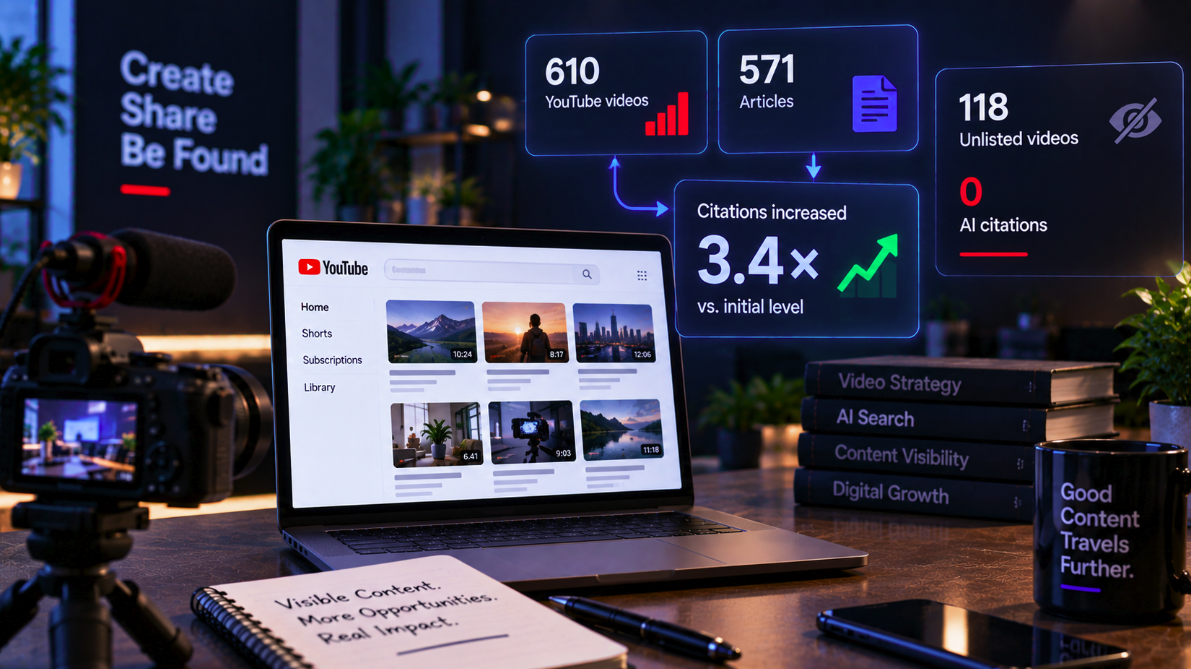
A 107-day AI-search experiment produced one of the starkest visibility splits yet measured for YouTube: 118 videos that remained live and playable by direct link but were set to unlisted received zero citations across the seven AI search engines being monitored.
The result comes from a new OtterlyAI case study with German financial publisher onvista. The broader project turned daily market livestreams into 610 YouTube videos and 571 written articles, then tracked how those assets appeared in AI-generated answers. Campaign citations per day eventually reached 3.4 times the pre-launch baseline.
The headline result is not simply that video worked. It is that public discoverability appeared to matter enormously. Partway through the experiment, onvista began leaving only a small number of each day’s clips publicly listed on its YouTube channel while setting the rest to unlisted. Those clips still existed and worked normally for anyone holding the URL. Across the measured period, however, none of the 118 unlisted videos earned a tracked AI citation.
That does not establish a universal law that every unlisted YouTube video is inaccessible to every AI system. OtterlyAI studied one publisher, one German-language finance prompt set and a defined group of engines during a particular period. But within that experiment, hiding videos from normal YouTube discovery was associated with a complete loss of citation visibility.
The experiment began as a content-repurposing test
onvista already produced a live market show every trading day. Instead of treating each broadcast as one long video, the publisher and OtterlyAI tested whether the same footage could create a larger AI-search footprint when broken into narrower assets.
Between January and August, the production pipeline generated 610 YouTube videos and 571 accompanying written articles. The underlying material came from 140 broadcast days. Rather than requiring hundreds of new shoots, the workflow extracted single-stock clips from programming that already existed.
The AI-search measurement ran for 107 days, from May 12 through August 26. OtterlyAI tracked 125 German-language prompts in Germany across ChatGPT, Google AI Overviews, Google AI Mode, Perplexity, Microsoft Copilot, Gemini and Claude.
Across the campaign, the researchers recorded 2,319 citations: 1,617 to videos and 702 to written articles.
Short, specific clips beat the full daily show
The first major result concerned format. Only 8.6% of the full broadcasts received at least one citation, compared with 27.2% of the short single-stock clips. OtterlyAI calculates that as a 3.2-times higher citation hit rate.
The citation volume per asset diverged even more sharply. Full shows averaged 0.56 citations each, while the clips averaged 4.36, a 7.8-times difference.
OtterlyAI attributes that pattern to topic specificity. A long market show may discuss a dozen companies, while a five-minute video dedicated to one stock is a much tighter match for a question about that company.
That interpretation is plausible, but it should remain an interpretation. The experiment was not a laboratory test that randomly assigned identical assets to different durations while holding every metadata and discovery variable constant. It was a real production workflow. What it demonstrates directly is the observed performance difference between the long shows and the narrower clips.
The unlisted videos created an accidental control group
The most interesting part of the study was not planned in advance. From July 13 onward, onvista changed how it managed the flood of new clips. It kept three clips from each broadcast day publicly listed and left the remaining clips unlisted.
An unlisted YouTube video is not deleted or private. Anyone with its direct URL can still watch it. But it no longer appears normally on the channel page or in YouTube search, and it is removed from much of the public discovery graph that can lead users and automated systems to the asset.
OtterlyAI identified 118 campaign videos that were absent from its scrape of onvista’s publicly listed channel videos. Across 107 days and all seven tracked AI engines, those 118 videos accumulated zero citations.
The contrast was strong enough that the researchers performed an additional matched comparison rather than relying on the raw totals.
A narrower comparison produced 42.4% versus zero
Topic selection could have explained part of the unlisted-video result. If onvista happened to hide clips about companies nobody asked about in the tracked prompts, those videos might have received zero citations regardless of their visibility setting.
To reduce that problem, OtterlyAI limited the comparison to clips published on or after July 13 and to stocks that were actually represented in the tracked prompt set. That produced 33 publicly listed clips and 33 unlisted clips from the same production period and topic universe.
Among the listed group, 42.4% received at least one citation. Among the unlisted group, the rate remained 0%.
That matched comparison makes discoverability a much stronger candidate explanation than the raw 118-video result alone. It still does not prove how each AI engine internally discovered YouTube URLs, but it shows that the visibility setting was associated with a dramatic difference even after narrowing the topic and timing conditions.
Publicly listed did not mean automatically citable
The study also contains an important corrective to an overly simple interpretation. Making a video public was necessary for success in this dataset, but it was nowhere near sufficient.
Of the 610 campaign videos, 17.7% were publicly listed and cited, while 63% were publicly listed but never cited. Another 19.3% were unlisted and never cited.
OtterlyAI found that topic coverage explained much of the publicly listed group that failed. Of the 610 videos, 249 discussed a stock that none of the 125 tracked prompts asked about. Those assets had very little opportunity to match the monitored questions.
When the analysis narrowed to publicly listed single-stock clips about companies represented in the prompt set, 45.8% received citations, averaging 7.44 citations each.
Visibility therefore opened the door. Relevance determined how much opportunity existed beyond it.
The 3.4x campaign lift came from a multi-format program
The study’s overall 3.4-times growth figure should not be misread as the isolated effect of making YouTube videos public. It describes campaign citations per day after onvista scaled a broader content-repurposing system involving both video and written articles.
That distinction matters because the two formats reached strikingly different AI ecosystems.
Among video citations, Google AI Overviews accounted for 56.1% and Google AI Mode for 40%. ChatGPT supplied the remaining 3.9%. Perplexity, Copilot, Claude and Gemini cited none of the 610 campaign videos during the measured coverage.
The written articles showed almost the reverse pattern. Copilot accounted for 43% of article citations and ChatGPT 39.2%, followed by Claude, Google AI Mode, Perplexity, Google AI Overviews and Gemini at much smaller shares.
In this dataset, video was overwhelmingly a Google-surface asset while written content reached a much broader mix of answer engines.
One format did not replace the other
Across the 571 topics for which onvista published both a video and a written article, only 10.5% were cited in both formats. Roughly 31.5% earned a citation somewhere, compared with 17.5% for video alone.
That lack of overlap is strategically important. Repurposing the same underlying expertise into different formats did not merely duplicate the same AI-search opportunity. It created exposure to different engines and retrieval patterns.
OtterlyAI also tested whether the rise in video citations had cannibalized written articles. Its analysis found no evidence for that explanation. Article citation declines appeared instead to track a sharp slowdown in new article production during the campaign.
The practical lesson is not “replace articles with YouTube.” It is closer to the opposite: the formats may cover different parts of AI search.
Video behaved more like a catalogue than a news feed
The researchers found another difference between the formats. Written articles tended to earn citations quickly and decay quickly, while videos often took longer to receive their first citation but continued producing citations from older inventory.
OtterlyAI reports a median of two days from publication to first citation for articles, compared with 23 days for video. Articles remained actively cited for a relatively short period, while the video back catalogue continued producing results even when new clip production paused.
During a three-week publishing pause, video citations actually peaked. That suggests the publicly discoverable video library retained value beyond the day each clip was uploaded.
For organizations already producing webinars, livestreams, interviews or long-form video, that creates an interesting economic argument. The AI-search value may sit not only in the newest upload but in building a searchable catalogue of narrowly focused assets over time.
Views did not predict citation success
The experiment also challenges the assumption that AI systems simply follow YouTube popularity. The median cited video had 888 views, while the median video that was never cited had 947.
In other words, the uncited group was not obviously less popular by this basic audience metric.
That finding fits the broader pattern in the study: discoverability and query relevance appeared more informative than raw view counts for the tracked AI citations.
Again, the result is specific to this dataset. It does not prove that views, engagement or channel authority are irrelevant to every AI retrieval system. It does show that marketers should not assume a video needs viral-scale consumption before it can become useful to an answer engine.
Titles also changed the observed citation rate
onvista changed one recurring word in clip titles during the experiment, replacing the German term “Aktie” with “Analyse.” OtterlyAI reports that the share cited increased from 24.1% to 34.4%, while citations per day live rose by 101%.
The researchers interpret the change as improving the semantic match between the asset and the kind of analytical questions users were asking.
That is another reason the unlisted-video finding should not be reduced to a visibility switch alone. Public availability creates a discovery opportunity, but the asset still needs a topic and description that correspond to real questions.
A publicly listed video about an irrelevant subject remains irrelevant.
Why unlisting may be especially costly for AI discovery
Humans can watch an unlisted YouTube video when someone sends them the link. Automated discovery systems face a different problem: they need some path to find the URL in the first place.
Public channel pages, YouTube search, playlists, embeds, links and other discoverable surfaces create connections between an asset and the wider web. Removing a video from those surfaces reduces the number of obvious discovery paths.
OtterlyAI describes this as removal from the crawlable link graph. That explanation is reasonable, but the experiment cannot establish the exact internal retrieval architecture of all seven AI platforms. Some answer engines may discover YouTube through search indexes, others through Google infrastructure, and others through separate retrieval systems.
The observable result is simpler: in this campaign, the videos that disappeared from public YouTube discovery also disappeared from measured AI citations.
Do not generalize one finance experiment into a universal platform rule
OtterlyAI’s own research methodology explicitly warns against treating its experiments as universal descriptions of AI ranking logic. The company measures public outputs and does not have access to the internal citation systems of ChatGPT, Google, Gemini, Perplexity or other platforms.
The onvista experiment used 125 German-language prompts in one financial-information context. Engine availability also changed during the study: Copilot and Claude began returning citations in the tracked workspace in June, while Gemini first did so in late July. OtterlyAI therefore used the four engines available throughout the period when calculating some growth comparisons.
These limitations do not erase the result. They define its scope.
The strongest claim is that unlisted YouTube videos were effectively invisible inside this measured AI-search environment, including a matched sample where comparable public clips were cited and unlisted clips were not.
Brands should think carefully before cleaning up a YouTube channel with unlisted status
Organizations often unlist videos for understandable reasons. A channel can become cluttered when webinars, product demonstrations, event clips and daily updates accumulate. Marketing teams may want a cleaner public profile while preserving direct links for landing pages or existing customers.
If AI-search visibility matters, the onvista results suggest that choice deserves more scrutiny.
OtterlyAI recommends using playlists, channel sections and ordering rather than unlisting purely for aesthetic organization. Those methods can keep the public channel manageable without removing the asset from normal discovery.
That recommendation should be balanced against legitimate reasons to unlist content. Outdated, inaccurate, sensitive or intentionally limited material should not remain public simply to chase AI citations. Discoverability is a business decision, not an absolute objective.
The bigger opportunity is repurposing expertise that already exists
The most transferable idea in the study may not be the visibility setting at all. onvista did not create 610 completely new editorial concepts. It took an existing daily broadcast and converted it into narrower assets that could answer narrower questions.
Many organizations already own similar raw material: webinars, podcasts, conference panels, product demonstrations, earnings calls, interviews and training sessions. Those long assets may be valuable to committed viewers but poorly aligned with specific search questions.
Breaking them into focused clips can increase the number of distinct topics, titles and URLs through which the underlying expertise can be discovered. Pairing those clips with written articles can extend that footprint to AI engines that do not retrieve much YouTube content.
In the onvista dataset, that multi-format strategy coincided with campaign citation volume reaching 3.4 times its initial level.
Public discoverability appears to be the prerequisite
The study does not prove that YouTube visibility settings are an official ranking signal in any AI engine. It does not show that every public clip will be cited, and it certainly does not establish that every unlisted video everywhere will remain invisible forever.
What it does provide is unusually concrete evidence from a live publishing operation. Across 118 unlisted videos, seven tracked AI engines and 107 days, citations remained at zero. In a narrower matched comparison, 42.4% of public clips earned citations while none of the unlisted clips did.
For brands pursuing generative-engine visibility through video, that makes public discoverability a sensible prerequisite to audit before worrying about more sophisticated optimization.
Your video can contain the perfect answer. But if it is deliberately removed from the places where search and retrieval systems are most likely to discover it, AI visibility may disappear with it.