
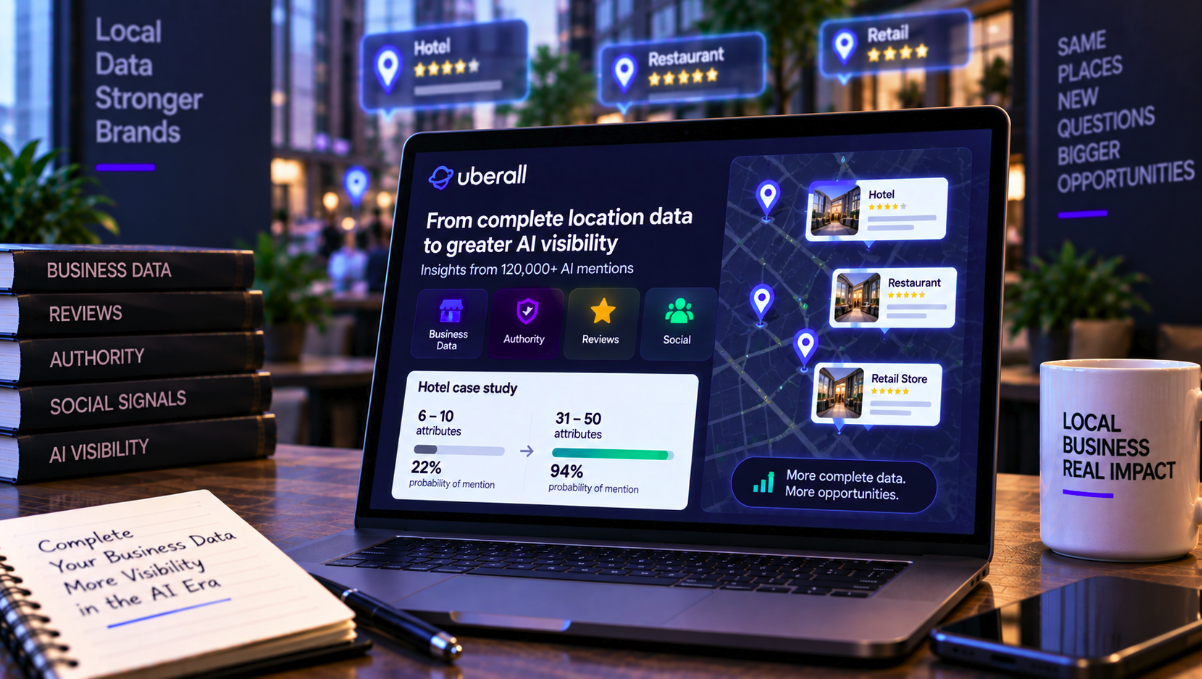
Local SEO has always depended on mundane data: the right address, accurate opening hours, categories, photos, reviews and enough information to distinguish one location from another. A new proprietary study from Uberall argues that those same fundamentals are becoming an eligibility layer for local visibility inside AI answers.
In a sponsored Search Engine Journal article published September 10, Uberall says it analyzed more than 120,000 AI mentions across 3,793 U.S. business locations, covering restaurants, hotels, grocery stores, dentists and banks. The company tested five AI models and grouped the recurring correlations it found into four categories: business data, authority, reviews and social signals. The most striking example comes from hotels, where locations with 6–10 profile attributes were mentioned in 22% of the tested cases, compared with 94% for hotels with 31–50 attributes.
That gap is large enough to attract attention, but the methodology determines what can safely be concluded. This is proprietary vendor research presented in sponsored content, not a randomized experiment or documentation from the AI providers themselves. The public article does not expose enough underlying data and statistical detail to conclude that adding attributes alone causes a location’s mention probability to jump from 22% to 94%. What it does provide is a substantial observational signal that complete, verifiable local information is associated with stronger AI visibility in Uberall’s test environment.
Uberall tested local discovery across five industries and five AI models
Uberall’s broader methodology description says its analyst Katya Shishchenko tested five AI models across real-world local discovery prompts in restaurants, hotels, grocery, dental and banking. The company says it used roughly 9–11 prompt intents per vertical and repeated model-and-prompt combinations 50–100 times, ultimately producing more than 120,000 business mentions. The Search Engine Journal version identifies 3,793 locations across U.S. cities including markets such as Chicago and New York.
The research is useful because local AI recommendations are unusually difficult to study. The same prompt can produce different businesses across models, cities and repeated runs, while some systems use live retrieval and others rely more heavily on information already available in model context or training. Uberall reports substantial model-specific differences: Gemini produced a broader set of restaurants in its tests, ChatGPT generated a more concentrated shortlist, Claude was more conservative in some categories, Grok drew more heavily on Instagram-related information, and Perplexity’s live-search behavior generated more mentions per run.
Those differences make the cross-model patterns more interesting, but they also argue against treating any one correlation as a universal AI ranking factor. Uberall’s “BARS” framework—Business Data, Authority, Reviews and Social—is a useful summary of its observations, not a disclosed scoring system shared by every AI engine.
Complete business data appears to function as an eligibility signal
The strongest practical message concerns profile completeness. Uberall says Google Business Profile richness and business age were associated more strongly with whether a location appeared at all than with how frequently it was mentioned after becoming visible. In other words, some location data may behave more like an eligibility threshold than a conventional ranking boost.
The hotel result illustrates that pattern. In Uberall’s sample, properties with only 6–10 profile attributes had a 22% mention probability, while those with 31–50 attributes reached 94%. Uberall repeats the same finding in its own multi-location SEO analysis and recommends adding every attribute that is genuinely relevant to the business category rather than mechanically maximizing field count.
Other verticals showed different indicators of data richness. A completed business description was associated with a three-fold mention-rate gap for grocery stores, while photo count was the strongest predictor of restaurant mention frequency in the company’s analysis. Top-mentioned restaurants averaged three times as many photos, and photo volume also emerged as an important predictor in dental and banking. These are correlations within Uberall’s dataset, but collectively they support a simple interpretation: an AI system has more evidence with which to understand and verify a location when its public business record is complete.
Authority did not reduce neatly to company size
One of the more interesting findings is that traditional market dominance did not consistently predict AI mention share. Uberall says brand size, measured through indicators such as store count, room supply or deposit share, was a weak predictor of how frequently brands were recommended across the five verticals. Scale did affect whether some brands appeared at all in grocery, hotels and banking, but independent restaurants and dental practices could outperform chains on mention rates.
Other authority signals showed stronger associations. Uberall reports that brands with more than 30 news mentions saw sharply higher mention frequency in banking and a 100% mention rate in its grocery sample. Presence in editorial lists also correlated with visibility: the company points to sources such as Bankrate, Forbes Travel Guide and Michelin, while Wikipedia presence was positively associated with mentions for hotels, grocery stores and banks but not dentists.
The temptation is to label these as direct LLM ranking signals, but that goes beyond the evidence. Editorial coverage and Wikipedia presence can correlate with many other characteristics, including brand awareness, longevity, web citations and the quantity of information available about a company. The study shows that authority footprints travel with stronger visibility in several tested contexts; it does not isolate a universal causal mechanism.
Review volume often mattered more than star ratings
Uberall’s review findings challenge the assumption that a 4.8-star business should automatically be more visible to AI than a 4.3-star competitor. Across all five verticals, the company says review volume predicted AI mentions, while average star ratings were weaker in four of the five categories. Hotels were the notable exception, where Google Business Profile ratings correlated more strongly with both mention probability and frequency.
The vertical differences are substantial. In grocery, Uberall says businesses with higher review volume but lower ratings were mentioned 94.3% of the time, versus 60.6% for high-rated businesses with low review volume. Dentists with 1,000 or more reviews reached a 92.9% mention rate in the dataset, while mentioned practices averaged 643 reviews compared with 253 for practices that were not mentioned. For restaurants, Uberall reports a 93.3% mention rate once Yelp review volume exceeded 1,000.
These thresholds should not become universal targets. They reflect particular businesses, markets, prompts and models in a proprietary study, and review volume is itself correlated with popularity, business age and customer traffic. The safer lesson is that AI systems may have more evidence to work with when a location has a substantial and current body of customer feedback, while a high rating supported by very few reviews can provide a thinner signal.
Social signals appear to work differently by platform and vertical
Uberall also found associations between social presence and AI mentions, but the pattern was not uniform. Facebook follower counts were linked more closely with whether a business entered the generated answer, while Instagram was associated with how frequently certain businesses were discussed once visible. For banks, Facebook follower count was the strongest social predictor in Uberall’s analysis; mentioned dental practices had almost five times as many followers as those not mentioned.
Instagram showed a particularly strong relationship in restaurants and boutique hotels. Uberall says restaurants with both strong Instagram and Yelp footprints were mentioned nearly seven times more frequently than businesses without that combination, while Instagram was the strongest predictor of AI mentions among boutique hotels in its sample. The company also observed that Grok referenced Instagram material more frequently than the other tested models.
Again, the mechanism remains uncertain. Social activity can act as a source of fresh information, evidence of popularity or simply a correlate of brands that invest heavily in digital marketing. The study establishes patterns worth testing, not a reason to buy followers or manufacture activity in pursuit of an assumed AI score.
Local AI visibility looks increasingly location-specific
The broader implication is that a strong national brand may not rescue a poorly documented individual branch. Local recommendations require evidence about a specific place: whether it exists, where it is, what it offers, when it is open and whether people appear to trust it. A corporate homepage can establish the brand, but it cannot always answer those location-level questions.
Uberall’s own research summary on how LLMs obtain business information says its tests covered real-world discovery intents and repeatedly found differences between models using live retrieval and those relying more heavily on existing model knowledge. The company argues that accurate listings across directories, review sites and structured local content provide the public evidence AI systems can use when assembling recommendations.
That framing makes local GEO look less like a new discipline replacing local SEO and more like an expansion of the surfaces local SEO has to serve. Accurate profiles, location pages, reviews, media coverage and social activity already mattered to people and conventional search. AI assistants create another consumer of the same distributed business identity.
The 22% to 94% hotel result is a correlation, not a guaranteed optimization lift
The hotel statistic will inevitably become the headline from this research, so its limitations deserve emphasis. Uberall compared locations with different levels of profile completeness and observed very different mention probabilities. The public sponsored article does not show a randomized intervention in which identical hotels were assigned additional attributes while every other variable remained fixed.
Hotels with 31–50 attributes may differ from hotels with 6–10 attributes in many ways. They may have stronger digital teams, more reviews, better photography, more complete listings on other platforms, greater brand awareness or simply more mature online operations. Statistical modeling can reduce some confounding, but the published article does not expose enough of the underlying model specification for independent reproduction.
The right operational response is therefore to treat profile completeness as a high-priority test, not as a promise of a 72-percentage-point visibility gain. Completing accurate attributes is low-risk local-search hygiene anyway; the Uberall data gives marketers an additional reason to measure whether it changes AI mentions in their own locations.
Sponsored research requires a commercial-context discount
The Search Engine Journal article explicitly states that it is sponsored by Uberall and that the opinions expressed are the sponsor’s own. That disclosure matters because the recommendations map closely to the services Uberall sells: listings management, review management, social publishing, local pages and GEO visibility monitoring. The company has a direct commercial interest in demonstrating that those activities influence AI discovery.
Commercial alignment does not invalidate the dataset. Vendors often have access to scale and operational data that academic researchers or independent publishers cannot obtain. But it raises the bar for interpretation. Findings should be separated from marketing claims, effect sizes should not be generalized beyond the measured sample, and correlations should not be described as platform-confirmed ranking factors.
Independent replication would be especially valuable here: the same verticals, prompts and cities tested with published model versions, full sampling details and reproducible statistical analysis. Until then, Uberall’s work is best treated as a substantial directional dataset rather than a universal rulebook for local AI search.
Local GEO starts with making every location legible
For multi-location brands, the actionable lesson is more conservative than the headline numbers but still important. Audit every location as if an AI system had never heard of the parent brand. Is the business category correct? Are relevant attributes complete? Do descriptions explain what is distinctive about the location? Are opening hours, photos and services current across the places where customers and machines retrieve them? Is there enough recent review evidence to understand the customer experience?
Those questions do not require belief in a mysterious new AI ranking formula. They improve the consistency and usefulness of the public data surrounding each location. If AI assistants increasingly synthesize directories, maps, reviews, editorial sources and social material, incomplete location records create uncertainty precisely where recommendation systems need confidence.
Uberall’s 120,000-plus mentions do not prove that business data, authority, reviews and social signals carry fixed weights across ChatGPT, Gemini, Claude, Grok or Perplexity. They do suggest that local AI visibility is emerging from the same distributed evidence businesses have spent years trying to manage—only now the audience interpreting that evidence is a collection of models rather than a single search results page.
That makes complete location data less glamorous than a new GEO hack, but potentially more important. Before a model can recommend a local business, it has to understand which business exists, where it is and why it fits the request. Uberall’s study suggests that brands leaving those answers incomplete may be failing before the recommendation contest even begins.