

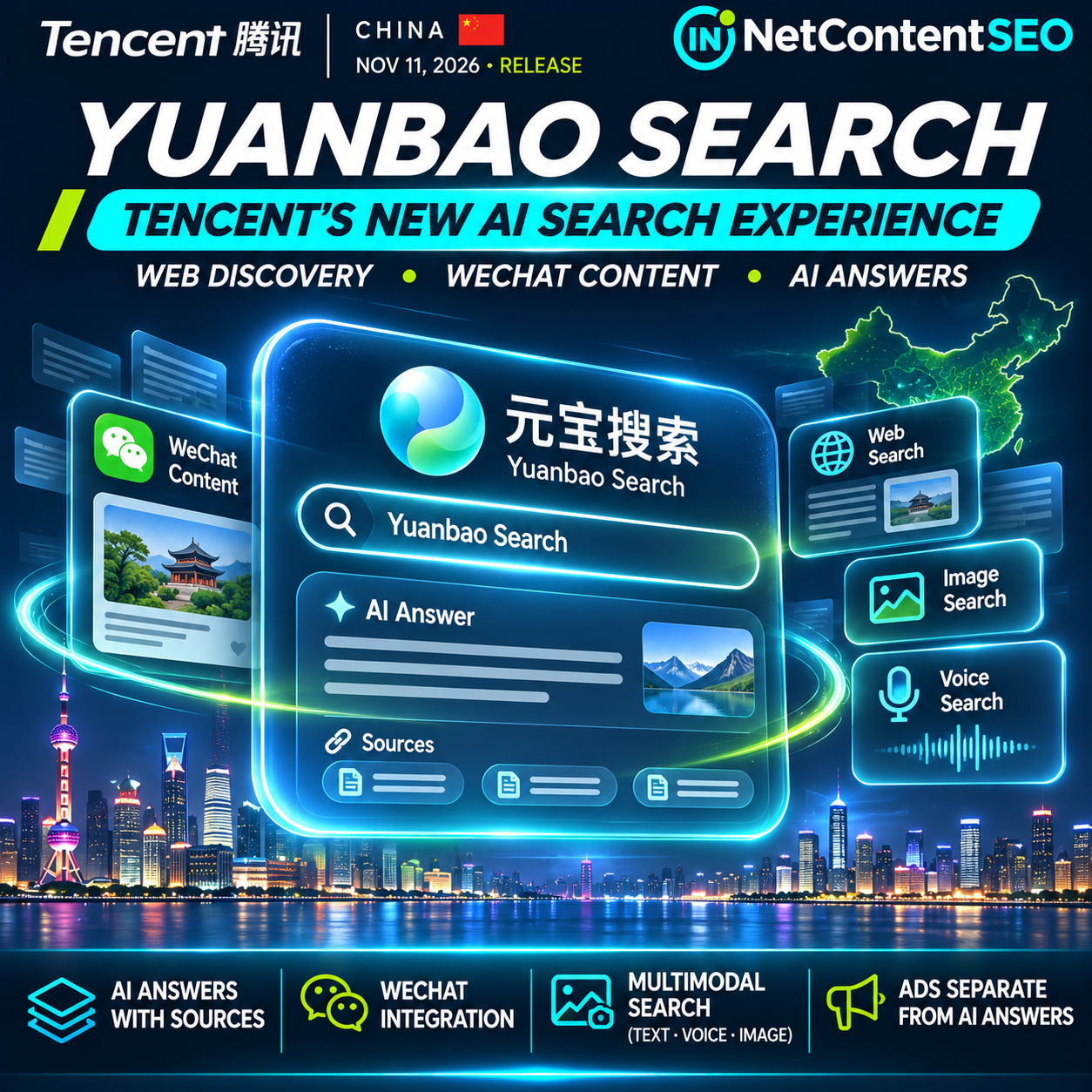

Tencent has launched Yuanbao Search (元宝搜索), a standalone AI-powered search service that combines open-web results with material from Tencent's own ecosystem, including WeChat Official Accounts and WeChat Channels. Announced on November 11, 2026, the product is accessible at so.qq.com and can be selected as a search engine in the latest QQ Browser.
This is more than another chatbot interface. Tencent says it has rebuilt the search process around its Yuanbao large-model capabilities, from understanding the user's question and retrieving information to ranking sources and assembling answers. The launch is confirmed by a Tencent Cloud announcement, with further reporting from 36Kr and Economic Observer. Its implications for SEO and AI visibility are significant, although the actual traffic and citation outcomes have not yet been independently measured.
What launched, and where can people use it?
Yuanbao Search is available through its independent web address, so.qq.com, without requiring users to begin in a conversational AI app. Users of the updated QQ Browser can also choose Yuanbao Search in the browser's search-engine settings. Tencent is presenting it as a consumer search product, not merely an API or a feature embedded in the existing Yuanbao assistant.
The November 11 consumer release follows an earlier enterprise-facing search offering introduced in October. According to Chinese technology reporting, the two products share underlying retrieval and AI capabilities but have different access models: the enterprise offering supports developer and business integrations, while the new website and QQ Browser integration target ordinary searchers. This distinction matters when assessing availability. A developer API, a browser search option and a general-purpose consumer search site are not interchangeable products.
The interface and official announcement are Chinese-language focused. Tencent has not announced a verified worldwide availability roadmap or a dedicated international product rollout. Overseas accessibility should not be mistaken for an international market launch.
How Yuanbao Search works
Tencent says its search stack uses a web index on the scale of hundreds of billions of indexed pages, together with material from WeChat Official Accounts, WeChat Channels and academic literature. It says AI is involved in understanding intent, retrieving and evaluating candidate sources, ranking information and composing a useful answer.
The product can summarize an answer before the user explores source material, offer follow-up questions, and display cards or charts where useful. It supports text input, voice queries and photo-based searching. For academic papers, Tencent highlights simplified explanations of research conclusions, preservation of original supporting references and one-click translation of English titles and abstracts.
These are product capabilities described by Tencent. They do not independently establish how consistently Yuanbao retrieves the best sources, how accurately it attributes statements, or how its results compare with Baidu, Google, Doubao or other AI search services. Those questions require systematic testing.
Why WeChat changes the discovery equation
The most consequential feature for digital visibility may be Yuanbao's ability to combine conventional websites with WeChat content. WeChat Official Accounts publish articles and institutional updates, while WeChat Channels host short-form and other video content. Those surfaces form a major information environment in China that cannot be reduced to ordinary website rankings.
Tencent says WeChat material complements open-web results rather than replacing them. In interviews with Chinese media, Yuanbao Search product leader Li Ruizhang described a scenario in which professional medical sources supply authoritative information, an Official Account offers an accessible explanation, and a doctor's video contributes another perspective. The ambition is to organize those source types into a coherent answer.
For brands, publishers and agencies, this creates a practical possibility: discovery may depend on whether the organization is represented accurately across its website, WeChat Official Account, relevant video content and other trustworthy sources. But the presence of WeChat content in the index does not prove that opening an account will improve ranking, guarantee citation, or generate referrals.
This also is not Tencent's first attempt to connect WeChat material with search. Historical Sogou products already provided access to WeChat Official Account content. The new development is the AI-centered integration of multiple source types into a general search experience, rather than the first-ever searchability of WeChat posts.
What Tencent means by authoritative sources
In its announcement, Tencent says Yuanbao Search integrates 157 authoritative information sources and prioritizes official institutions and authoritative material. Chinese coverage describes partnerships across 13 industries. This is a potentially important product choice because AI-generated answers are only as useful as the evidence they select and represent.
However, “157 authoritative sources” is a Tencent-reported figure, not a published independent audit of source quality or ranking outcomes. Tencent has not supplied a comprehensive public list, a reproducible evaluation showing citation accuracy across industries, or a ranking formula that publishers can use to predict inclusion.
Nor should the phrase “prioritizes official sources” be interpreted as a guarantee that official websites always appear first. Search results can depend on the question, source coverage, relevance and other system choices. For high-stakes topics such as health, law or finance, users should still open and verify the underlying documents.
AI answers with citations: visibility is not the same as traffic
Yuanbao Search allows users to inspect supporting material and, according to Tencent, preserves source references for academic research. This matters because AI-generated answers can satisfy a question without requiring the user to visit the publisher.
For SEO and generative engine optimization (GEO), it is essential to distinguish four outcomes: a source being indexed or retrievable; its content being used to inform an answer; a visible citation or source link appearing in the interface; and an actual visit or conversion resulting from that exposure.
None of these steps is guaranteed by the previous one. A website may be cited without receiving meaningful clicks, and a source may influence an answer without a clearly measurable referral. Tencent has not released publisher-facing attribution metrics or a standardized way to report Yuanbao Search impressions, citation counts or click-through rates.
That makes claims of immediate traffic opportunity premature. The launch establishes a new discovery surface worth monitoring, not a proven new acquisition channel for every publisher.
Ads are separate from answers—according to Tencent
Tencent says sponsored content is presented in clearly labeled, separate advertising modules, including a label equivalent to “related ads” and an option to collapse the advertising block. Li Ruizhang told Chinese journalists that commercial material should not interfere with the ordering of natural results and that the company does not intend to disguise ads as answers.
That is a meaningful stated design principle, particularly as AI search products experiment with monetization. But it remains a company claim. Independent tests across commercial query categories, devices and time periods are needed to determine whether advertising and organic answer selection remain separate in practice.
The product does not promise to be ad-free. Tencent explicitly sees opportunities for advertising when users search for hotels, services and other commercial needs. The relevant question is whether sponsored placements are labeled and separated consistently—and whether paid participation can influence what appears in an ostensibly organic answer.
From consumer search to agents and enterprise discovery
Tencent's November announcement also says its agents had begun using Yuanbao Search capabilities roughly two weeks before the public launch. Chinese reporting describes the underlying enterprise search service as available through interfaces including APIs and agent-oriented integrations.
This is an important distinction for the future of digital discovery. A search engine presents results to a human. An agent may retrieve information, compare options, call tools and perform additional steps without requiring the user to visit each source. If the same retrieval infrastructure supports both experiences, the quality and accessibility of a business's information can matter beyond conventional search-result pages.
Still, agent use of a retrieval service does not automatically establish that Yuanbao Search can complete transactions or bookings, or that all enterprise customers have the same features. The reported integration is evidence of an infrastructure strategy, not proof of a mature end-to-end agentic commerce ecosystem.
What the launch means for SEO in China
China's search market already contains mature web-search providers, social content ecosystems and AI assistants. Yuanbao Search adds a distinct consumer entry point backed by Tencent's distribution and content assets. Its ability to become a meaningful traffic source will depend on user adoption, answer quality, retention and the willingness of searchers to switch habits.
For international brands targeting China, this makes the familiar “Google-only” visibility model even less adequate. Chinese-language content, accessible official information, locally relevant sources, and a consistent presence across the platforms where customers already search can all matter. But it is not yet possible to prescribe a validated “Yuanbao ranking formula.”
Teams should also avoid assuming that optimizing for WeChat is identical to optimizing a conventional website. Official Accounts, video content and web pages have different publication formats, access patterns and governance requirements. Content should be designed for the audience and channel, then evaluated for how it appears in Yuanbao Search.
A practical Yuanbao Search audit for brands and publishers
- Confirm access. Open so.qq.com or use the latest QQ Browser's search settings. Record whether the product is available from your location and account.
- Create a Chinese-language query set. Include branded searches, product and service categories, local-intent questions, comparisons and informational questions. Keep the exact queries for repeat testing.
- Document the complete results interface. Capture the AI answer, visible citations, traditional links, WeChat Official Account material, WeChat Channels results and labeled ads.
- Test source attribution. Open cited links and compare the answer with the original source. Note unsupported claims, outdated details and ambiguous attribution.
- Check entity consistency. Verify that the brand name, website, products, locations, contact information and official WeChat presence agree across authoritative sources.
- Separate discovery metrics. Record appearance in results, visible citations and actual referred sessions separately. Do not report citation counts as website traffic.
- Repeat the audit. Search behavior may change as the product evolves. Compare the same query set across dates, devices and interfaces.
- Validate commercial claims. For high-value purchase-intent searches, check whether advertisements are labeled and whether organic results can be distinguished from paid content.
- Compare competitors carefully. Test equivalent Chinese-language queries on other relevant services, but account for different interfaces and source coverage before drawing conclusions.
What we still do not know
Several essential measurements remain unavailable: Yuanbao Search's active user base, share of the Chinese search market, publisher referral volume, comprehensive source-inclusion criteria, full list of authoritative partners, and independent evaluation of answer accuracy or ad separation. Tencent has not disclosed a general international launch timetable.
Some Chinese reporting relays company performance figures for retrieval and inference efficiency. Those internal claims are not equivalent to independently verified consumer search quality. Speed, index size and source counts are useful engineering indicators, but they do not tell us whether users receive better answers or publishers gain traffic.
Frequently asked questions
What is Tencent Yuanbao Search?
Yuanbao Search (元宝搜索) is Tencent's AI-powered search service combining open-web search with Tencent ecosystem content and AI-organized answers. It launched publicly on November 11, 2026.
Where can I use Yuanbao Search?
Visit so.qq.com or select Yuanbao Search in the updated QQ Browser. Availability and experience outside China have not been established as part of an official international rollout.
Does Yuanbao Search include WeChat content?
Yes. Tencent says it can retrieve WeChat Official Account articles and WeChat Channels content alongside conventional web pages and academic literature.
Does Yuanbao Search cite its sources?
Tencent describes source-linked answers and preservation of original academic references. Citation completeness and accuracy have not yet been independently benchmarked.
How many authoritative sources does Tencent claim to use?
Tencent says the service integrates 157 authoritative sources. The number is company-reported and does not by itself verify the quality of every search result.
Can users search with images or voice?
Yes. Tencent lists text, voice and photo-based search among the product's supported interactions.
Are there advertisements in Yuanbao Search?
Yes. Tencent says advertisements are labeled, separated from AI answers and can be collapsed. Independent confirmation of consistent separation is still needed.
Does Yuanbao Search replace WeChat Search or Sogou?
Tencent has not announced a wholesale replacement. Chinese reporting says Sogou will continue serving existing users, while Yuanbao Search is positioned as a newer AI-oriented search experience.
Can brands optimize specifically for Yuanbao Search?
Brands can test how their official pages, WeChat presence and other sources appear, correct inconsistent information and publish useful Chinese-language material. No independently validated Yuanbao-specific ranking checklist has been published.
Is this already a measurable GEO traffic channel?
It is a live discovery product, but publisher-facing impression, citation and referral metrics have not been publicly established. A measurable acquisition channel must be demonstrated with actual analytics, not inferred from the launch.
The bigger picture: AI search is becoming regional and ecosystem-specific
Yuanbao Search illustrates why the future of AI discovery cannot be understood only through ChatGPT, Gemini and Google. Tencent is combining a large web index with social publishing, video, academic information, AI-generated answers and agent-oriented retrieval infrastructure.
The strategic question is not simply which model generates the best response. It is which ecosystems control the information sources, user entry points and follow-up actions through which people discover organizations and make decisions.
For SEO and GEO practitioners, the launch is a clear signal to study China's search ecosystem on its own terms. Tencent has introduced a credible new product with significant distribution advantages and distinctive content access. Whether that becomes durable publisher visibility or referral traffic remains an open, measurable question.
Sources
- Tencent Cloud — Official Yuanbao Search launch announcement, November 11, 2026 (Chinese).
- 36Kr — Yuanbao Search launches and Tencent competes for the default search entry point, November 12, 2026 (Chinese).
- Economic Observer — Tencent's search strategy and interview with product leader Li Ruizhang, November 12, 2026 (Chinese).
- IT Home — Tencent on Yuanbao Search advertising and answer separation, November 11, 2026 (Chinese).
- Jiemian News — Yuanbao Search official launch report, November 11, 2026 (Chinese).
- Yuanbao Search — Official product.