

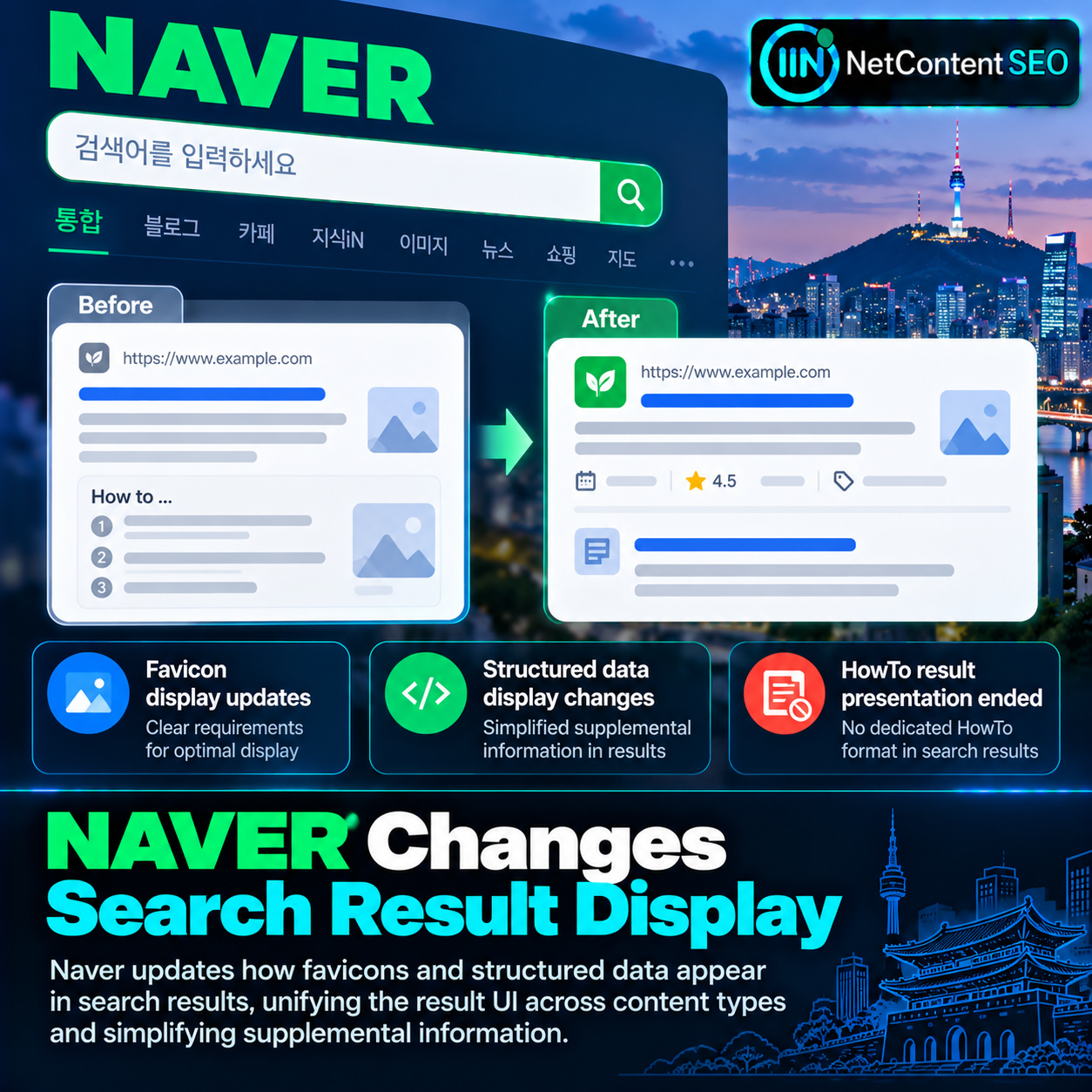

Naver published a webmaster announcement on October 15, 2026, titled 파비콘 및 구조화된 데이터 노출 방식이 일부 변경됩니다 (“Some favicon and structured-data display methods are changing”). The notice appears on the official Naver Search Advisor homepage, with a link to the original Naver Webmaster Blog post.
The full original blog text could not be independently retrieved for this report. Accordingly, the announcement's existence, title and date are confirmed by Naver itself, while the more detailed description below is attributed to a Korean-language analysis by 247COMPASS that cites the official notice. This distinction matters when assessing what has changed and what has not.
A more consistent search-result presentation
According to the 247COMPASS account, Naver is unifying aspects of its result interface across web, blog, cafe, Knowledge iN and video listings. Certain additional details associated with structured data—including information such as addresses, ratings, recipes and reviews—are described as moving toward more concise summaries.
This is primarily a change in how information is displayed to searchers. A shorter or redesigned result treatment does not, by itself, demonstrate a change to how pages are crawled, indexed or ranked.
Dedicated HowTo result formatting is being retired
The same secondary report says Naver has ended the dedicated HowTo search-result format and shifted those results toward ordinary result presentation. It also reports that Naver told publishers they do not need to remove existing HowTo markup and that the presentation change does not affect crawling, indexing or ranking.
Because the complete original notice was not accessible for direct verification, publishers should consult Naver's announcement before making large-scale markup changes. Removing valid structured data solely because a particular rich-result design disappears may be unnecessary.
What publishers should check about favicons
Naver's official favicon guidance sets out concrete requirements for search display. Favicons should be square and at least 16 by 16 pixels, with 32 pixels or more recommended for attractive rendering across devices. Supported formats include ICO, PNG, GIF, JPEG, APNG and SVG.
Naver recommends a stable favicon URL, an icon representative of the site and access for its crawler. Its documentation instructs publishers to declare the favicon using a link element in the HTML head with an absolute URL. It also documents precedence among link relationships, including shortcut icon and icon, and warns that duplicate declarations with the same relationship can cause problems.
Changing the file or URL does not guarantee immediate replacement in results: recrawling and caches may delay the visible update. Naver's robots.txt guidance also recommends making important resources, including favicons, accessible.
What this means for structured data SEO
Structured data helps describe entities and page content, but support for a markup type and eligibility for a prominent search feature are separate questions. If Naver displays fewer details or retires a dedicated result design, publishers should evaluate changes in search appearance and click-through behavior rather than assume the underlying content has become irrelevant.
A sensible audit checks whether structured data remains valid, whether its information matches visible page content and whether the website's favicon is consistently accessible. Site owners should also review actual Naver results for their priority queries before attributing traffic changes to the October announcement.
Does the change affect AI Search?
There is no verified evidence in the accessible primary materials that this announcement changes Naver's AI answer-generation systems, AI citation selection or an AI-specific ranking algorithm. A search-result UI redesign may influence how users perceive brands and snippets, but that is an editorial inference, not an announced AI Search update.
The broader industry trend toward simpler results and AI-assisted search is worth monitoring. However, conventional rich-result presentation, organic ranking, retrieval for AI answers and citations within generated responses must be measured separately.
NetContentSEO assessment
Naver's October 15 notice is relevant to international technical SEO because it highlights the difference between machine-readable metadata and the interface in which that information appears. Publishers targeting South Korea should verify favicon implementation, retain valid structured data unless Naver specifically instructs otherwise and watch changes in result presentation. They should not treat the update as proof of an AI ranking shift.
Sources: Naver Webmaster official announcement; Naver Search Advisor official announcement listing; Naver official favicon guide; 247COMPASS analysis of the display changes.