

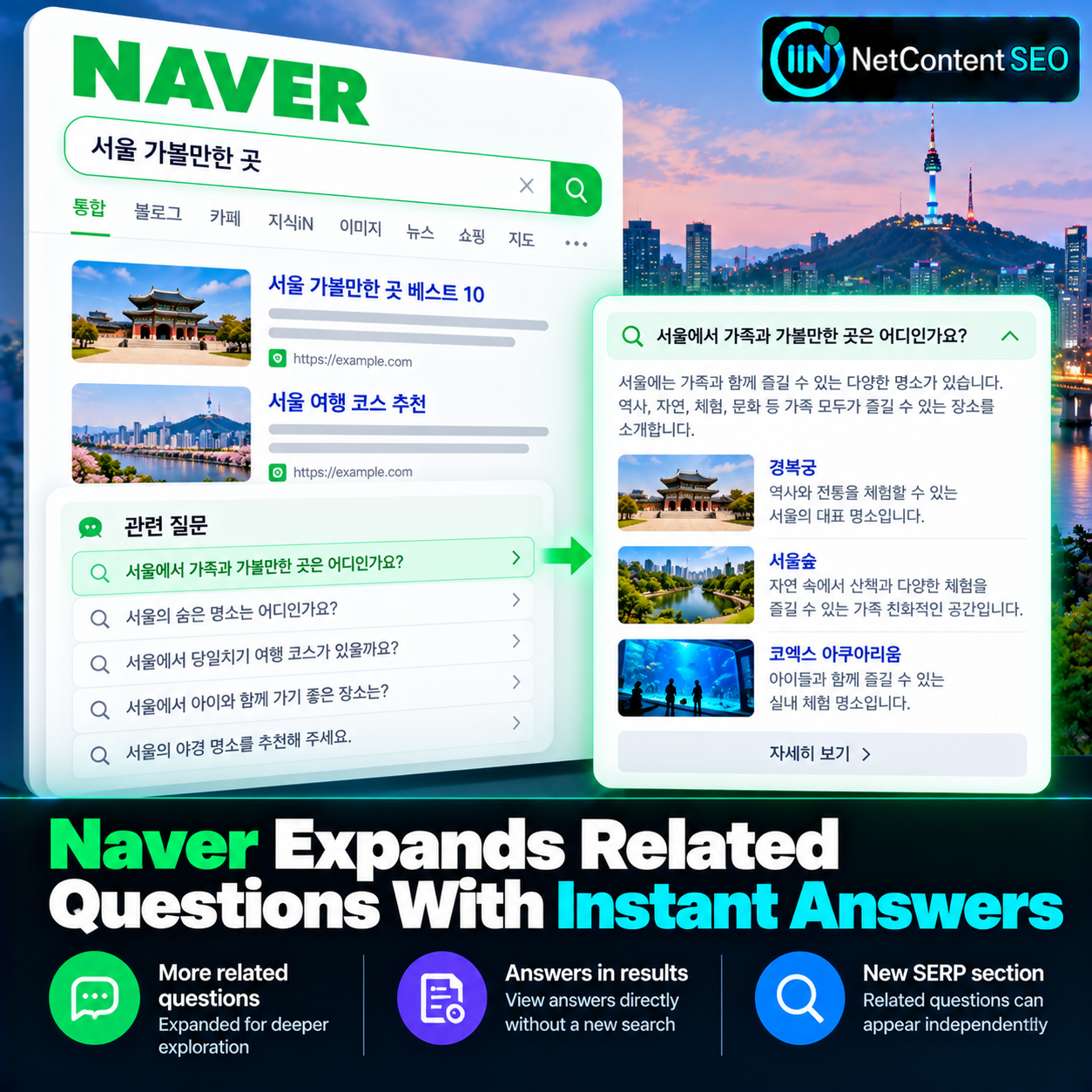

Naver expanded its Related Questions experience on October 22, 2026, allowing people to explore follow-up questions and reveal answers directly within search results. The update was announced on October 19 in an official Naver Search Blog post titled 검색 후 이어지는 관련질문과 답변을 바로 확인해보세요, roughly translated as “Check related questions and answers right after searching.”
The original Naver blog text was not fully accessible during verification. The launch date and key mechanics are corroborated by Korean industry reports from i-BOSS and The Check, both published before the October 22 expansion and linking to the official announcement.
Related questions move beyond AI Briefing
Previously, Naver displayed related questions beneath AI Briefing. Under the expanded experience, the feature can also appear as an independent section in search results. Naver is targeting queries with a strong tendency toward follow-up exploration rather than promising the feature for every search.
Users can choose a suggested question and reveal its answer without opening a separate search results page. This keeps the discovery process in context: someone researching a topic can move from an initial question to adjacent details without retyping queries or leaving the result screen.
The update is about the organization and interaction of the search interface. It is not described as a new crawling system, a change in indexing requirements or a revision of organic ranking criteria.
Why the change matters for search behavior
Related-question modules can make the search engine itself a place where users complete more of their information gathering. By placing follow-up answers directly in the results, Naver may reduce the need to perform separate searches or visit external pages for some straightforward questions.
That creates a potential zero-click search effect, but a potential is not the same as a measured result. Naver has not published data establishing that this expansion reduces traffic to publishers, nor has it identified a universal set of queries affected by the new section.
For site owners, the sensible response is to compare search visibility, referral visits and downstream actions over time rather than assume an immediate traffic loss. Different kinds of questions may produce different user journeys.
SEO implications: answer the next question, not just the first
Content teams can use the update as a prompt to examine whether their pages address the natural follow-up questions readers ask. For example, a page explaining a service may also need clear information about eligibility, costs, timing, exceptions and next steps.
Those additions should be made because they help users, not because Naver has announced a special markup or a guaranteed way to enter the Related Questions section. No such eligibility formula was confirmed in the accessible reporting.
Technical SEO fundamentals still apply: make useful pages discoverable, keep information accurate and ensure that important content can be accessed and understood. The update does not establish that a particular FAQ format or structured-data property will cause Naver to show a page as an instant answer.
AI Search implications: conversational exploration inside the SERP
The design resembles an increasingly conversational search journey: an initial query leads to related questions, and those questions lead to immediate answers. It is consistent with a broader movement toward systems that help users explore a subject rather than simply return a ranked list of links.
However, the Related Questions expansion should not automatically be described as a change to AI-generated citations. Naver's official search overview distinguishes conventional Naver Search, AI Briefing and its conversational AI tab. The October announcement concerns a related-question interface; it does not disclose new source-selection rules for generative answers.
Publishers should therefore keep several outcomes separate: appearing in organic results, being represented in a Related Questions answer, being cited in AI Briefing and receiving a referral visit. These are related but not interchangeable measures of search visibility.
What marketers and publishers should monitor
For sites targeting South Korea, a practical evaluation starts with a sample of priority queries and the follow-up questions they now surface. Record whether the independent module appears, what kind of answer it provides and whether external sources are visible or accessible. Then compare organic visits and conversions for the same content over a suitable period, taking seasonality and unrelated search changes into account.
Businesses can also review whether their pages provide the conditions, limitations and decision-making details customers commonly seek. This is a content-quality opportunity regardless of whether the pages are selected for Naver's new interface.
NetContentSEO assessment
Naver's October 22 rollout is a meaningful search-experience update because it makes follow-up exploration faster and more self-contained. Its importance for SEO lies in the possibility that users will complete additional informational steps inside the search engine. Its relevance to AI Search lies in the increasingly conversational structure of discovery, not in any proven change to AI ranking or citation mechanisms.
Sources: Naver Search Blog announcement; i-BOSS, October 19, 2026; The Check, October 20, 2026; Naver official search overview.