

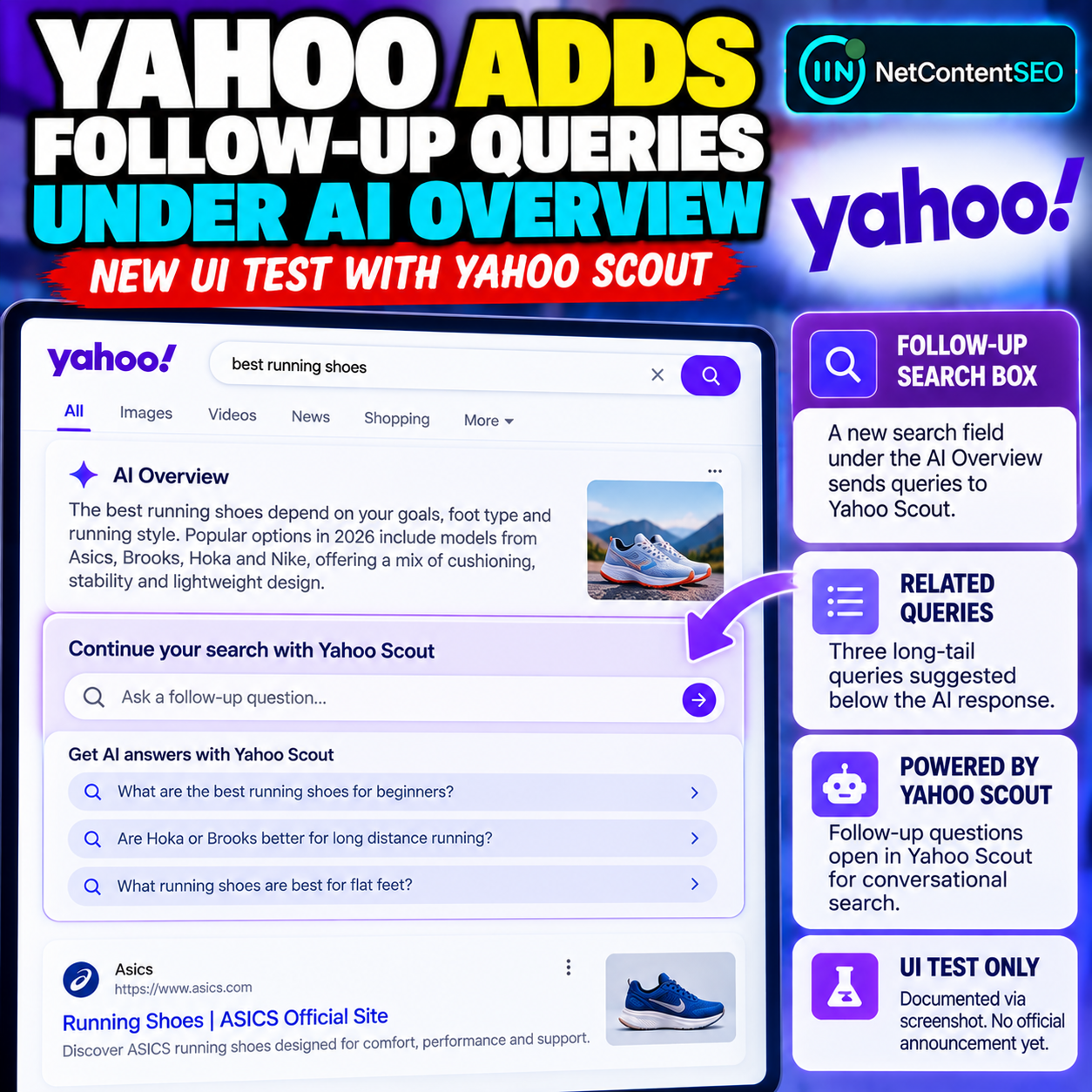

Yahoo is testing a search box and related-query suggestions beneath its AI Overview that send users into Yahoo Scout, the company's AI answer experience. Search Engine Watch reported the interface observation on October 8, 2026. The reported layout includes a field for entering a follow-up query, an option to expand the AI Overview, and a “Get AI answers with Yahoo Scout” module containing three suggested long-tail queries.
The test creates another route from a conventional Yahoo results page into Scout. However, the specific interface has not been officially announced by Yahoo, and the report does not confirm general availability or measure its effect on user behaviour.
What Yahoo is testing below the AI Overview
According to Search Engine Watch, the interface contains three main elements beneath the AI-generated summary:
- A follow-up search box: users can enter a new query, which redirects them to Yahoo Scout.
- An expand control: a “Show more” option can expand the AI Overview.
- Suggested Scout queries: a section labelled “Get AI answers with Yahoo Scout” presents three long-tail query suggestions. Selecting one starts a new query in Scout.
The search box and the suggested queries are separate entry points, but both move the user from the results page into Yahoo Scout. The reported observation concerns how the interface routes the next question; it does not establish that the AI Overview itself becomes a continuing Scout conversation.
Why this matters for AI search journeys
Traditional search results often end with links or related searches. The reported Yahoo test adds a more explicit path from an initial AI summary to a follow-up question in an AI answer engine. Users can either write their own query or choose one of the suggested long-tail questions.
This design may help Yahoo expose Scout at the moment a user wants more detail. That is a plausible product rationale, not a measured outcome: the source does not provide data showing that the box increases Scout usage, query volume, engagement or retention.
What is confirmed—and what remains unknown?
- Observed: a search box beneath Yahoo's AI Overview that redirects queries to Yahoo Scout.
- Observed: a “Show more” control for expanding the AI Overview.
- Observed: a “Get AI answers with Yahoo Scout” module with three suggested long-tail queries.
- Source and date: Search Engine Watch, October 8, 2026.
- Not confirmed: an official Yahoo announcement or a general rollout.
- Not established: the test's geographic reach, duration, audience size or impact on engagement and publisher traffic.
How this fits Yahoo Scout
Yahoo describes Scout in its official help materials as an AI-powered search experience where users can ask questions, refine results with follow-ups and continue a conversation in a thread. That existing functionality explains the destination of the reported links, but it does not confirm the new placement below the AI Overview.
The October observation also follows earlier reports of Scout entry points appearing in Yahoo's search experience. Those observations suggest Yahoo is experimenting with multiple ways to connect search-result journeys to Scout, but they do not prove that any particular placement is permanent or visible to everyone.
Potential implications for publishers and SEO teams
If the test becomes more widely available, it could encourage some users to continue exploring within Scout instead of clicking directly through to a publisher's website. The opposite is also possible: suggested follow-up queries could surface new questions and sources. The report provides no traffic or click data to determine the net effect.
- Monitor branded and informational queries. Record whether the box appears and what types of searches trigger it.
- Document the destination. Confirm whether typed queries and suggested questions both open Scout and how the new query is represented.
- Track referral data carefully. Do not infer changes in publisher traffic from the UI alone; use analytics and available referral reporting.
- Separate observation from impact. A new route into Scout is a product change to monitor, not evidence of a proven shift in clicks.
How to check the test
- Run a query on Yahoo that displays an AI Overview.
- Look below the overview for a search field and a “Show more” control.
- Check for the “Get AI answers with Yahoo Scout” section and its three suggested queries.
- Test the search box and a suggested query separately to see where each leads.
- Record the date, browser, device and market alongside screenshots, because the interface is an unconfirmed test.
If the elements do not appear, that does not prove the test has ended; if they do appear, it does not prove that all users see them.
Frequently asked questions
What is Yahoo testing?
A follow-up search box and three suggested long-tail queries below its AI Overview, with both routes directing users to Yahoo Scout.
What does the “Show more” option do?
The report says it expands the AI Overview. It is separate from the follow-up search box and Scout query suggestions.
Has Yahoo officially announced the test?
No official announcement for this specific interface was identified in the cited report.
Will this reduce publisher traffic?
The effect is unknown. The test creates another route into Scout, but no measured publisher traffic or click-through impact is reported.
Is Yahoo Scout already available?
Yahoo's official help materials describe Scout as an AI-powered search experience available on desktop and mobile web and in the Yahoo Search app. That does not establish general availability of this specific results-page test.
The takeaway
Yahoo is testing a search box and three suggested follow-up queries beneath its AI Overview, giving users a direct route into Yahoo Scout. The layout could make AI follow-ups a more prominent part of the search journey, but the specific UI has not been officially announced and its impact on engagement or publisher traffic is unknown. Treat it as a documented interface test, not a confirmed rollout or proven traffic shift.
Sources
Search Engine Watch — Yahoo tests search box and related queries below AI overview (October 8, 2026); Yahoo Help — Get started with Yahoo Scout AI search.