

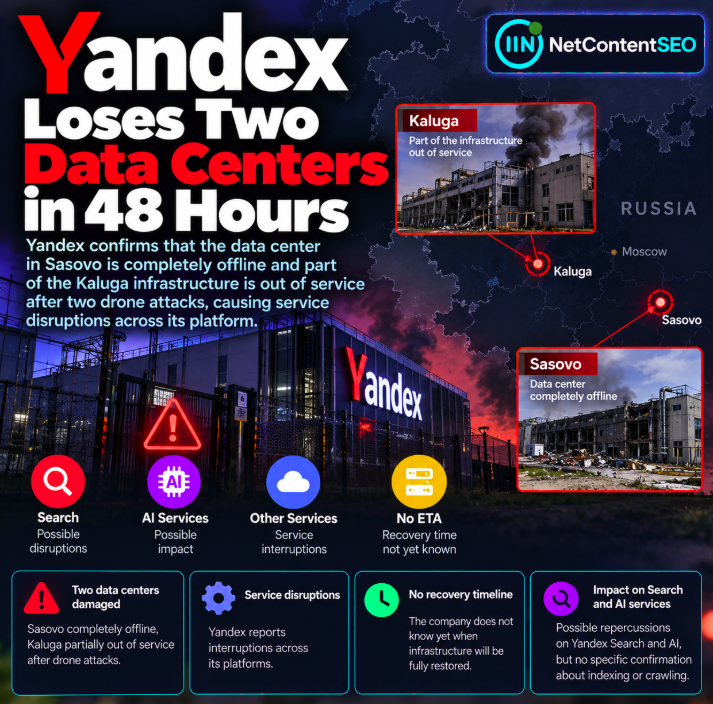

Yandex said on October 9, 2026, that its Sasovo data center was completely offline and part of its Kaluga infrastructure was out of service following two drone attacks. The company acknowledged service disruptions and said it could not yet provide a timeline for full infrastructure recovery.
For search and AI industry observers, the incident raises questions about infrastructure resilience. But the distinction between confirmed facts and possible downstream effects is critical: Yandex has not specifically confirmed an interruption to Yandex Search crawling or indexing in the information reported here.
Primary source: Yandex — Official Statement, October 9, 2026.
What Yandex confirmed
The company's October 9 statement identifies two affected facilities. Sasovo was described as completely stopped, while a portion of the infrastructure at Kaluga was unavailable. Yandex linked the damage to two drone attacks and reported interruptions affecting its services.
The company also indicated that it did not yet know when the affected infrastructure could be fully restored. An uncertain recovery timeline does not necessarily mean every Yandex service will remain unavailable until the physical facilities are repaired; service recovery and physical restoration are separate questions.
The confirmed infrastructure status
| Facility | Reported status | What remains unknown |
|---|---|---|
| Sasovo | Data center completely offline | Full restoration timeline and precise downstream workload impact |
| Kaluga | Part of the infrastructure out of service | Extent of affected capacity and precise downstream workload impact |
| Yandex services | Service interruptions acknowledged | Complete product-by-product outage scope |
| Yandex Search crawling and indexing | No specific interruption confirmed in the cited statement | Whether any measurable crawler or indexing disruption occurred |
Why data center disruptions matter for search engines
Modern search platforms depend on distributed computing, networking, storage and processing infrastructure. Data centers can support many types of workload, from user-facing applications to background data processing. Damage to infrastructure can create operational challenges, but the effects depend on architecture, redundancy, workload placement and failover mechanisms.
That means a data center outage is not, by itself, proof of a search index outage. A search engine may operate multiple facilities and recovery systems, and the exact placement of crawlers, index shards, query serving or AI inference workloads is not established by the statement.
Could Yandex Search be affected?
Potentially, but the reported facts do not establish which search components, if any, experienced disruptions. Search systems typically involve distinct processes for fetching pages, processing content, maintaining an index and answering queries. A failure in one area does not necessarily produce an identical effect in every other area.
For technical SEO teams, the right question is therefore not simply whether Yandex lost data center capacity, but whether measurable changes appeared in crawler activity, indexing behavior or search result availability.
What about Yandex's AI services?
AI products can depend on substantial compute and storage resources. Infrastructure disruption can affect such workloads, depending on where they run and what redundancy exists. However, the statement summarized here does not identify specific AI models, inference clusters or training systems as offline.
It would be premature to declare an outage of a particular Yandex AI product without a product-specific status report or independently verified observation.
How to check for actual crawling changes
- Inspect server logs. Compare verified Yandex crawler requests before and after October 9.
- Check response codes. Look for unusual changes in successful fetches, errors or timeouts.
- Track discovery and indexing evidence. Review available Yandex Webmaster reports and known indexed URLs.
- Separate bot traffic from demand. A traffic decline is not automatically evidence of a crawler outage.
- Compare against normal variation. Account for day-of-week patterns, site changes and infrastructure maintenance.
- Follow official updates. Prioritize Yandex statements or service-status notices over speculation.
What publishers should avoid concluding
A website experiencing slower discovery or reduced Yandex visibility should not automatically attribute the change to the damaged facilities. Indexing can vary for many reasons, including site accessibility, crawl scheduling, quality evaluation and technical configuration.
Similarly, there is no evidence in the cited statement of a new Yandex ranking update, a change to search quality policies or an intentional reduction in crawling.
Resilience and redundancy: the broader lesson
The incident illustrates why infrastructure resilience matters for large digital platforms. Geographic distribution, backup capacity, monitoring, incident response and clear status communications can reduce uncertainty when individual facilities become unavailable.
But the specific resilience measures Yandex used, and their effectiveness in this incident, cannot be inferred from the basic facility status alone. A complete technical assessment would require operational data that has not been provided.
Why this is relevant to SEO monitoring
Search professionals often interpret crawler activity, indexing delays and ranking volatility as search-engine policy or algorithm signals. Infrastructure incidents provide another possible category of explanation—but one that must be tested rather than assumed.
Where an official incident is confirmed, teams can annotate their monitoring timelines and compare affected dates with actual logs and search performance. That creates a more reliable record than retroactively assigning every unusual metric to a headline.
What is not yet known?
- The date on which both facilities will be fully restored.
- The complete list of affected Yandex products.
- Whether Yandex Search's crawler experienced a measurable interruption.
- Whether indexing freshness or query serving was affected.
- Whether specific AI inference or training workloads were disrupted.
- How much capacity was shifted to unaffected infrastructure.
FAQ
Which Yandex data centers were affected?
Yandex identified Sasovo and Kaluga in its October 9 statement.
Was the Sasovo data center offline?
Yes. The company described it as completely stopped.
Was all of Kaluga offline?
No. The report describes part of the infrastructure there as out of service.
Has Yandex confirmed crawling or indexing problems?
Not specifically in the cited statement.
When will the facilities be restored?
Yandex had not provided a full restoration timeline in its October 9 communication.
Is this a Yandex Search ranking update?
No. The reported event is an infrastructure incident, not an announced search algorithm change.
NetContentSEO analysis
Yandex's reported data center damage is a significant operational incident, but its implications for search visibility remain unproven. The most useful response for SEO teams is evidence-based monitoring: record the official timeline, inspect crawler logs and search performance, and avoid claiming indexing or AI outages that have not been confirmed. Infrastructure resilience is a legitimate concern; attributing specific search failures requires specific evidence.
Primary source: Yandex official statement, October 9, 2026.