

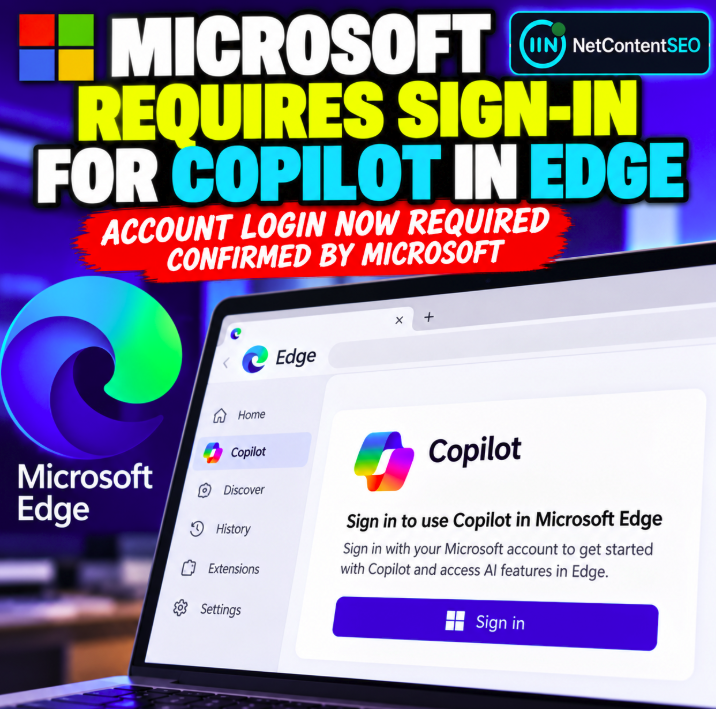

Microsoft is requiring users to sign in before they can use Copilot integrated into its Edge browser, according to a report published by Search Engine Watch on October 7, 2026. The change was also publicly acknowledged by Krishna Madhavan, a Principal Product Manager at Microsoft AI/Bing. The reported requirement concerns Copilot in Edge; it should not automatically be generalized to every Copilot product or entry point.
What changed in Copilot for Edge?
Users attempting to access Copilot in Edge may see a message asking them to sign in before continuing. The report describes a change in access to the browser-integrated assistant, with authentication required to use the feature.
The scope matters. This report concerns Copilot integrated into Edge and does not, by itself, establish that every Microsoft Copilot experience across the web, Windows, mobile apps or enterprise products follows the same rule.
What has been confirmed?
- Observed behaviour: a sign-in prompt appears before using Copilot integrated into Edge.
- Public acknowledgement: Krishna Madhavan, Principal Product Manager at Microsoft AI/Bing, publicly addressed the change, according to the cited report.
- Scope: the reported verification concerns Copilot in Edge.
- Not established by this report: a universal sign-in requirement for every Copilot product or access point.
These distinctions are important when reporting product changes. A browser-specific access requirement should not be described as a blanket policy across all Microsoft AI services unless broader evidence supports that conclusion.
Why authentication matters for AI Search
A sign-in requirement adds a step between opening an assistant and using it. Depending on the user and context, that step may support account-linked features and continuity, but it can also create friction for people who want to try an assistant immediately. The cited report confirms the requirement and public acknowledgement; it does not quantify the effect on adoption, usage or retention.
For AI Search, the broader question is how access design influences the path from a browser or search page to an AI-assisted answer. Login prompts, account eligibility and product availability can all affect who reaches a feature, but their actual impact needs user data rather than assumption.
What this means for users
- Expect a sign-in prompt. If Copilot in Edge asks you to authenticate, follow the browser's official sign-in flow if you choose to use it.
- Check which product you are using. Edge-integrated Copilot and other Copilot experiences may have different access rules.
- Use official Microsoft guidance. Requirements can change, and account type or managed-device policies may affect the experience.
- Do not assume the change affects rankings. The report concerns access to the assistant, not a search-ranking update.
Implications for publishers and SEO teams
For publishers monitoring AI-driven discovery, a login requirement is a product-access change worth tracking, but it is not evidence on its own of a change in search visibility, citations or referral traffic. Teams should distinguish access friction from the behaviour of the underlying search or answer system.
If Microsoft changes how Copilot is accessed, useful follow-up questions include whether the requirement is consistent across devices and account types, whether users are redirected to a sign-in page, and whether Microsoft publishes updated product documentation. Any claim about reduced usage or changed referrals should be backed by measured data.
Frequently asked questions
Does Copilot in Edge now require users to sign in?
According to Search Engine Watch's October 7, 2026 report, Edge displays a sign-in prompt before users can use integrated Copilot.
Did Microsoft confirm the change?
The report says Krishna Madhavan, a Principal Product Manager at Microsoft AI/Bing, publicly acknowledged it.
Does this apply to every Microsoft Copilot product?
The cited report verifies the change for Copilot integrated into Edge. It does not establish a universal requirement across every Copilot product or access point.
Will this affect AI Search traffic or SEO rankings?
The report provides no measured evidence of changes to traffic, citations or rankings. Authentication is an access change, not proof of an algorithm update.
What should users do if they see the prompt?
If they want to use Copilot in Edge, they can follow Microsoft's official sign-in flow. Users should check official guidance for the latest requirements on their account and device.
The takeaway
Microsoft is reportedly placing Copilot integrated into Edge behind a sign-in step, with the change publicly acknowledged by a Microsoft AI/Bing product manager. The confirmed scope is Edge-integrated Copilot. Broader claims about all Copilot products, user adoption or AI Search traffic go beyond what the cited report establishes.
Source
Search Engine Watch — Microsoft Locks Copilot Behind Sign-In in Edge (October 7, 2026).