

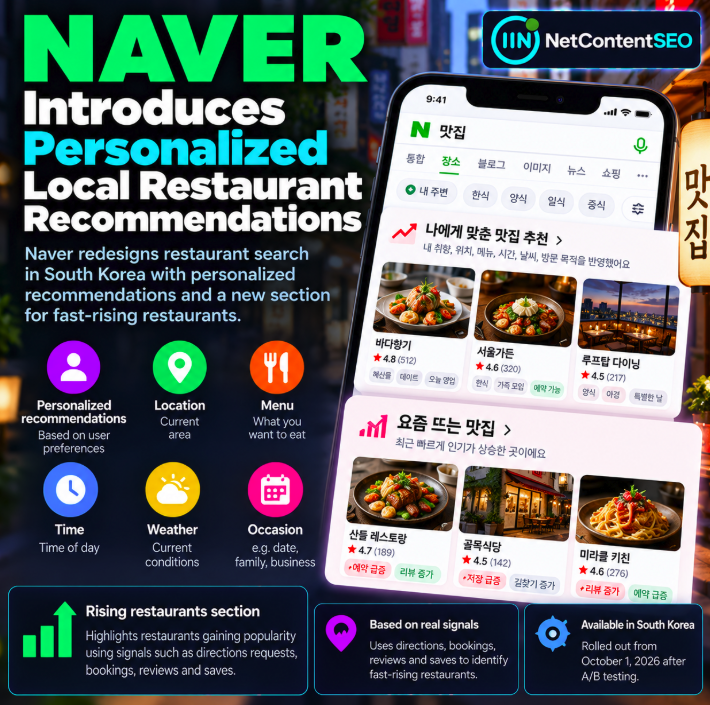

Naver has begun rolling out a redesigned restaurant search experience in selected areas of South Korea, bringing personalized recommendations and a dedicated way to discover restaurants gaining popularity. The rollout began on October 1, 2026, following A/B testing, with an official SmartPlace announcement published October 2.
The update illustrates how local search can use context and changing user interest to present restaurant choices. But the signals described in Naver's announcement should not be interpreted as a public formula for ranking every restaurant, and the rollout should not be assumed to cover every location in South Korea.
Primary source: Naver SmartPlace — Official Announcement.
What changed in Naver restaurant search?
Naver's updated local restaurant experience introduces two distinct discovery ideas. One is personalized recommendations that take the user's situation into account. The other highlights restaurants whose popularity is rising, using indicators of customer interest and engagement.
Together, they make restaurant discovery less dependent on a single static list and more responsive to the context of a particular search. The company announced the change after testing alternative experiences, rather than presenting it as an untested concept.
Personalized recommendations: more than a keyword match
Naver describes recommendations that consider multiple kinds of context, including personal preferences, location, menu interests, time of day, weather and the occasion for a visit.
For example, a person searching for somewhere to eat may have different needs on a rainy evening than during a quick weekday lunch. A family meal, casual date or business gathering can also imply different expectations. These examples illustrate the role of context; they are not a disclosure of the precise recommendation algorithm.
Which contextual factors are involved?
| Factor | Potential relevance to restaurant discovery |
|---|---|
| User preferences | May help tailor recommendations to dining interests |
| Location | Helps identify restaurants relevant to the user's area |
| Menu or cuisine | Connects restaurant offerings to what the user wants to eat |
| Time | Can distinguish lunch, dinner or other dining situations |
| Weather | Adds environmental context to recommendations |
| Occasion | May help match a restaurant to the purpose of a visit |
Naver has not disclosed exact weights for these factors in the information cited here. They should be described as inputs or contextual considerations, not as individually quantified ranking factors.
Rising restaurants: a second discovery route
Alongside contextual recommendations, Naver is highlighting restaurants that appear to be gaining popularity quickly. The described signals include requests for directions, reservations, reviews and saves.
These behaviors represent different forms of user interest. A directions request may suggest intent to visit; a reservation can reflect planning; reviews provide post-visit engagement; and saves can indicate consideration for a future occasion.
However, these are interpretations of possible user behavior. The announcement does not provide a mathematical score or confirm that increasing any one metric by a specific amount guarantees placement in the rising-restaurants section.
What do directions, bookings, reviews and saves tell us?
For local search researchers, the interesting aspect is the variety of interaction signals described. A restaurant's visibility can potentially reflect not only its basic business information but also patterns of interest across Naver's local ecosystem.
That does not mean all interactions have equal importance or that the section uses a simple count of actions. Without technical documentation, the ranking and recommendation logic remains partly opaque.
What is confirmed about the rollout?
The reported timeline is clear at a high level: the rollout began October 1, 2026, and Naver published an official announcement on October 2 following A/B testing. The update concerns restaurant searches in certain areas of South Korea.
The available information does not establish universal availability, identical behavior across devices, or a commitment to roll out the same interface internationally.
Why this matters for local SEO
Traditional local optimization often concentrates on business profiles, category relevance, geographic accuracy, opening hours, photos and customer reviews. Naver's announcement is a reminder that local discovery experiences can also organize results around a user's immediate circumstances and a business's changing popularity.
For restaurants operating in supported Naver markets, maintaining accurate SmartPlace information and providing a good customer experience remain sensible priorities. But the announcement does not justify promising rankings in exchange for artificially increasing saves, bookings or review volume.
What restaurant owners can do responsibly
- Maintain accurate SmartPlace information. Check address, contact details, opening hours and relevant restaurant categories.
- Keep menus current. Ensure the available food and dining options are represented accurately.
- Support legitimate reservations. Make booking information useful and reliable where applicable.
- Encourage authentic customer feedback. Avoid fabricated reviews or manipulative engagement tactics.
- Monitor visibility by context. Compare relevant searches across times and locations without assuming every user sees the same results.
- Watch the rollout. Confirm that the new sections actually appear in the business's supported area before attributing performance changes to them.
Why the A/B testing detail matters
Naver's reference to A/B testing indicates that alternative experiences were evaluated before the rollout. But it does not reveal the test sample, outcome metrics or the magnitude of any improvement.
It would therefore be inaccurate to claim a specific increase in restaurant visits, reservations, clicks or satisfaction without published supporting data.
Does this change Google Maps or Bing Places rankings?
No. This is a Naver product update affecting a local search experience in South Korea. Google Maps, Google Search and Bing Places operate their own systems. Similarities in local discovery trends do not establish that other platforms have adopted Naver's implementation.
What about AI Search and personalized discovery?
The redesign reflects a broader direction toward contextual recommendations in search interfaces. Yet the announcement should not automatically be labeled a new generative AI answer engine, and it does not establish changes to AI-generated citations.
The relevant, supported observation is that Naver is using richer context and popularity signals to present local restaurant options.
How to study the new SERP modules
SEO teams researching the rollout can document the exact query, location, device, time, weather conditions and whether the personalized or rising-restaurants module appears. Repeating observations under controlled conditions can help distinguish persistent patterns from individual variations.
When comparing results, researchers should also avoid treating a personalized ordering as a universal ranking position. Different contexts may legitimately produce different restaurant selections.
FAQ
When did Naver launch the restaurant search update?
The rollout began October 1, 2026, with an official announcement dated October 2.
Is the redesign available across all of South Korea?
The announced rollout covers selected areas; nationwide availability is not established here.
What powers personalized recommendations?
Naver describes factors such as preferences, location, menu, time, weather and visit occasion.
How does Naver identify rising restaurants?
The announcement mentions signals including directions requests, reservations, reviews and saves, without publishing exact weights.
Can a restaurant guarantee placement by increasing saves?
No. The available information does not establish any single guaranteed ranking action.
Is this a new Google local ranking update?
No. It is an update to Naver's restaurant search experience.
NetContentSEO analysis
Naver's redesigned restaurant results show two complementary approaches to local discovery: relevance to the user's immediate situation and recognition of emerging popularity. The most important lesson for local SEO is not a newly revealed formula but a measurement challenge: a restaurant's visibility may differ by context, location and time. Researchers and businesses should observe the new modules carefully, maintain trustworthy business information and avoid reducing a multifactor experience to one supposed ranking signal.
Primary source: Naver SmartPlace official notice.