

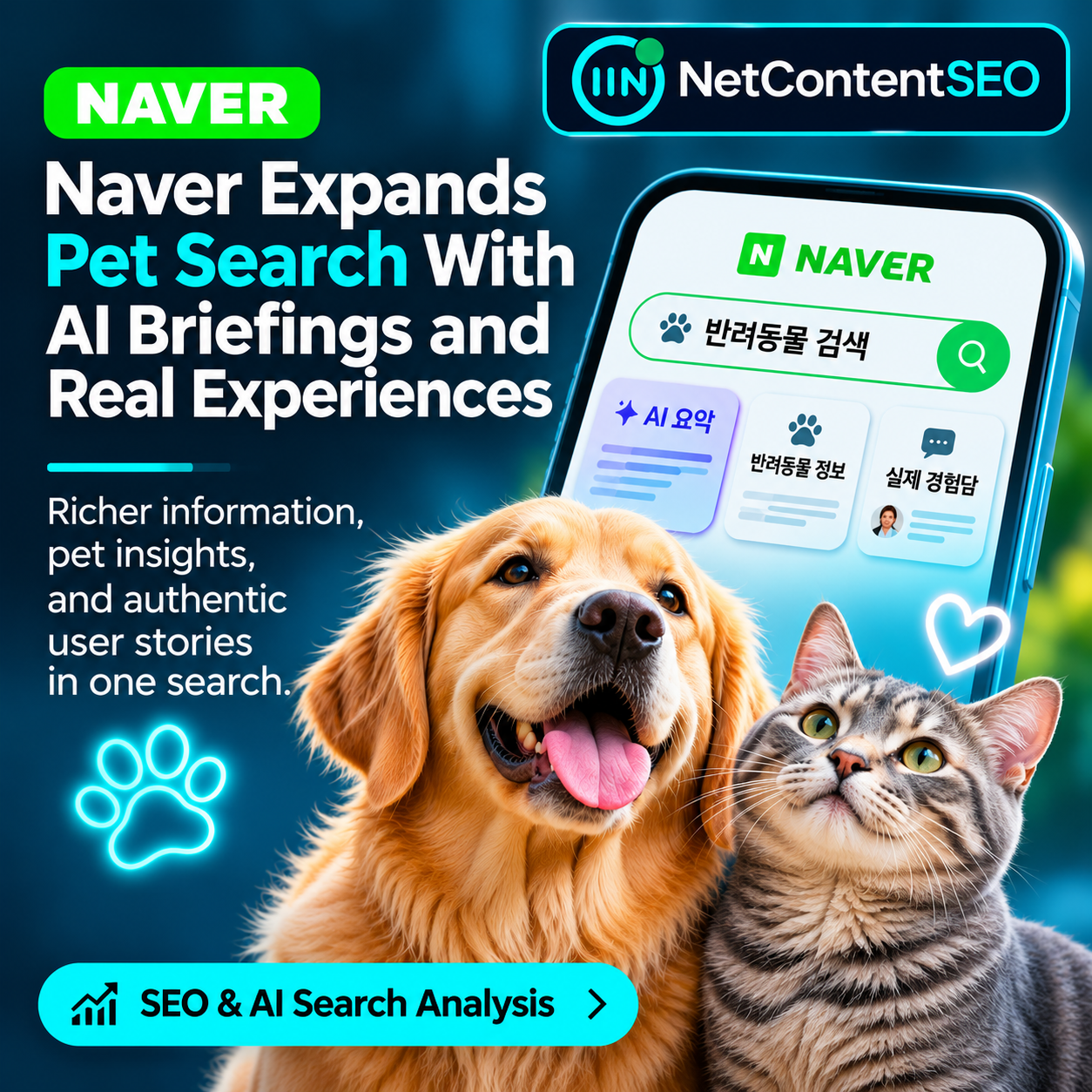

On November 3, 2026, South Korean search platform Naver announced an expanded pet-search experience, combining AI-generated briefings, creator videos, community accounts and more granular animal discovery filters. The change is particularly interesting for publishers: pet-related discovery is no longer presented as a list of interchangeable pages, but as a task-oriented experience that brings together structured attributes and lived experience.
The announcement, titled 반려동물 검색, 더욱 풍부한 정보와 생생한 경험담을 확인해 보세요 (“Explore richer information and first-hand experiences in pet search”), appears on Naver Search’s official blog and was listed on the Naver Search Advisor homepage on November 3. The detailed blog page was not directly retrievable during our review; the feature breakdown below is corroborated by a same-day Korean industry report that links to the original announcement. That distinction matters when assessing precisely what was launched.
What changed in Naver’s pet search?
Naver’s updated search experience broadens animal discovery beyond dogs and cats to include smaller pets and reptiles, including hamsters, rabbits, geckos and turtles. Users can explore options according to their circumstances and preferences rather than depending solely on species or breed names.
Reported filters cover characteristics such as size, shedding, activity level and difficulty of care. AI Briefing presents concise information while short-form clips and real-life accounts from Naver Café communities help users understand how pet ownership works in practice. These formats serve different purposes: attributes help comparison, visual media illustrates behavior, and first-hand narratives reveal practical trade-offs that a static description may miss.
The announcement does not establish that user experience is a new standalone ranking signal, nor does it disclose a change to Naver’s underlying ranking weights. It describes a search-interface and content-discovery enhancement.
Why the change matters for SEO
The most actionable observation is the importance of describing entities in ways that support filtering and decision-making. A page about a rabbit or gecko becomes more useful when its species, care requirements, activity, size, living conditions and suitability are explicit, understandable and accurate. Content should answer the practical question behind the search, not merely repeat the animal’s name.
A second lesson concerns original experience. Naver’s publisher content guidance already encourages material based on expertise and first-hand knowledge, and warns that keyword repetition or word count alone does not guarantee visibility. In this search experience, detailed owner accounts and creator content sit alongside explanatory information. That is a reason to invest in verified observations, context, dates, photographs and clearly attributed authorship—not to manufacture testimonials.
Third, publishers should think in multiple formats. Well-written pages remain important, but relevant photographs, accessible video descriptions, first-hand community discussion and scannable facts may support discovery across more of Naver’s surfaces. A format appearing in a search interface is not proof that every website can enter that format, so channel eligibility and publisher access should be checked separately.
What it says about AI Search
Naver describes its AI Briefing as summarizing intent-relevant information while linking creators and original sources. The pet-search redesign provides a concrete example of AI-assisted summaries coexisting with community accounts and short-form media, rather than completely replacing the underlying material.
For AI visibility, the sensible objective is to make each content unit easy to understand and verify: define the subject clearly, state important attributes in plain text, document actual experience, distinguish fact from personal opinion, and link to reputable veterinary or animal-welfare sources where health or safety claims are involved. Structured data can help clarify eligible content when implemented accurately, but Naver has not stated that a new pet-specific schema is required for this update.
In practical terms, a pet-care publisher could audit whether a page addresses living-space needs, care complexity, expected activity, common misconceptions and source quality. It could then add genuinely helpful media and observational evidence. Any effect on visibility should be measured instead of assumed.
Related direction: veterinary discovery
The development also fits a broader Naver product direction. In a separate June 15, 2026 announcement, the company described veterinary-clinic Place Plus features based on partner-system information, including service-specific filters and recent treatment statistics. This is a different product update, but it illustrates the same emphasis on useful attributes and practical selection criteria.
What publishers should do next
Start by separating evergreen reference information from real-world experience. Make important characteristics explicit, answer questions that reflect users’ actual constraints, and verify consequential animal-care advice against qualified sources. Add media where it genuinely explains something, and maintain accurate bylines and provenance. Finally, inspect the actual Naver results for target Korean queries and monitor changes in impressions, visits and referral quality before drawing causal conclusions.
Bottom line: Naver’s latest pet-search update is a useful case study in search as decision support. AI summaries, structured choices and first-hand community experiences are being combined in one journey. For SEO and AI Search, the opportunity is not a shortcut to ranking: it is richer, more attributable and more decision-ready information.
Sources
- Naver Search official announcement, November 3, 2026
- Naver Search Advisor — official announcement listing
- i-Boss — same-day Korean report on Naver's pet-search update
- Naver Corporation — AI Briefing and AI Tab overview
- Naver Search Advisor — publisher content recommendations
- Naver Corporation — veterinary Place Plus announcement, June 15, 2026