

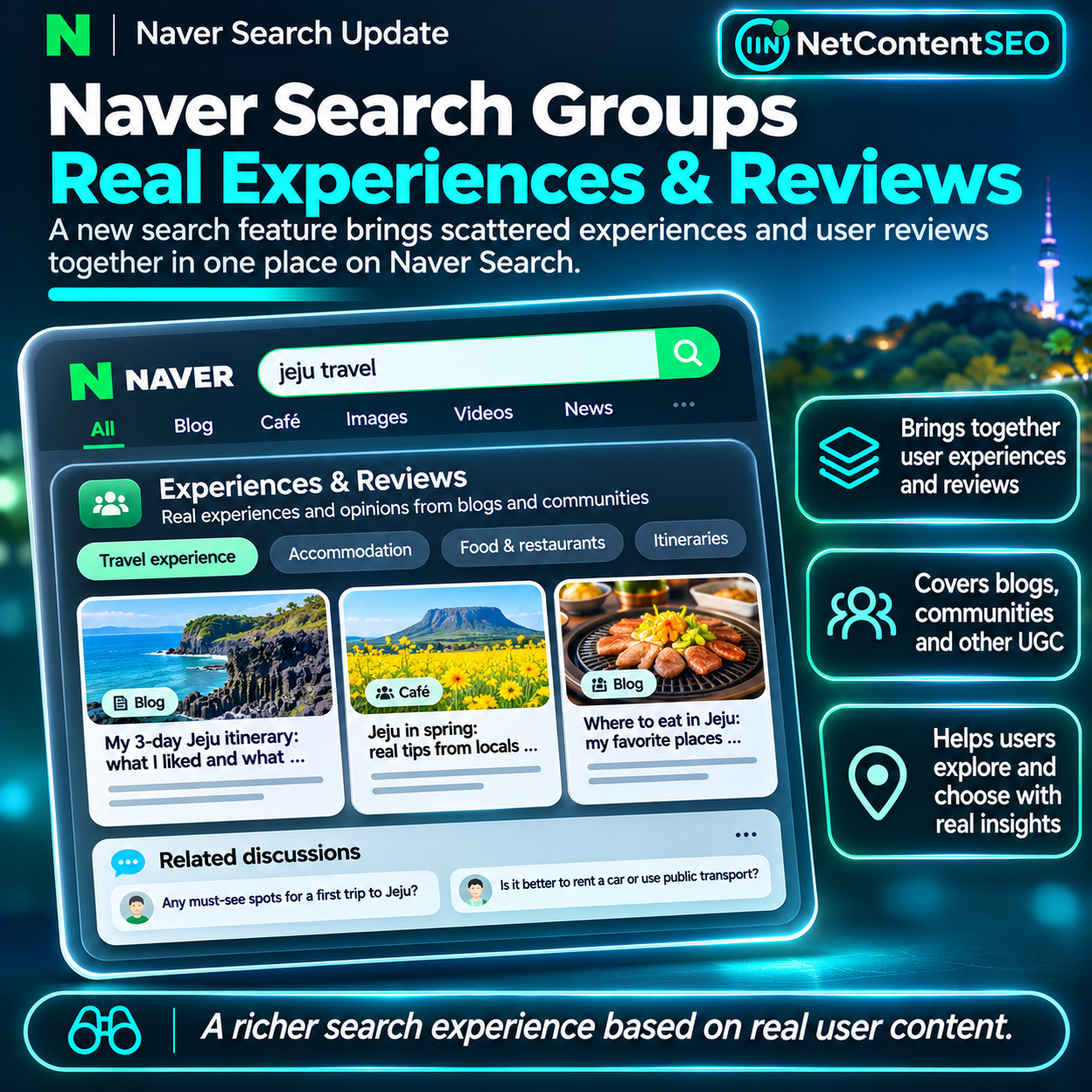

November 5, 2026. Naver Search is introducing a new way to explore firsthand experiences and reviews that were previously scattered across Naver Blog and Naver Café. The feature, described in Korean as an experience UGC block, groups user-generated accounts around the subjects people are researching and brings excerpts, topic labels, tags and community comments closer to the search results.
The development is relevant beyond South Korea. It illustrates a search interface built around the decision a user is trying to make, rather than a simple ranked list of individual pages. For SEO teams, the practical question is how original experiences become understandable, discoverable and useful within a topic-based search presentation. It is not evidence of a new disclosed ranking factor or proof that generative AI is writing the summaries.
What Naver announced on November 5
The announcement is titled 흩어져 있던 경험·후기, 이제 네이버 검색에서 한눈에 확인하세요, meaning approximately “Scattered experiences and reviews can now be viewed at a glance in Naver Search.” The official Naver Search blog URL is identifiable, but its full article was not directly retrievable in our review. A same-day Korean industry report from i-Boss, linking to that announcement, confirms the principal product details.
According to that report, the experience UGC block aggregates experiences and reviews from blogs and cafés by topics of interest. For frequently explored subjects related to a search, it may show a subheading, a passage excerpt, tags and comments from Naver Café discussions. The intended benefit is that users can understand the nature of other people's experiences before opening each source document.
The report says the feature is available from November 5 and that both the subtopics and the featured posts may change with new content and shifting user interests. The precise coverage across queries, devices and accounts was not independently measured at publication time.
How the experience UGC block works
Consider a search about visiting Jeju Island, choosing a neighborhood or comparing a service. The useful information may be distributed across a personal travel diary, a detailed review, a Café discussion and several follow-up comments. A topic-oriented block can surface the relevant fragments together, allowing the user to identify practical themes before deciding what to read in full.
That Jeju example is illustrative, not a verified screenshot of the new feature. The confirmed components are topic grouping, subheadings, excerpts, tags and community comments. The original report does not provide a public ranking formula, fixed eligibility list or evidence that every query will receive the block.
The interface potentially changes the meaning of visibility. A publisher might gain exposure through a relevant excerpt even when the user does not first see a traditional blue link. Conversely, a result that conveys the essential point in the SERP could reduce some clicks. Both are plausible effects, but neither has been quantified for this rollout.
Why this is an evolution of Naver Smart Blocks
Naver has been organizing user-generated content by intent for several years. In February 2024, the company announced that its traditional VIEW results would be replaced by popular-post Smart Blocks, grouping Blog and Café material into more specific topics instead of merely displaying a chronological or relevance-ranked list.
That earlier launch emphasized firsthand experiences, opinions and reviews from creators. It also separated Blog and Café navigation so users could continue exploring particular source types. The November 2026 experience UGC block appears consistent with that product direction: make user-generated material easier to scan by topic, with more contextual information visible in the search interface itself.
There is an even longer precedent. In November 2022, Naver described Smart Blocks that reorganized questions and answers from Knowledge iN, blogs and cafés into FAQ and Q&A presentations. The underlying idea is not that all content must become AI-generated; it is that search can repackage distributed contributions into more task-relevant interfaces.
Is the new block powered by generative AI?
The November announcement, as confirmed by the available report, describes aggregation and presentation of UGC. It does not establish that the excerpts are newly generated by a large language model, that the feature belongs to Naver's AI Briefing product, or that a new generative ranking system has launched.
Naver uses AI and other relevance technologies across search. Its 2024 integrated report describes generative-AI-based re-ranking technology that interprets user intent and sorts multiple content types. But the existence of such technology elsewhere in the platform does not prove its precise role in this particular block.
For AI Search analysis, this distinction is essential: AI-assisted retrieval, semantic clustering, extracted snippets and generated answers are different technical behaviors. They may share a user-facing objective without sharing the same implementation.
What changes for SEO and content discovery?
The clearest opportunity is to make real-world experience legible at the level of specific questions. A generic review that says a restaurant was “great” offers less practical detail than a review describing wait times, reservation conditions, menu choices, accessibility and the date of the visit. A travel post that documents transport, costs and what changed during the trip can answer multiple distinct intents.
This is an editorial recommendation based on the announced presentation, not a claim that Naver has confirmed those details as ranking factors. More descriptive content may be easier for users and retrieval systems to interpret, but no particular heading, tag, word count or review format guarantees inclusion.
Because Naver's blocks draw on Blog and Café content, publishers should also distinguish visibility within Naver's own UGC ecosystem from visibility of an external website. Naver's official blog-search guidance explains that Naver and collected external blogs can appear in blog search, but inclusion is not guaranteed. Its systems use relevance and quality technologies including C-Rank and D.I.A., alongside spam and duplicate-content filtering.
Original experience matters more than manufactured reviews
Firsthand evidence can be useful because it supplies information that generic descriptions often miss: constraints, trade-offs, exceptions and what happened in practice. For a business or publisher, that argues for authentic case studies, verified customer feedback, clearly attributed experiences and content maintained when conditions change.
It does not justify fabricated testimonials, mass-produced community posts or keyword-stuffed reviews. Naver's SmartPlace help documentation says blog-review visibility uses automated relevance systems that filter spam and abnormal patterns. That documentation concerns the Place review environment, not the exact ranking formula of the new experience block, but it reinforces the need to avoid manipulative UGC tactics.
Where reviews include sensitive claims about health, safety or financial outcomes, accurate context and source verification matter more than the pursuit of visibility. Experience is evidence of what one person observed; it is not automatically generalizable advice.
How to audit content for experience-led search
Start with search intent. Identify queries where users are comparing options, looking for practical experiences or evaluating risk. Search those terms in Naver and record whether an experience block appears. Note its topics, content types and source mix rather than assuming all queries behave alike.
Review existing firsthand content. Check whether each useful experience explains who did what, when, under which conditions and with what outcome. Add relevant details when they are true and helpful, not merely to satisfy a speculative algorithm.
Make topics explicit. Descriptive headings, accurate tags and natural terminology can help readers navigate material. They can also make it easier to understand which question a section answers. No new mandatory schema markup or tag syntax has been announced for this feature.
Protect authenticity. Attribute authors, distinguish sponsored or incentivized experiences, and do not generate fictional comments. When a review becomes outdated, update it transparently or explain the original visit date.
Measure exposure and traffic separately. Capture representative search-result screenshots over time, track relevant Naver referrals and assess engagement or conversions on the destination pages. A changed SERP layout can alter click distribution even when content quality remains constant. Without controlled measurements, do not attribute every traffic fluctuation to the new block.
What should brands and community managers do?
For brands with active Naver Blog or Café communities, the immediate task is not to manufacture more reviews. It is to understand which genuine questions customers ask and whether existing contributions answer them clearly. Product setup, delivery, suitability, maintenance and customer-service experiences can all contain information that is difficult to convey in a short promotional description.
Community managers should make it easy for users to share useful, honest experiences without directing them toward a predetermined positive conclusion. Publishers should maintain their own independent, well-organized source material while recognizing that Naver's interface may select excerpts or comments from within its ecosystem.
For businesses outside South Korea, the feature is a case study rather than a direct instruction to change Google SEO tactics. Google, Bing and Naver have different content sources, interfaces and ranking systems. The transferable lesson is to support specific user decisions with attributable, experience-rich information—not to assume identical algorithms.
Does this reduce clicks to original posts?
Possibly, but it has not been demonstrated. When a search result shows an informative excerpt, some users may find enough context without opening the full post. Others may be more likely to click because the excerpt shows that a source directly addresses their question.
The outcome depends on query intent, excerpt length, source presentation, device and the user's next action. Publishers should compare traffic and engagement for relevant queries before and after the rollout while accounting for seasonality, ranking changes and new content. The announcement provides no CTR study or traffic-loss estimate.
How does this relate to AI visibility and GEO?
The new block reinforces a broad design trend: search interfaces increasingly organize information around topics and decisions, rather than only around individual documents. In that environment, being understood as a relevant source for a specific question may matter alongside conventional page ranking.
However, GEO should not be used as a blanket label for every enhanced search block. This feature is confirmed as a UGC aggregation interface, not a disclosed LLM citation system. The useful comparison with AI Search is at the level of user experience and information architecture: both can reduce the work required to discover relevant evidence.
For SEO teams, the practical response is to invest in trustworthy content that answers real questions, then measure the actual surfaces where it appears. Visibility, snippet exposure, referral clicks and downstream business outcomes are distinct metrics.
Frequently asked questions
What is Naver's experience UGC block?
It is a new search presentation that groups experiences and reviews from Naver Blog and Café around topics, with excerpts, tags and community comments designed to make information easier to scan.
When did the feature launch?
The Korean report linking to Naver's official announcement says the service begins November 5, 2026. Availability for individual queries or devices may vary.
Does Naver use AI to write these summaries?
The accessible launch coverage does not confirm generative summaries. It describes grouped UGC and excerpts; the precise technical implementation is not publicly established in the verified materials.
Is there a new ranking factor or required structured data?
No new ranking weight or required schema was disclosed in the verified announcement coverage. Existing relevance and quality guidance remains useful, but it should not be presented as a guaranteed inclusion formula.
Can external websites appear?
The launch coverage specifically identifies Blog and Café sources. Naver's broader blog search can collect some external blogs, but that does not confirm eligibility for this new experience block. Treat external-site inclusion as unverified until Naver clarifies it.
Has Barry Schwartz covered the update?
A targeted search of Search Engine Roundtable and Search Engine Land did not find a specific article about this November 5 Naver feature at the time of review. This is a search result, not proof that coverage will never appear.
The takeaway
Naver's experience UGC block brings scattered firsthand accounts into a more organized search experience. The confirmed change is in how reviews and community material are presented; a new ranking factor, generative synthesis engine or measurable CTR effect has not been established.
For SEO and AI Search practitioners, the actionable lesson is to make real experiences useful, specific and attributable, then observe whether and how search interfaces surface them. The future of discovery is not only about which page ranks first, but also about which piece of evidence helps someone make a better decision.
Sources
- Naver Search official blog, “흩어져 있던 경험·후기, 이제 네이버 검색에서 한눈에 확인하세요,” November 5, 2026 — primary announcement URL; full page not directly retrievable.
- i-Boss, “네이버 검색, 관심사별 경험 후기 묶어 제공,” November 5, 2026 — same-day Korean report linking to the primary announcement.
- Naver Corporation, February 1, 2024 Smart Block and VIEW replacement announcement — historical product context.
- Naver Corporation, November 11, 2022 UGC FAQ and Q&A Smart Blocks — historical context.
- Naver Search Help, blog search overview — content inclusion and quality context.
- Naver SmartPlace Help, blog review visibility criteria — separate review system and spam-filtering context.